
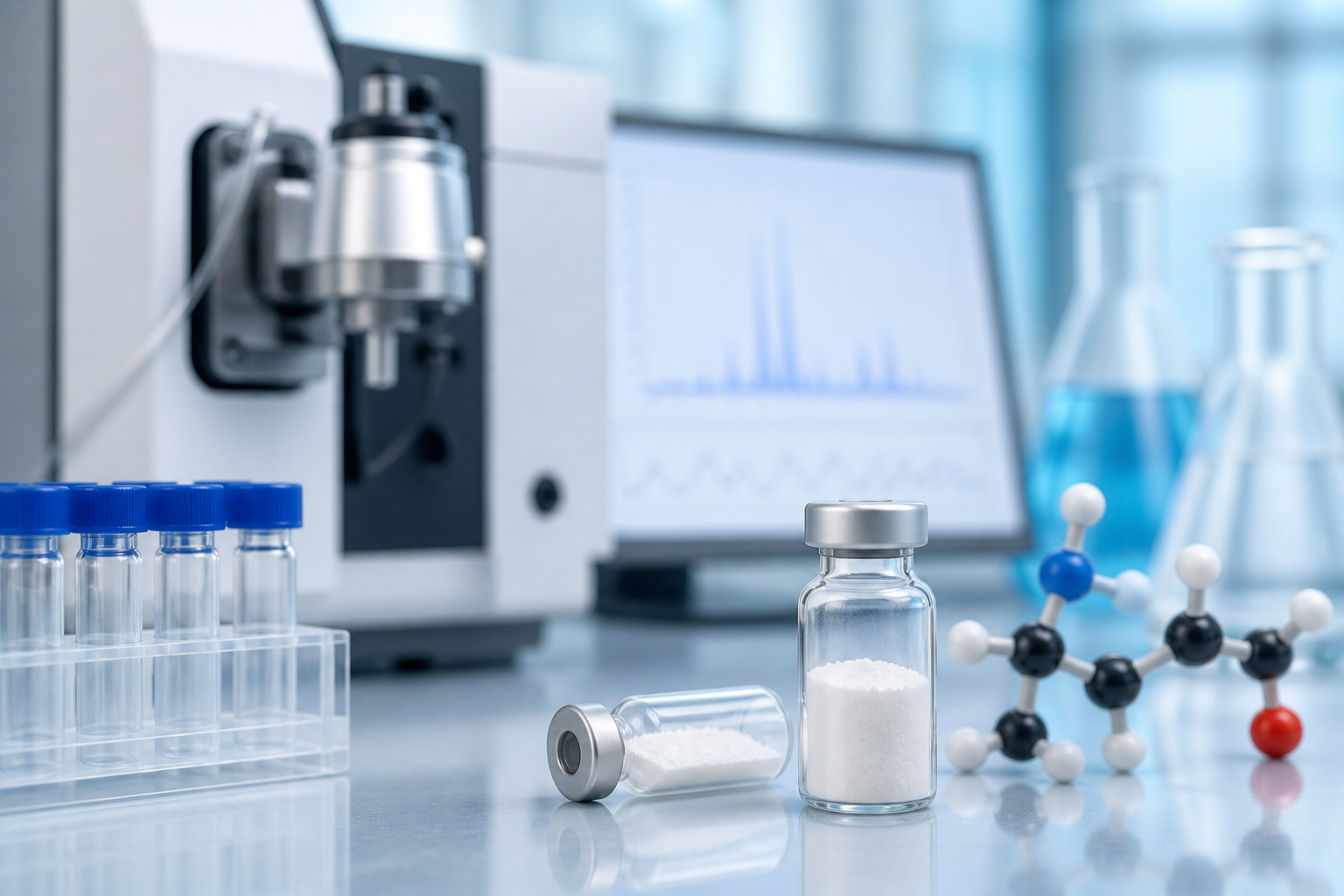
Peptides are widely used in biomedical research, analytical method development, diagnostics, and pharmaceutical discovery. Because many peptides are custom synthesized and may be structurally complex, independent analytical verification can be an important part of a quality assurance strategy. Third-party peptide testing refers to testing performed by an independent laboratory that is separate from the peptide manufacturer, distributor, or end user. The goal is to provide objective data about peptide identity, purity, mass, impurities, and other quality attributes relevant to the intended research use.
For laboratory researchers, procurement teams, and institutional quality groups, third-party testing can support risk-based purchasing decisions and help confirm that a peptide lot is suitable for its intended application. It is not a substitute for a validated manufacturing quality system or for regulatory release testing where such testing is required. However, it can provide an additional layer of evidence, particularly for high-value peptides, critical experiments, or materials sourced from unfamiliar suppliers.
What Is Third-Party Peptide Testing?
Third-party peptide testing is the independent analysis of a peptide sample by a qualified external laboratory. The testing laboratory typically receives a representative sample, performs agreed analytical methods, and issues a report or certificate of analysis with results and method details. Depending on the scope, testing may verify the peptide sequence, measure chromatographic purity, detect common impurities, assess residual solvents or counterions, or evaluate physical and chemical stability indicators.
How It Differs from Supplier Testing
Most reputable peptide suppliers provide a certificate of analysis generated from in-house or contracted testing. Supplier testing is useful and often sufficient for routine research materials. Third-party testing differs because the analytical laboratory is independent of the supplier and purchaser transaction. This separation can reduce potential conflicts of interest and may be valuable when results will influence institutional acceptance, cross-laboratory comparability, or high-impact experimental decisions.
When Independent Testing Is Most Useful
Independent testing is commonly considered when peptides are used as reference standards, assay calibrators, immunogens, cell culture reagents, or critical components in mechanistic studies. It may also be appropriate when a peptide has unusual modifications, a long sequence, a high hydrophobic content, or known stability challenges. In procurement settings, third-party testing may be used to qualify new suppliers, compare lots, investigate unexpected experimental outcomes, or verify claims for expensive or custom materials.
Key Quality Attributes Evaluated in Peptide Testing
The appropriate test panel depends on the peptide, its intended use, and the level of risk associated with the experiment. A short, unmodified research peptide may require a different scope than a modified, fluorescently labeled, cyclic, or disulfide-containing peptide. The following attributes are among the most frequently evaluated.
Identity and Molecular Mass
Identity testing confirms that the material is consistent with the expected peptide. Mass spectrometry is commonly used to verify molecular weight and detect major mass-related discrepancies. For many peptides, liquid chromatography coupled to mass spectrometry provides both separation and mass confirmation. For sequence-sensitive applications, tandem mass spectrometry may be used to provide fragment-level evidence, although full sequence confirmation can be challenging for some peptides, especially those with isobaric residues or complex modifications.
Purity
Peptide purity is often reported as chromatographic purity, usually by reversed-phase high-performance liquid chromatography or ultra-high-performance liquid chromatography. The result is typically expressed as the percentage of the main peak area relative to total detected peak area under defined conditions. It is important to understand that chromatographic purity is method-dependent. Different columns, gradients, wavelengths, ion-pairing reagents, and detection conditions can produce different purity profiles. A reported value should therefore be interpreted alongside the method parameters.
Impurity Profile
Peptide impurities may include deletion sequences, truncated sequences, incomplete deprotection products, oxidized species, hydrolysis products, aggregation-related forms, residual protecting groups, and side products from synthesis or cleavage. Some impurities are closely related to the target peptide and may co-elute under certain chromatographic conditions. Third-party laboratories may use orthogonal methods, such as different chromatographic gradients or mass-based detection, to improve impurity characterization when needed.
Water Content, Salts, and Counterions
Peptides are often hygroscopic and may contain variable amounts of water, residual salts, and counterions such as trifluoroacetate, acetate, or chloride. These components can affect accurate weighing, molar concentration calculations, biological assay interpretation, and formulation behavior. Water content may be measured by Karl Fischer titration, while counterions and inorganic ions may be assessed by ion chromatography or other suitable techniques. For quantitative studies, net peptide content may be more relevant than gross vial mass.
Residual Solvents and Reagents
Depending on synthesis, purification, and lyophilization conditions, residual solvents may be present at low levels. Testing may include gas chromatography methods for common solvents or targeted analysis for specific reagents of concern. Residual solvent testing is most relevant when peptides are intended for sensitive biological assays, formulation studies, or preclinical workflows where solvent carryover could interfere with results.
Common Analytical Methods Used by Third-Party Laboratories
No single analytical technique provides a complete picture of peptide quality. Reliable assessment often relies on complementary methods selected according to the peptide structure and testing objective.
HPLC and UHPLC
Reversed-phase HPLC and UHPLC are standard tools for peptide purity assessment. Detection is commonly performed by ultraviolet absorbance at wavelengths such as 214 nm, 220 nm, or 280 nm, depending on peptide composition and chromophores. Method suitability should be evaluated, particularly for peptides with weak UV absorbance or closely related impurities. For labeled peptides, additional wavelength monitoring may be needed.
Mass Spectrometry
Mass spectrometry provides molecular mass confirmation and can help identify impurities. Techniques such as electrospray ionization and matrix-assisted laser desorption ionization are widely used for peptide analysis. LC-MS is particularly useful because it separates components before mass detection. High-resolution mass spectrometry can increase confidence in elemental composition or modification status, but data interpretation still requires expertise and appropriate controls.
Amino Acid Analysis
Amino acid analysis can support peptide content determination and composition verification. It is useful when accurate quantitation is required, especially for peptides lacking strong UV absorbance. However, certain residues may degrade or require specialized handling during hydrolysis, and some modifications may not be fully recovered. Results should be interpreted in the context of the method limitations.
Additional Specialized Tests
Additional tests may include peptide mapping, capillary electrophoresis, circular dichroism for secondary structure, endotoxin testing, bioburden testing, elemental impurities, or aggregation analysis by size-exclusion chromatography and light scattering. These methods are not necessary for every peptide but may be relevant for specific research or translational contexts.
Understanding Certificates and Test Reports
A third-party report should provide enough information for a scientifically informed review. At minimum, it should identify the sample, test methods, instrument conditions or method references, acceptance criteria if defined, numerical results, and the date of analysis. Reports should also indicate whether methods are validated, qualified, or performed as non-validated research-use analytical methods.
Reviewing Purity Claims
When reviewing purity data, examine the chromatogram, integration approach, detection wavelength, and whether mass confirmation was obtained for the main peak. A purity percentage without chromatographic conditions is of limited value. Researchers should also consider whether the stated purity threshold aligns with the study objective. For some screening studies, moderate purity may be acceptable. For quantitative binding studies, structural biology, or reference standard work, higher characterization may be needed.
Interpreting Mass Spectrometry Data
Mass spectra should show a peak or charge-state envelope consistent with the expected molecular mass. For modified peptides, the expected mass should account for terminal modifications, labels, disulfide bonds, isotope labels, salts, and counterions when applicable. A matching mass supports identity but does not always prove sequence order or stereochemistry. Where exact sequence confirmation is critical, additional fragmentation or orthogonal testing may be required.
Documentation and Chain of Custody
For institutional or regulated environments, documentation practices are important. Chain-of-custody records, sample receipt conditions, storage conditions, analyst review, and quality unit approval may be required. Even in non-regulated research environments, clear sample labeling and traceability reduce the risk of mix-ups and improve confidence in conclusions.
Sampling and Handling Considerations
Testing results are only as representative as the sample submitted. Peptides can be sensitive to moisture, temperature, oxidation, light, and repeated freeze-thaw cycles. Improper sampling or shipping can change the material before analysis and may lead to misleading conclusions.
Representative Sampling
A representative sample should be taken from the lot under appropriate environmental conditions. If the peptide is supplied in multiple vials, the sampling plan should reflect how the material will be used. For high-risk applications, testing more than one vial or retaining a reference sample may be appropriate. Sample quantity should be confirmed with the testing laboratory before shipment, as some methods require more material than others.
Storage and Shipping
Peptides are commonly stored lyophilized at low temperature and protected from moisture. Some peptides require inert atmosphere, light protection, or shipment on dry ice. The testing laboratory should receive storage instructions and known stability information. If a peptide is prone to oxidation, deamidation, or aggregation, pre-analytical handling should be carefully controlled and documented.
Selecting a Third-Party Peptide Testing Laboratory
Choosing a testing laboratory should be based on scientific capability, quality systems, method transparency, and experience with peptide analysis. Cost and turnaround time are practical considerations, but they should not be the only selection criteria for critical materials.
Technical Expertise
Peptide analysis requires familiarity with ionization behavior, chromatographic method development, modifications, degradation pathways, and data interpretation. Laboratories should be able to explain method selection and limitations. Experience with the specific class of peptide, such as cyclic peptides, stapled peptides, glycopeptides, or fluorescent conjugates, can be important.
Quality Systems and Accreditation
Depending on the intended use, laboratories may operate under ISO/IEC 17025, Good Laboratory Practice, Good Manufacturing Practice support systems, or internal quality procedures. Accreditation does not automatically mean a specific peptide method is within scope, so purchasers should verify the exact capabilities. For research-use testing, a well-documented qualified method may be sufficient, provided expectations are clear.
Communication and Fit-for-Purpose Testing
A qualified laboratory should be willing to discuss the study objective, sample properties, required detection limits, reporting format, and acceptance criteria. Fit-for-purpose testing helps avoid unnecessary assays while ensuring that critical quality questions are addressed. Written test plans are particularly useful when results will be used for supplier qualification or institutional review.
Limitations of Third-Party Testing
Third-party testing provides analytical evidence for the sample tested, but it has limitations. Results may not fully represent every vial in a lot unless an appropriate sampling plan is used. Some impurities may not be detected if they lack UV absorbance, do not ionize well, or co-elute with the main peak. A passing test does not guarantee performance in every biological system, and an out-of-specification result should be investigated before conclusions are drawn about the entire lot or supplier.
It is also important to distinguish analytical quality from biological activity. A peptide can meet identity and purity specifications yet perform poorly in an assay because of solubility, aggregation, incorrect storage, incompatible buffer conditions, or loss of conformation. Conversely, a peptide with modest chromatographic purity may still be adequate for certain exploratory experiments. The appropriate standard depends on the scientific question.
Best Practices for Researchers and Purchasing Teams
Institutions can improve consistency by establishing a risk-based approach to peptide testing. Routine catalog peptides for preliminary experiments may require review of the supplier certificate only. Critical or high-cost peptides may require independent testing before use. Peptides used across multiple laboratories may benefit from centralized qualification and shared documentation.
Define Acceptance Criteria Early
Acceptance criteria should be defined before testing whenever possible. Criteria may include minimum chromatographic purity, correct molecular mass, acceptable counterion level, maximum water content, or absence of specific impurities. Predefined criteria reduce ambiguity and make procurement decisions more transparent.
Use Orthogonal Evidence
For important materials, combine supplier documentation, third-party results, and in-house functional checks. Orthogonal evidence is especially helpful when peptide structure is complex or when experimental outcomes are sensitive to trace impurities. Maintaining lot-specific records can also support reproducibility and troubleshooting.
Plan for Retesting and Stability
Peptide quality can change during storage. Stability-indicating retesting may be appropriate after long-term storage, repeated handling, or unexpected assay changes. Retesting should use comparable methods when possible so that results can be evaluated over time.
Conclusion
Third-party peptide testing is a practical tool for independent verification of peptide identity, purity, and related quality attributes. Its value depends on appropriate method selection, representative sampling, careful handling, and scientifically informed interpretation of results. For researchers and institutions, a risk-based testing strategy can strengthen confidence in peptide materials and support more reproducible experimental work.