
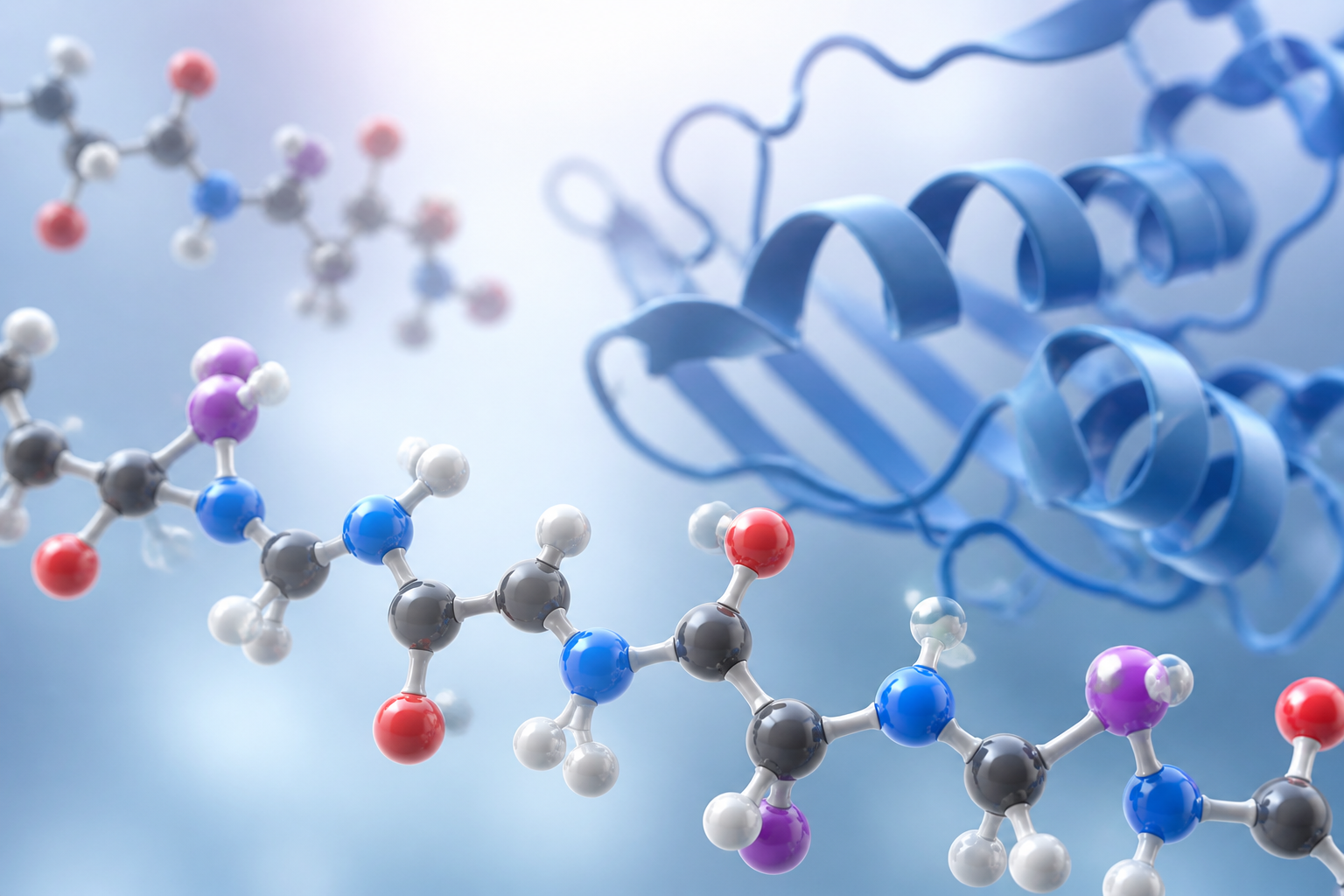
Amino acid sequences are the linear instructions that determine how peptides and proteins behave in biological and experimental systems. Even short peptides can display specific binding, catalytic, structural, or signaling functions because the order of amino acids influences charge distribution, hydrophobicity, hydrogen bonding, and conformational flexibility. For laboratory researchers and scientific purchasers, understanding the relationship between sequence and structure is important for peptide design, synthesis planning, analytical verification, and interpretation of functional data.
What Is an Amino Acid Sequence?
An amino acid sequence is the ordered arrangement of amino acid residues in a peptide or protein chain. Sequences are conventionally written from the amino terminus, or N-terminus, to the carboxyl terminus, or C-terminus. This directionality is important because reversing a sequence changes the chemical context of every residue and can substantially alter biological activity.
Each amino acid is represented by a three-letter or one-letter code. For example, glycine may be written as Gly or G, alanine as Ala or A, and lysine as Lys or K. The one-letter format is compact and widely used for database entries, synthesis orders, bioinformatics analysis, and sequence alignments. The three-letter format is often preferred where clarity is needed, particularly in documentation that includes modified residues or non-standard amino acids.
Standard and Non-Standard Residues
The 20 standard amino acids differ in side-chain size, polarity, charge, aromaticity, and hydrogen-bonding potential. These chemical properties are central to peptide structure. Non-standard residues, such as D-amino acids, beta-amino acids, ornithine, norleucine, hydroxyproline, or chemically protected derivatives, may be incorporated to adjust stability, solubility, conformation, or resistance to enzymatic degradation. In research peptides, such substitutions should be documented precisely because small changes can influence analytical behavior and experimental outcomes.
The Peptide Bond and Chain Directionality
Amino acids are connected by peptide bonds formed between the carboxyl group of one residue and the amino group of the next. The peptide bond has partial double-bond character, which restricts rotation and favors a planar geometry. This rigidity contributes to the formation of regular secondary structures and limits the conformational space available to the peptide backbone.
Although the peptide bond is chemically stable under many physiological conditions, peptide chains can be hydrolyzed by strong acids, bases, or proteolytic enzymes. Sequence composition affects susceptibility to enzymatic cleavage. For example, trypsin preferentially cleaves after lysine and arginine residues unless structural context or adjacent residues interfere. This principle is widely used in proteomics workflows and peptide mapping.
Levels of Peptide and Protein Structure
Peptide structure is commonly described using the same hierarchical framework applied to proteins: primary, secondary, tertiary, and, in some cases, quaternary structure. Not every peptide forms all levels of structure. Many short peptides are conformationally flexible in solution, while others adopt defined structures when cyclized, bound to a receptor, inserted into a membrane, or stabilized by disulfide bonds.
Primary Structure
Primary structure is the amino acid sequence itself, including covalent modifications such as disulfide bonds, terminal acetylation or amidation, phosphorylation, glycosylation, lipidation, and other post-translational or synthetic modifications. Primary structure is the foundation for all higher-order organization. Sequence errors, deletion products, incomplete deprotection, oxidation, or unintended modifications can affect purity, identity, and function.
Secondary Structure
Secondary structure refers to local backbone arrangements stabilized primarily by hydrogen bonds. Common motifs include alpha helices, beta sheets, beta turns, and polyproline helices. Sequence strongly influences secondary structure propensity. Alanine and leucine often support helical conformations, while proline can disrupt alpha helices because its cyclic side chain restricts backbone geometry and lacks an amide hydrogen for typical helix hydrogen bonding. Glycine is highly flexible and can facilitate turns but may also reduce structural rigidity.
Tertiary Structure
Tertiary structure describes the overall three-dimensional arrangement of a single peptide or protein chain. In larger proteins, tertiary structure is driven by hydrophobic packing, electrostatic interactions, hydrogen bonds, van der Waals contacts, metal coordination, and disulfide linkages. In short peptides, tertiary structure may be limited, but constrained peptides, stapled peptides, cyclic peptides, and disulfide-rich peptides can adopt well-defined architectures.
Quaternary Structure
Quaternary structure refers to the association of multiple peptide or protein chains into a functional complex. Some peptides self-assemble into dimers, oligomers, fibrils, hydrogels, or membrane-associated structures. Such behavior can be useful in materials science and biomedical research but may also complicate solubility, quantitation, or assay interpretation.
How Sequence Determines Peptide Properties
The sequence of a peptide governs many experimentally relevant properties. These include net charge, isoelectric point, hydrophobicity, solubility, aggregation tendency, protease sensitivity, and binding specificity. Researchers often evaluate these properties during peptide selection or custom synthesis planning.
Charge and Isoelectric Point
Ionizable residues such as aspartic acid, glutamic acid, lysine, arginine, histidine, cysteine, and tyrosine contribute to the peptide’s net charge. The N-terminus and C-terminus also contribute unless modified. Net charge changes with pH and influences solubility, chromatographic retention, electrophoretic mobility, and interactions with biomolecules. A peptide near its isoelectric point may show reduced solubility because its net charge approaches zero.
Hydrophobicity and Solubility
Hydrophobic residues such as valine, leucine, isoleucine, phenylalanine, methionine, and tryptophan can promote membrane interactions or binding to hydrophobic pockets. However, sequences with high hydrophobic content may be difficult to dissolve in aqueous buffers and may aggregate. Incorporating charged or polar residues, adjusting terminal modifications, or using appropriate solvents can improve handling, but such changes may also affect structure and activity.
Stereochemistry and Chirality
Most naturally occurring peptides contain L-amino acids. D-amino acids can be introduced to increase resistance to proteolysis, alter receptor selectivity, or induce specific conformational effects. Because D- and L-residues have different stereochemistry, substitutions are not chemically equivalent even when side-chain composition is unchanged. Analytical documentation should clearly specify stereochemistry when D-residues or racemic mixtures are involved.
Structural Motifs in Peptides
Certain sequence patterns are associated with recurring structural or functional motifs. Amphipathic helices contain hydrophobic residues on one face and polar or charged residues on the opposite face, enabling membrane interaction or protein binding. Cysteine-rich sequences can form disulfide-stabilized loops, as seen in many peptide hormones, toxins, and antimicrobial peptides. Proline-rich motifs may adopt extended conformations and participate in recognition by modular protein domains.
Short motifs can also serve as tags, epitopes, cleavage sites, localization signals, or receptor-binding elements. In these cases, the precise sequence context matters. Residues flanking a motif can influence accessibility, local structure, and susceptibility to degradation.
Post-Translational and Synthetic Modifications
Peptide structure is often shaped by modifications beyond the standard amino acid sequence. N-terminal acetylation can reduce positive charge and may improve stability in some systems. C-terminal amidation neutralizes the terminal carboxylate and is common in bioactive peptides. Phosphorylation introduces negative charge and can regulate binding interactions. Disulfide bond formation can constrain conformation, while cyclization can reduce flexibility and sometimes improve metabolic stability.
Other modifications, including biotinylation, fluorescent labeling, PEGylation, lipidation, methylation, and glycosylation, may be used for detection, immobilization, solubility adjustment, or biological modeling. The position and chemistry of each modification should be selected with attention to steric effects, charge changes, and potential interference with the active region of the peptide.
Methods for Analyzing Amino Acid Sequences and Structure
Accurate characterization is essential for interpreting peptide experiments. Mass spectrometry is widely used to confirm molecular weight and detect truncations, adducts, oxidation, or other modifications. Tandem mass spectrometry can provide sequence information and support peptide mapping. High-performance liquid chromatography is commonly used to assess purity and separate related impurities based on hydrophobicity, charge, or other physicochemical differences.
Additional methods may be used depending on the peptide and research objective. Amino acid analysis can quantify composition. Edman degradation can provide N-terminal sequence information for suitable samples. Circular dichroism spectroscopy is useful for assessing secondary structure content, particularly helix and sheet formation. Nuclear magnetic resonance spectroscopy can provide residue-level structural information for peptides in solution. X-ray crystallography and cryo-electron microscopy are more commonly applied to larger complexes but may be relevant when peptides are bound to protein partners.
Practical Considerations for Peptide Design and Procurement
When designing or ordering peptides, researchers should consider sequence length, hydrophobicity, charge distribution, cysteine content, terminal modifications, isotopic labels, and intended assay conditions. Peptides with multiple hydrophobic residues, long stretches of identical residues, or several cysteines may require additional planning for synthesis, purification, and storage. Disulfide-containing peptides should specify the desired connectivity when more than one pairing is possible.
Purity requirements should match the application. Crude peptides may be adequate for preliminary screening in some contexts, whereas quantitative binding studies, cell-based assays, structural studies, immunological assays, and reference standards often require higher purity and identity confirmation. Documentation may include analytical HPLC traces, mass spectra, certificate of analysis, counterion information, and storage recommendations.
Storage and Handling Effects on Peptide Structure
Peptides can be sensitive to moisture, oxidation, repeated freeze-thaw cycles, and prolonged exposure to light or elevated temperature. Methionine, tryptophan, and cysteine are particularly susceptible to oxidation. Lyophilized peptides are commonly stored frozen and protected from moisture. Once dissolved, aliquoting can reduce freeze-thaw exposure. Buffer composition, pH, ionic strength, and solvent content should be compatible with both peptide stability and downstream assays.
Solubilization strategies should be selected carefully. Basic peptides may dissolve more readily in mildly acidic solutions, while acidic peptides may dissolve better under mildly basic conditions. Hydrophobic peptides may require small amounts of organic solvent such as DMSO, acetonitrile, or ethanol before dilution into aqueous buffer. Compatibility with cells, enzymes, receptors, or analytical platforms should be verified.
Conclusion
Amino acid sequence is the primary determinant of peptide structure, but its effects extend beyond a simple linear code. Side-chain chemistry, stereochemistry, terminal groups, covalent modifications, solvent conditions, and intermolecular interactions all influence conformation and function. A clear understanding of these relationships supports better peptide design, more appropriate analytical specifications, and more reliable interpretation of experimental results.