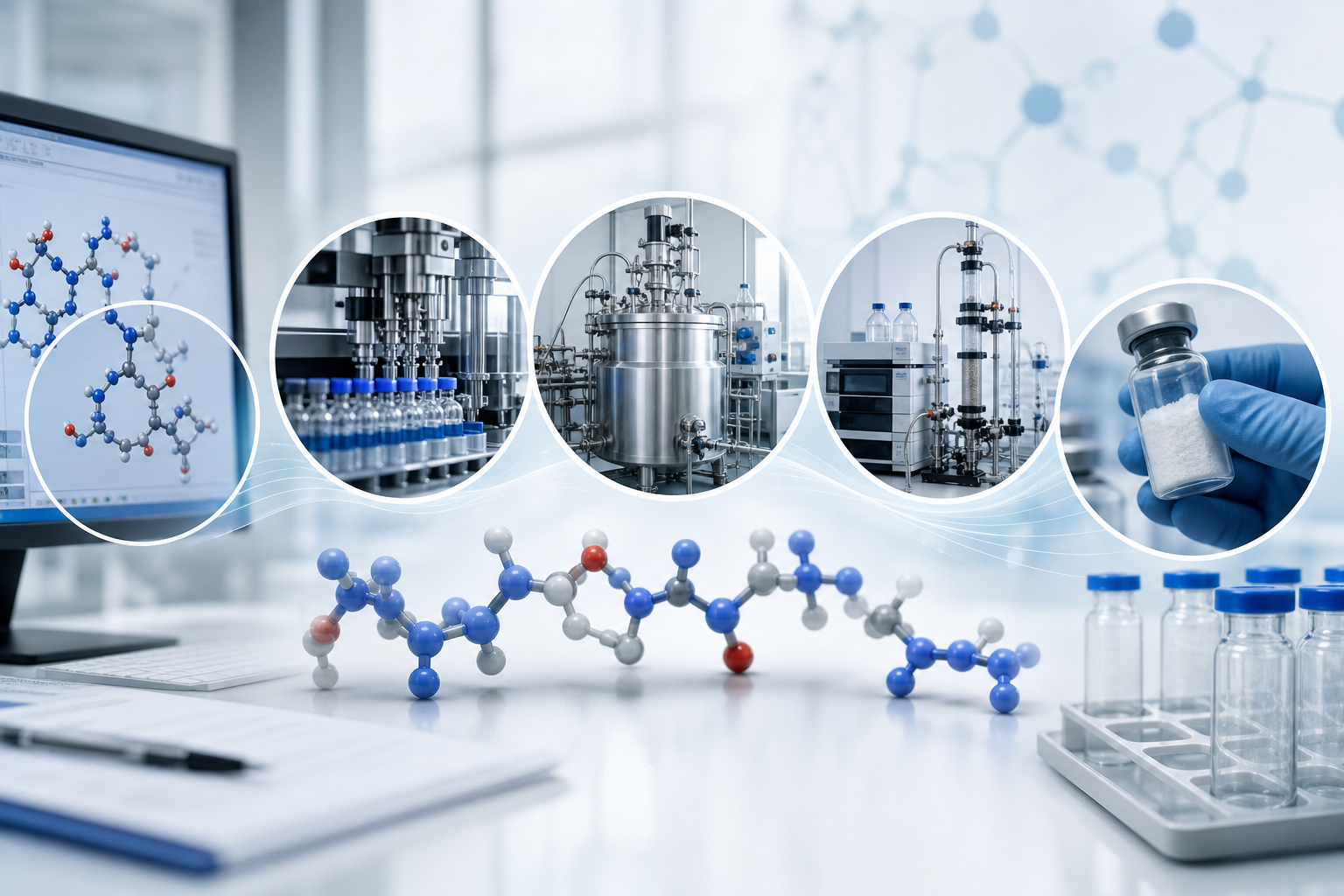
Peptides are used across a broad range of scientific and clinical applications, including biochemical research, diagnostic assay development, drug discovery, vaccine research, and therapeutic manufacturing. Their production requires controlled chemistry, appropriate purification, and rigorous analytical testing to ensure that the final material meets its intended specifications. The peptide manufacturing process can vary depending on peptide length, sequence complexity, purity requirements, regulatory expectations, and production scale, but most workflows follow a structured sequence of design, synthesis, cleavage, purification, characterization, and formulation or storage.
This article provides a technical overview of the peptide manufacturing process for researchers, procurement teams, and laboratory decision-makers seeking to understand how peptides are produced and assessed.
Overview of Peptide Manufacturing
Peptide manufacturing is the controlled production of amino acid chains through chemical or biological methods. Most custom and research-grade peptides are manufactured by chemical synthesis, particularly solid-phase peptide synthesis, because it allows precise control over amino acid sequence, modifications, and scale. For some longer peptides or peptide-containing proteins, recombinant expression or hybrid approaches may be more appropriate.
The main goal of peptide manufacturing is to produce a molecule with the correct sequence, defined purity, acceptable impurity profile, and documented analytical identity. The process must account for potential side reactions, incomplete couplings, oxidation, aggregation, and degradation. These risks increase with peptide length, hydrophobicity, unusual residues, post-translational modifications, and complex disulfide patterns.
Peptide Design and Feasibility Assessment
Sequence Review
Manufacturing begins with a detailed sequence review. The amino acid composition, length, charge distribution, hydrophobic regions, and presence of reactive residues are evaluated to identify potential synthesis challenges. Peptides rich in valine, isoleucine, leucine, phenylalanine, or other hydrophobic residues may aggregate on the resin during synthesis or show low solubility during purification. Sequences containing cysteine, methionine, tryptophan, asparagine, glutamine, or multiple basic residues may require additional precautions because these residues can participate in side reactions or be sensitive to oxidation and degradation.
Modification and End-Group Planning
Many peptides include modifications such as N-terminal acetylation, C-terminal amidation, biotinylation, fluorescent labels, phosphorylation, methylation, lipidation, cyclization, or non-natural amino acids. These features must be incorporated into the synthetic strategy from the beginning. Some modifications can be introduced during synthesis, while others are more efficiently added after chain assembly. Protecting groups, linker selection, and cleavage conditions are chosen to preserve sensitive functional groups.
Defining Quality Requirements
Before synthesis begins, the intended use of the peptide should define the quality requirements. A peptide for preliminary screening may require a different purity level and documentation package than a peptide intended for regulated studies. Common specifications include purity by high-performance liquid chromatography, identity by mass spectrometry, appearance, net peptide content, counterion form, residual solvent limits, water content, endotoxin level, and sterility where applicable.
Synthesis Methods Used in Peptide Manufacturing
Solid-Phase Peptide Synthesis
Solid-phase peptide synthesis, often abbreviated as SPPS, is the most widely used method for manufacturing synthetic peptides. In SPPS, the first amino acid is attached to an insoluble resin through a linker. The peptide chain is then assembled stepwise by repeated cycles of deprotection and coupling. Because the growing peptide remains bound to the resin, excess reagents and byproducts can be removed by washing after each step.
SPPS is commonly performed using Fmoc chemistry. In this approach, the N-terminal Fmoc protecting group is removed under basic conditions, and the next protected amino acid is coupled using activating reagents. Side-chain protecting groups remain in place throughout synthesis and are removed during final cleavage. Fmoc chemistry is favored because it is compatible with many peptide sequences and avoids the use of strongly acidic conditions during each deprotection cycle.
Liquid-Phase Peptide Synthesis
Liquid-phase peptide synthesis is less common for routine custom peptides but remains important in selected industrial applications. It can be useful for short peptides, fragment condensation strategies, or large-scale processes where crystallization and intermediate isolation are advantageous. Liquid-phase methods may offer high control over specific intermediates but often require more extensive purification between steps.
Hybrid and Recombinant Approaches
For very long peptides, peptide-protein constructs, or sequences that are difficult to synthesize chemically, recombinant expression may be considered. In this approach, a host organism such as Escherichia coli, yeast, or mammalian cells expresses the peptide or a fusion protein precursor. The product is then isolated and processed, often requiring enzymatic cleavage and purification. Hybrid methods may combine recombinant fragments with chemical ligation to produce complex molecules.
Solid-Phase Peptide Synthesis Workflow
Resin Selection
Resin selection determines the C-terminal functionality and influences swelling, loading capacity, reaction efficiency, and cleavage behavior. Common resin types include Wang resin for C-terminal acids and Rink amide resin for C-terminal amides. Low-loading resins may be preferred for long or aggregation-prone peptides because they reduce steric crowding and can improve coupling efficiency.
Deprotection and Coupling Cycles
Each synthesis cycle generally includes Fmoc deprotection, washing, amino acid activation, coupling, and another washing step. Coupling efficiency is critical because incomplete reactions generate deletion sequences that can be difficult to remove later. Manufacturers may use double coupling, extended reaction times, stronger coupling reagents, or microwave-assisted synthesis for difficult sequences. Monitoring methods such as colorimetric tests or automated instrument readouts can help assess reaction completion during production.
Capping and Process Controls
Capping may be used to block unreacted amino groups and prevent them from forming deletion products in later cycles. While capping can reduce certain impurities, it must be applied appropriately because it may also introduce capped byproducts. Process controls, including reagent quality, solvent quality, resin swelling, mixing efficiency, and reaction temperature, contribute to reproducibility.
Cleavage, Deprotection, and Crude Peptide Recovery
After chain assembly, the peptide must be cleaved from the resin and side-chain protecting groups must be removed. In Fmoc SPPS, this is typically performed using trifluoroacetic acid with scavengers that capture reactive species generated during deprotection. The exact cleavage cocktail is selected based on the sequence and protecting groups. For peptides containing cysteine, methionine, tryptophan, or other sensitive residues, scavenger composition and cleavage time are particularly important.
The cleaved peptide is then separated from the resin by filtration, and the crude peptide is commonly precipitated using cold ether or a similar solvent. The precipitate is collected, washed, and dried before purification. At this stage, the crude product contains the target peptide along with deletion sequences, truncated products, protecting group remnants, oxidized species, and other synthesis-related impurities.
Purification of Peptides
Preparative HPLC
Preparative reverse-phase high-performance liquid chromatography is the most common purification method for synthetic peptides. It separates components primarily based on hydrophobicity using a stationary phase such as C18 and a mobile phase gradient containing water, organic solvent, and an ion-pairing acid. Fractions containing the target peptide are collected and analyzed before pooling.
Purification conditions are optimized according to the peptide’s retention behavior, solubility, impurity profile, and required purity. Some peptides require multiple purification steps or alternative chromatography methods. Highly hydrophobic peptides may need modified solvent systems, elevated temperatures, or additives to reduce aggregation and improve recovery.
Ion Exchange and Other Methods
Ion exchange chromatography can be useful for peptides with strong charge differences relative to impurities. Size-exclusion chromatography, affinity purification, or specialized methods may be applied for certain modified peptides, cyclic peptides, or recombinant products. The purification strategy should balance purity, yield, peptide stability, and scalability.
Counterion Exchange
Peptides purified by reverse-phase HPLC often contain trifluoroacetate as the counterion. For some biological applications, acetate or chloride forms may be preferred. Counterion exchange can be performed by additional chromatography or repeated lyophilization from appropriate solutions. The selected salt form can influence solubility, handling, and assay compatibility.
Analytical Quality Control
Identity Testing
Mass spectrometry is a primary method for confirming peptide identity. Matrix-assisted laser desorption ionization time-of-flight mass spectrometry and electrospray ionization mass spectrometry are commonly used. The observed molecular mass should match the theoretical mass within the method’s acceptable tolerance. For modified or disulfide-containing peptides, additional interpretation may be required.
Purity Assessment
Analytical HPLC is widely used to estimate peptide purity. A chromatogram shows the relative area of the main peak and detectable impurities under specified analytical conditions. Purity values depend on the method, wavelength, gradient, and column used, so chromatographic conditions should be documented. For critical applications, orthogonal methods may be used to better characterize impurity profiles.
Additional Testing
Depending on intended use, additional tests may include amino acid analysis, peptide content, water content by Karl Fischer titration, residual solvent analysis, elemental analysis, endotoxin testing, bioburden testing, sterility testing, and host cell protein or DNA testing for recombinant materials. For GMP peptides, validated or qualified analytical methods and formal release specifications are generally required.
Lyophilization, Formulation, and Storage
After purification, peptide-containing fractions are typically concentrated and lyophilized to produce a dry powder. Lyophilization removes water and volatile solvents under low temperature and reduced pressure, helping improve storage stability. The appearance of the final lyophilized product may vary from a fluffy powder to a compact film, depending on concentration, salt form, buffer components, and freezing conditions.
Formulation requirements depend on the peptide’s application. Research peptides are often supplied as dry material without excipients, while regulated or clinical materials may require defined formulations, buffers, stabilizers, or sterile fill-finish processes. Storage conditions should be selected based on stability data when available. Many peptides are stored desiccated at low temperature and protected from repeated freeze-thaw cycles after reconstitution.
Scale-Up Considerations
Scaling peptide manufacturing from milligram quantities to gram or kilogram quantities is not always linear. Resin loading, mixing efficiency, heat transfer, reagent stoichiometry, solvent volumes, and purification capacity can significantly affect performance. Impurities that are manageable at small scale may become more prominent at larger scale, and purification bottlenecks can reduce overall yield.
Process development for larger-scale production often includes optimization of coupling conditions, resin selection, cleavage conditions, crude peptide handling, purification gradients, fraction pooling criteria, and lyophilization parameters. Solvent consumption, waste management, operator safety, and raw material availability also become more important as scale increases.
GMP Manufacturing and Documentation
When peptides are intended for clinical, diagnostic, or regulated applications, Good Manufacturing Practice requirements may apply. GMP manufacturing emphasizes controlled procedures, qualified equipment, traceable raw materials, trained personnel, validated cleaning processes, deviation management, change control, and comprehensive batch records. The level of GMP control depends on the development phase and regulatory context.
Documentation is a central part of quality assurance. A typical documentation package may include a certificate of analysis, chromatograms, mass spectra, batch production records, material safety information, residual solvent data, and test method summaries. For regulated projects, additional documents such as impurity reports, stability data, method validation reports, and regulatory support files may be required.
Common Challenges in Peptide Manufacturing
Difficult Sequences
Some sequences are intrinsically difficult to synthesize because they aggregate on resin or form secondary structures during chain assembly. Strategies to address these challenges include using pseudoproline dipeptides, backbone protecting groups, low-loading resin, altered solvent systems, or modified coupling protocols.
Oxidation and Disulfide Formation
Peptides containing cysteine may require controlled disulfide bond formation. Random oxidation can produce incorrect disulfide isomers, particularly when multiple cysteine residues are present. Orthogonal protecting groups and stepwise oxidation strategies may be used to direct correct pairing. Methionine and tryptophan oxidation must also be controlled during synthesis, purification, and storage.
Solubility and Recovery
Poor solubility can complicate purification, analysis, and downstream use. Adjusting pH, salt form, solvent composition, or formulation may improve handling. However, any additive or condition used during manufacturing must be compatible with the peptide’s intended application and analytical specifications.
Conclusion
The peptide manufacturing process is a multidisciplinary workflow that combines synthetic chemistry, purification science, analytical testing, and quality management. A successful process begins with careful sequence assessment and continues through controlled synthesis, cleavage, purification, identity confirmation, purity evaluation, and appropriate storage. For research and regulated applications alike, understanding these steps helps laboratories set realistic specifications, interpret analytical documentation, and select manufacturing approaches that align with the peptide’s intended use.