Laboratory sample tracking systems are used to identify, locate, document, and manage samples throughout their lifecycle. In research, clinical, pharmaceutical, environmental, forensic, and industrial laboratories, samples may move through multiple rooms, instruments, analysts, storage units, and analytical steps. Without a controlled tracking process, laboratories face increased risk of misidentification, delayed testing, incomplete records, compromised chain of custody, and avoidable repeat work.
A sample tracking system can be as simple as a structured barcode-based workflow or as comprehensive as an integrated laboratory information management system (LIMS) connected to instruments, storage devices, electronic laboratory notebooks, and quality management systems. The appropriate approach depends on sample volume, regulatory expectations, workflow complexity, and the degree of traceability required.
What Is a Laboratory Sample Tracking System?
A laboratory sample tracking system is a combination of procedures, labels, identifiers, software, hardware, and data governance practices used to monitor samples from receipt or creation through analysis, storage, transfer, and disposal. Its central purpose is to maintain a reliable link between the physical sample and its associated metadata.
Common metadata include sample source, collection date and time, sample type, container type, storage condition, project or study association, processing steps, analytical results, personnel actions, and disposition. In regulated laboratories, tracking records may also include chain-of-custody documentation, audit trails, electronic signatures, and version-controlled methods.
Sample Lifecycle Coverage
Effective tracking typically covers the complete sample lifecycle, including:
- Sample collection, accessioning, or creation
- Labeling and assignment of unique identifiers
- Aliquoting, pooling, dilution, or derivatization
- Internal transfer between personnel, departments, or instruments
- Storage location management, including freezer, rack, box, and position
- Analytical testing and result association
- Shipment to external laboratories or collaborators
- Retention, archiving, depletion, destruction, or disposal
Why Sample Tracking Matters
Sample tracking is a foundational element of laboratory quality. Analytical results are only meaningful if the identity, condition, and handling history of the sample are reliable. A well-designed system reduces ambiguity and supports reproducible scientific work.
Data Integrity and Traceability
Data integrity requires that records are attributable, legible, contemporaneous, original, accurate, complete, consistent, enduring, and available. Sample tracking contributes to these principles by recording who performed each action, when it occurred, what was changed, and how the sample moved through the workflow.
Traceability is especially important when multiple aliquots, derivatives, or extracts originate from a single parent sample. A tracking system should maintain parent-child relationships so that results, deviations, and storage events can be interpreted in context.
Operational Efficiency
Manual sample searching is a common source of lost time in busy laboratories. Tracking systems help personnel locate specimens, determine testing status, identify available aliquots, and manage storage capacity. This can reduce delays and improve planning for batch analysis, stability studies, biobanking, and multi-site projects.
Risk Reduction
Incorrect sample identification can lead to invalid results, incorrect conclusions, regulatory observations, or the need to repeat collection and testing. Automated identification methods such as barcodes and radio frequency identification (RFID) reduce reliance on handwritten labels and manual transcription, both of which are known sources of error.
Core Components of Sample Tracking Systems
Although implementations vary, most laboratory sample tracking systems include several core components: unique identifiers, physical labels, scanning or reading devices, software records, controlled workflows, and reporting tools.
Unique Sample Identifiers
A unique sample identifier is the primary link between the physical container and the electronic record. Identifier schemes should be designed carefully to avoid duplication and ambiguity. Many laboratories use non-intelligent identifiers, where the code itself does not encode meaning, because they are less vulnerable to errors when sample attributes change.
Some laboratories use structured identifiers that include project, date, sample type, or site information. This can be useful for visual interpretation but requires governance to ensure consistency and long-term compatibility. Regardless of the format, the identifier must remain unique and persistent.
Labels and Label Materials
Laboratory labels must remain readable under expected conditions. Requirements differ depending on whether samples are stored at room temperature, refrigerated, frozen at -20°C or -80°C, held in liquid nitrogen vapor phase, exposed to solvents, autoclaved, or handled in high-humidity environments.
Label design should consider container size, curvature, scan orientation, human-readable text, and barcode density. For cryogenic vials, labels must tolerate low temperatures and repeated freeze-thaw cycles. For chemical laboratories, solvent-resistant labels and ribbons may be required.
Barcode and RFID Technologies
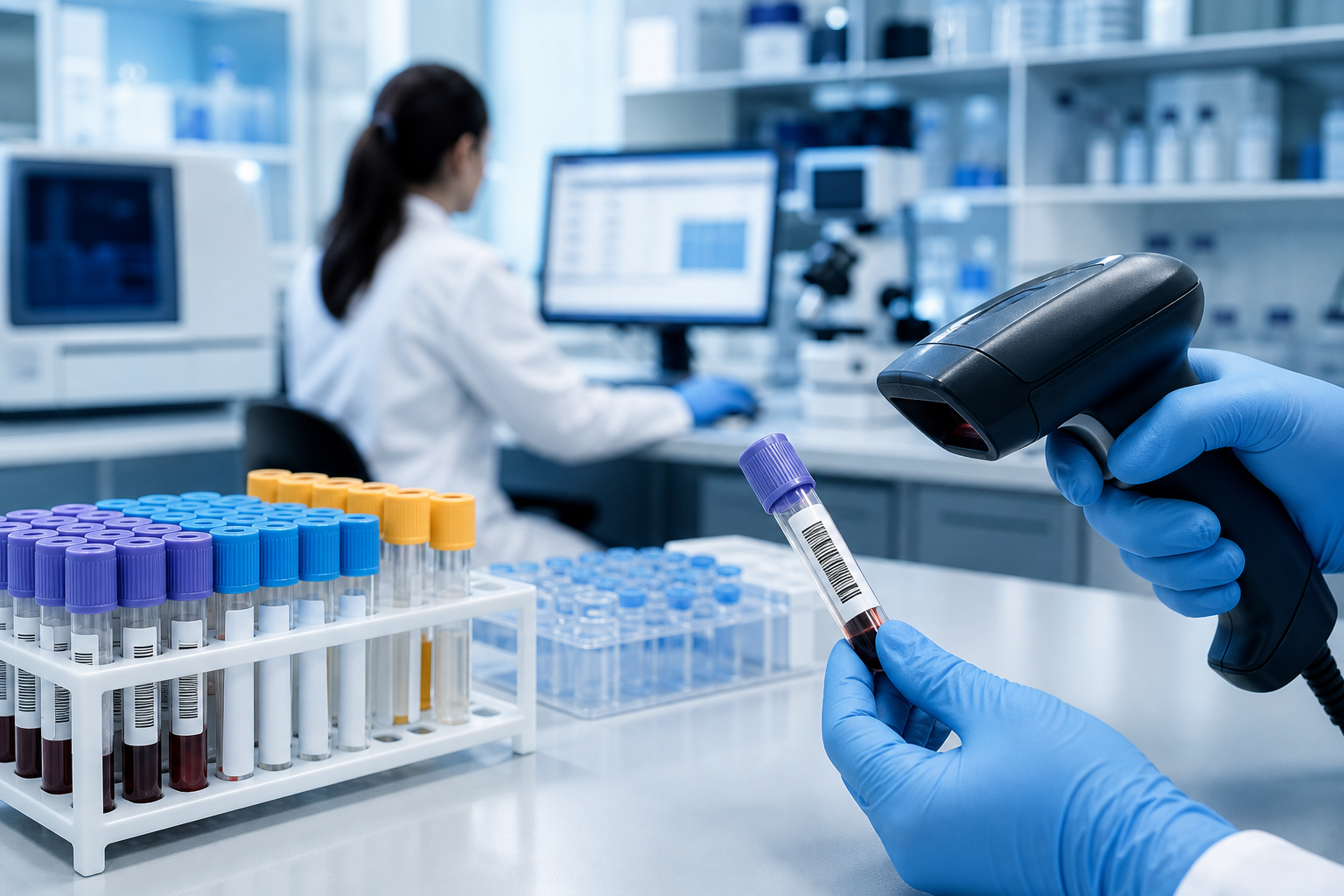
Barcodes are widely used because they are cost-effective, simple to implement, and compatible with many laboratory workflows. One-dimensional barcodes can be suitable for larger containers and simple identifiers, while two-dimensional barcodes, such as Data Matrix codes, are common on small tubes, plates, and cryovials.
RFID can be useful where line-of-sight scanning is difficult or when bulk reading of multiple items is needed. However, RFID implementation requires evaluation of tag compatibility, reader placement, interference from liquids or metals, cost, and data security. For many laboratories, barcodes remain the primary technology, while RFID is adopted for selected use cases.
Software Platform
The software layer stores sample metadata, workflow events, user permissions, locations, analytical associations, and reporting information. Options range from dedicated sample tracking applications to LIMS, laboratory execution systems, electronic laboratory notebooks, biobank management platforms, and custom database systems.
The software should support controlled vocabularies, configurable workflows, audit trails, user roles, search functions, and data export. For regulated environments, validation status, electronic records compliance, and auditability are critical considerations.
Common Laboratory Workflows
Sample tracking systems must reflect actual laboratory workflows. A system that does not align with routine practice may lead to workarounds, delayed data entry, or incomplete records.
Sample Receipt and Accessioning
At receipt, staff verify sample condition, documentation, labeling, and acceptance criteria. The system records receipt time, responsible personnel, submitter information, sample type, container count, and any discrepancies. For external submissions, accessioning may also involve assigning laboratory identifiers and linking them to client or study identifiers.
Aliquoting and Derivative Creation
Many laboratories create aliquots to reduce freeze-thaw cycles, support parallel testing, or distribute material to different departments. The tracking system should record the relationship between the original sample and each aliquot, including volume, concentration, preparation method, and storage location.
Testing and Instrument Association
During analysis, sample identifiers should be linked to methods, batches, instruments, analysts, reagents, and results. Where possible, barcode scanning at critical points helps confirm that the correct sample is loaded or processed. Integration with instruments can reduce transcription errors, although interfaces require careful configuration and maintenance.
Storage and Retrieval
Storage tracking often includes hierarchical location mapping, such as building, room, freezer, shelf, rack, box, row, and column. Good location management supports rapid retrieval and helps monitor capacity. For temperature-sensitive materials, integration with environmental monitoring systems may provide additional context for deviations or excursions.
Shipment and Disposal
When samples are shipped, the system should document recipient, courier, shipment conditions, package contents, transfer date, and chain-of-custody details where applicable. Disposal records should include authorization, method, date, and personnel involved, particularly for regulated, hazardous, infectious, or consent-restricted materials.
Integration with Laboratory Systems
Sample tracking is most effective when it is connected to the broader laboratory information environment. Isolated systems may still improve identification and location control, but integration can reduce duplicate data entry and improve consistency.
LIMS and ELN Integration
A LIMS often serves as the central system for sample registration, workflow management, testing, and reporting. An electronic laboratory notebook may capture experimental design, observations, and interpretation. Integrating tracking data with these systems helps maintain a continuous record from sample creation through analysis and reporting.
Instrument Connectivity
Instrument interfaces can transmit sample lists, run sequences, raw data, processed results, or status updates. Interface design should include clear rules for sample identifier matching, error handling, result review, and reprocessing. Laboratories should also consider how instrument software updates may affect validated interfaces.
Inventory and Quality Management Systems
Sample tracking may overlap with reagent inventory, equipment management, document control, deviation management, and corrective and preventive action processes. Links between these systems can help assess whether a sample result may have been affected by reagent lot issues, equipment maintenance events, or environmental excursions.
Regulatory and Compliance Considerations
Compliance expectations vary by sector. Clinical laboratories, pharmaceutical quality control laboratories, forensic laboratories, environmental testing laboratories, and biorepositories may follow different standards and regulations. However, several common principles apply.
Audit Trails and User Accountability
Systems used for regulated work should record significant actions in secure audit trails. These may include sample creation, status changes, location changes, result association, record edits, and disposal. Audit trails should identify the user, date and time, original value, new value, and reason for change when appropriate.
Electronic Records and Signatures
Where electronic records are used to meet regulatory requirements, laboratories should evaluate applicable rules such as 21 CFR Part 11, EU Annex 11, ISO 17025, CLIA, GxP expectations, or institutional policies. Requirements may include access control, system validation, record retention, electronic signatures, backup, and security controls.
Chain of Custody
Chain of custody is required when the history of sample possession must be legally or scientifically defensible. This is common in forensic testing, environmental monitoring, anti-doping analysis, and some clinical or regulated studies. Tracking systems should document each transfer, the responsible parties, dates, times, conditions, and evidence of acceptance.
Selection Criteria for a Sample Tracking System
Choosing a system requires evaluation of scientific, operational, technical, and compliance needs. A laboratory should define requirements before comparing products or designing an internal solution.
Workflow Fit
The system should support current workflows while allowing controlled improvement. Requirements gathering should include sample types, container formats, throughput, aliquoting rules, storage structures, review steps, reporting needs, and exceptions. Input from bench scientists, quality personnel, data managers, and information technology teams is important.
Scalability and Performance
A system that works for a few thousand samples may not perform adequately for millions of records, high-throughput scanning, or multi-site operations. Laboratories should consider expected growth, archive requirements, concurrent users, and data retrieval performance.
Usability
Usability affects compliance with the tracking process. If the system requires excessive clicks, does not support mobile or benchtop scanning, or lacks clear error messages, users may delay entry or create informal records. Practical workflow testing with representative users is essential.
Security and Access Control
Access controls should reflect job responsibilities. Not all users require permission to edit sample metadata, approve disposal, modify storage locations, or export sensitive data. Security planning should address authentication, role-based permissions, password policies, data encryption, backups, and disaster recovery.
Implementation Best Practices
Successful implementation depends on more than software installation. It requires standardized procedures, training, change control, data quality management, and ongoing system ownership.
Map Processes Before Configuration
Process mapping helps identify decision points, handoffs, duplicate records, and error-prone steps. Laboratories should document the current state and define the desired future state before configuring workflows. This reduces the risk of digitizing inefficient or inconsistent practices.
Standardize Naming and Metadata
Controlled vocabularies improve searchability and reporting. Sample type, species, matrix, study name, storage condition, status, and disposal reason should be standardized where possible. Free-text fields may still be necessary, but excessive free text can reduce data quality.
Validate the System When Required
For regulated laboratories, validation demonstrates that the system is suitable for its intended use. Validation activities may include user requirements, functional specifications, risk assessment, installation qualification, operational qualification, performance qualification, test scripts, traceability matrices, and change control records.
Train Users and Monitor Adoption
Training should cover routine workflows and exception handling, such as damaged labels, missing samples, rejected submissions, freezer relocation, and system downtime. After launch, laboratories should monitor adoption, error rates, and user feedback to identify areas for refinement.
Common Challenges and Practical Mitigations
Sample tracking initiatives can encounter predictable challenges. Addressing them early improves system reliability and user acceptance.
Legacy Data Migration
Existing spreadsheets, databases, and paper logs may contain inconsistent identifiers or incomplete locations. Data migration should include cleansing, mapping, verification, and documented assumptions. In some cases, phased migration is preferable to importing poor-quality historical data.
Label Failure
Labels that detach, smear, or become unreadable can undermine the entire tracking process. Laboratories should qualify label materials under expected storage, handling, and chemical exposure conditions before full deployment.
Uncontrolled Workarounds
Workarounds often indicate that the configured workflow does not match laboratory reality. Regular review of deviations, user feedback, and audit trail patterns can reveal where procedures or system configuration need adjustment.
Conclusion
Laboratory sample tracking systems support reliable identification, traceability, workflow control, and data integrity across the sample lifecycle. The most effective systems combine appropriate labeling technology, well-designed software, standardized procedures, and user-centered implementation. By aligning tracking practices with scientific requirements, compliance expectations, and day-to-day laboratory operations, organizations can reduce sample-related risk and maintain more dependable laboratory records.