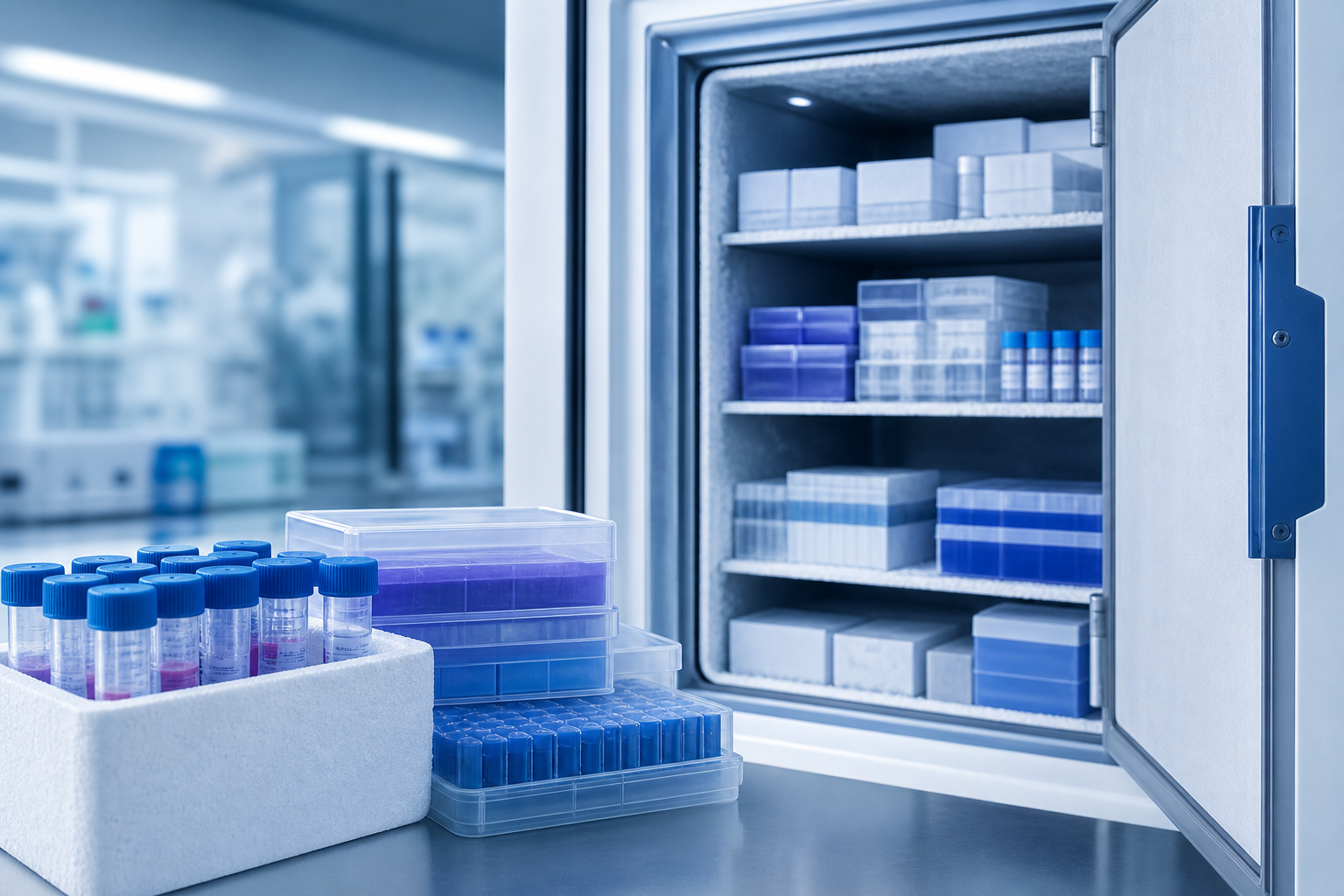
Cold storage is a routine but critical part of research operations. Biological specimens, reagents, reference standards, enzymes, antibodies, nucleic acids, cell lines, clinical samples, and temperature-sensitive chemicals may all lose integrity when stored outside defined conditions. Appropriate storage practices help preserve sample identity, reduce experimental variability, support reproducibility, and maintain compliance with institutional and regulatory requirements.
The appropriate cold storage strategy depends on the material, its intended use, stability data, container type, storage duration, and tolerance for freeze-thaw events. The guidelines below provide a practical framework for laboratories managing research materials across refrigerated, frozen, ultra-low temperature, and cryogenic environments.
Why Cold Storage Conditions Matter
Many research materials are chemically or biologically unstable at ambient temperature. Proteins can denature or aggregate, enzymes can lose activity, metabolites can degrade, and living cells can lose viability. Even when materials remain visibly unchanged, subtle degradation may affect downstream assays, sequencing quality, biomarker measurements, or cell-based experiments.
Cold storage slows many degradation pathways by reducing molecular motion and enzyme activity. However, lower temperatures do not automatically eliminate risk. Ice crystal formation, repeated freeze-thaw cycles, desiccation, oxidation, light exposure, and container failure can all compromise material quality. A well-managed cold storage program therefore considers temperature control together with handling, labeling, monitoring, documentation, and contingency planning.
Common Cold Storage Temperature Ranges
Refrigerated Storage: 2°C to 8°C
Refrigerated storage is commonly used for short-term storage of many buffers, media, diagnostic reagents, antibodies, kits, and temperature-sensitive chemicals. A range of 2°C to 8°C is typical, although specific products may require tighter limits. Materials should not be stored in locations prone to temperature excursions, such as refrigerator doors, near cooling vents, or against freezer compartments in combination units.
For research use, refrigerators should be purpose-built laboratory units when possible. Domestic refrigerators may have wide temperature variation, limited air circulation, and insufficient monitoring features. Food and beverages should not be stored in laboratory refrigerators used for research materials.
Standard Freezer Storage: -20°C to -30°C
Many reagents, nucleic acids, enzymes, aliquoted samples, and some reference materials are stored in standard laboratory freezers. The commonly used -20°C range is suitable for many materials over short to moderate periods, but it is not ideal for all specimens. Frost-free freezers are generally unsuitable for critical samples because automatic defrost cycles can create temperature fluctuations.
Where possible, use manual-defrost or laboratory-grade freezers for important research materials. Store samples in secondary containers, avoid overcrowding, and minimize door-open time to reduce warming events.
Ultra-Low Temperature Storage: -70°C to -86°C
Ultra-low temperature freezers are widely used for long-term storage of biological specimens, proteins, RNA, plasma, serum, microbial stocks, and other sensitive materials. Storage at approximately -80°C slows degradation more effectively than standard freezer temperatures for many biomolecules.
Ultra-low freezers require careful management because they contain high-value inventories and can warm quickly during door openings, mechanical failure, or power loss. Inventory organization, alarm systems, backup storage, and emergency response procedures are essential components of responsible ultra-low temperature storage.
Cryogenic Storage: Vapor Phase or Liquid Nitrogen
Cryogenic storage is generally used for viable cells, primary tissues, embryos, stem cells, microbial cultures, and other materials requiring long-term preservation of biological function. Liquid nitrogen has a temperature of approximately -196°C, while vapor phase systems typically maintain temperatures below the glass transition range required for many cryopreserved cells.
Vapor phase storage is often preferred when reducing the risk of cross-contamination associated with direct liquid contact is important. Cryogenic systems require specialized containers, personal protective equipment, oxygen monitoring where appropriate, and procedures for safe handling of liquid nitrogen.
Match Storage Conditions to Material Type
Nucleic Acids
DNA is generally more stable than RNA, but both require protection from nucleases, repeated freeze-thaw cycles, and contamination. Purified DNA may be stored refrigerated for short periods or frozen for longer storage depending on concentration, buffer, and intended use. RNA is more labile and is commonly stored at -80°C, often in nuclease-free water or appropriate stabilization solutions.
Aliquoting is strongly recommended for frequently accessed nucleic acid stocks. Avoid repeated warming of the primary stock, and use nuclease-free tubes, tips, and handling practices.
Proteins, Enzymes, and Antibodies
Protein stability varies widely. Some antibodies are stable at 2°C to 8°C for routine use, while enzymes and purified proteins may require -20°C or -80°C storage. Stabilizers such as glycerol, carrier proteins, reducing agents, or preservatives may be included depending on the reagent formulation. Freezing can damage some proteins, especially if ice crystal formation or concentration effects alter structure.
Laboratories should follow manufacturer instructions or validated internal stability data. For critical reagents, record the date received, date opened, storage location, and number of freeze-thaw cycles where relevant.
Cells and Microbial Stocks
Viable cell lines and microbial stocks require controlled cryopreservation. Cells are typically frozen using cryoprotectants such as dimethyl sulfoxide or glycerol, combined with a controlled cooling process before transfer to long-term cryogenic storage. Improper cooling rates can reduce post-thaw viability.
Cell banks should be organized using master and working stock concepts. This approach reduces repeated handling of original stocks and supports consistency across experiments. Authentication, mycoplasma testing, passage history, and storage records should be maintained for cell lines.
Clinical and Environmental Specimens
Clinical specimens such as serum, plasma, tissue, urine, and swabs require storage conditions aligned with the analytes of interest and study protocol. Environmental specimens may require preservation methods that prevent microbial activity, chemical transformation, or volatilization. For regulated or human-derived materials, chain-of-custody, consent, biosafety, and privacy requirements must also be considered.
When samples are collected for future unknown analyses, conservative storage at -80°C or validated stabilization methods may help preserve a broader range of potential analytes. However, the optimal method should be defined by study objectives and documented before collection begins.
Labeling and Inventory Control
Cold storage is only effective if materials can be reliably identified and retrieved. Labels must remain legible at the intended temperature and withstand moisture, frost, solvents, and handling. Use cryogenic labels or direct marking systems appropriate for the container and storage condition. Avoid standard office labels in freezers or cryogenic systems because adhesive failure is common.
Labels should include, at minimum, a unique identifier, material name or code, preparation date, concentration or passage number if applicable, hazard information where needed, and owner or project reference. For small containers, use a unique code linked to a digital inventory rather than attempting to print excessive information on the tube.
A digital inventory system should record storage unit, rack, box, position, lot or batch, quantity, date received, expiration or retest date, and access history for controlled materials. Regular reconciliation helps detect misplaced, depleted, expired, or unidentifiable materials before they affect research work.
Packaging and Container Selection
Container choice affects sample stability and safety. Tubes, vials, plates, ampoules, and bottles should be rated for the storage temperature and compatible with the sample matrix. Cryogenic vials must be specifically designed for low-temperature storage; not all plastic tubes can tolerate ultra-low or liquid nitrogen conditions.
Use leak-resistant closures and secondary containment for hazardous, infectious, or high-value materials. For cryogenic storage, avoid overfilling vials because expansion during freezing can cause rupture. Ensure that containers intended for liquid nitrogen use are appropriate for either vapor phase or liquid phase storage as specified by the manufacturer.
For plates and multiwell formats, use validated sealing films or caps to prevent evaporation, cross-contamination, and frost intrusion. Consider edge effects and seal integrity when plates are stored for extended periods.
Temperature Monitoring and Documentation
Continuous Monitoring
Research materials should be stored in equipment with routine temperature monitoring. For critical materials, continuous monitoring with alarms is preferable to manual checks alone. Monitoring probes should be placed in representative locations and may be buffered in glycol or another suitable medium for refrigerated units to reduce false alarms from brief air-temperature fluctuations.
Temperature records should be reviewed periodically and retained according to institutional policy, sponsor requirements, or regulatory expectations. Alarms should be tested, and contact lists should remain current. Alarm fatigue can be reduced by setting scientifically appropriate limits and escalation procedures.
Temperature Mapping
Temperature mapping evaluates spatial variation within a storage unit. Refrigerators, freezers, and cold rooms may have warm or cold zones, particularly near doors, vents, walls, or heavily loaded shelves. Mapping is especially useful when commissioning new equipment, after repairs, after relocation, or when storing critical materials.
Mapping results can guide where to place sensitive materials and where not to store them. The objective is not only to confirm average temperature but also to identify locations that may exceed acceptable limits during routine operation.
Managing Freeze-Thaw Cycles
Repeated freeze-thaw cycles are a common cause of degradation for proteins, enzymes, cells, RNA, and some metabolites. Each cycle can cause physical and chemical stress, including ice crystal damage, pH shifts, concentration of solutes, oxidation, and aggregation.
Aliquot materials into single-use or limited-use volumes whenever feasible. Plan aliquot sizes based on actual experimental needs rather than convenience. Record freeze-thaw exposure for sensitive reagents and specimens. If a material must be thawed repeatedly, validate whether performance remains acceptable after the expected number of cycles.
Thawing should be controlled and appropriate for the material. Some samples should be thawed rapidly to reduce ice crystal damage, while others may require slow thawing on ice to preserve activity. Mix gently after thawing if the material permits, and avoid vortexing fragile proteins or cells unless specified by a validated protocol.
Storage Unit Organization and Good Practices
Cold storage units should be organized to reduce search time and door-open duration. Use racks, boxes, dividers, and clear location codes. Maintain an updated map for each unit. Avoid placing samples directly on freezer floors or in locations that block airflow. Overloading a freezer can reduce temperature uniformity and increase recovery time after door openings.
Routine housekeeping is important. Remove expired, unidentified, or abandoned materials according to institutional procedures. Excess inventory consumes storage capacity, increases energy use, and can obscure critical samples. Defrost manual freezers when frost accumulation interferes with seals, airflow, or storage organization.
Access should be limited to trained personnel for units containing hazardous, regulated, or irreplaceable materials. Training should cover proper door handling, alarm response, sample retrieval, use of personal protective equipment, and incident reporting.
Backup Systems and Emergency Planning
Cold storage failures can occur due to power outages, compressor failure, door seal problems, accidental unplugging, depleted liquid nitrogen supply, or human error. Laboratories should maintain written emergency procedures for each critical storage unit.
Emergency plans should identify responsible personnel, after-hours contacts, backup units, dry ice or liquid nitrogen suppliers, transport materials, and prioritization criteria for sample relocation. High-value or irreplaceable collections may require duplicate storage in separate units or separate facilities.
Backup power should be considered for critical refrigerators, freezers, monitoring systems, and cryogenic infrastructure. For ultra-low freezers, carbon dioxide or liquid nitrogen backup systems may provide temporary protection, but they require maintenance, safety review, and clear operating procedures. Emergency drills can reveal gaps before a real incident occurs.
Transporting Temperature-Sensitive Materials
Transport is a high-risk period because materials leave controlled storage and may be exposed to delays, vibration, temperature shifts, or handling errors. Packaging should maintain the required temperature for the entire expected transit time plus a reasonable safety margin. Use qualified insulated containers, dry ice, gel packs, phase-change materials, or liquid nitrogen dry shippers as appropriate.
Dry ice shipments must comply with applicable dangerous goods regulations because carbon dioxide can displace oxygen and build pressure in sealed containers. Liquid nitrogen dry shippers also require specific handling and documentation. For regulated biological materials, infectious substances, human specimens, or hazardous chemicals, packaging and shipping must follow all relevant institutional, national, and international requirements.
Include temperature indicators or data loggers for critical shipments. On receipt, inspect containers, confirm temperature condition where possible, document deviations, and transfer materials promptly to the appropriate storage unit.
Quality Management and Compliance Considerations
Cold storage practices should be integrated into the laboratory quality system. Standard operating procedures should define acceptable temperature ranges, monitoring frequency, alarm response, maintenance schedules, inventory practices, sample disposal, and deviation management. Deviations should be documented with an assessment of potential impact on material integrity.
Equipment maintenance is also part of quality control. Refrigerators and freezers should receive routine cleaning, seal inspection, filter cleaning where applicable, calibration checks, and performance evaluation. Calibration of monitoring devices should follow a defined schedule using traceable standards when required.
For laboratories operating under good laboratory practice, good clinical practice, biobanking standards, accreditation programs, or sponsor-specific requirements, additional documentation and validation may be necessary. The level of control should be proportional to the scientific, ethical, and regulatory importance of the stored materials.
Conclusion
Cold storage is more than placing samples in a refrigerator, freezer, or cryogenic tank. It requires selecting the correct temperature range, using suitable containers, controlling freeze-thaw exposure, maintaining accurate inventory records, monitoring equipment performance, and preparing for failures. When these elements are managed systematically, laboratories can better preserve research material integrity and improve the reliability of downstream results.
Because stability requirements vary by material and application, laboratories should base final storage conditions on validated protocols, manufacturer instructions, safety data sheets, and institutional procedures. Regular review of cold storage practices helps ensure that stored materials remain fit for their intended research purpose.