
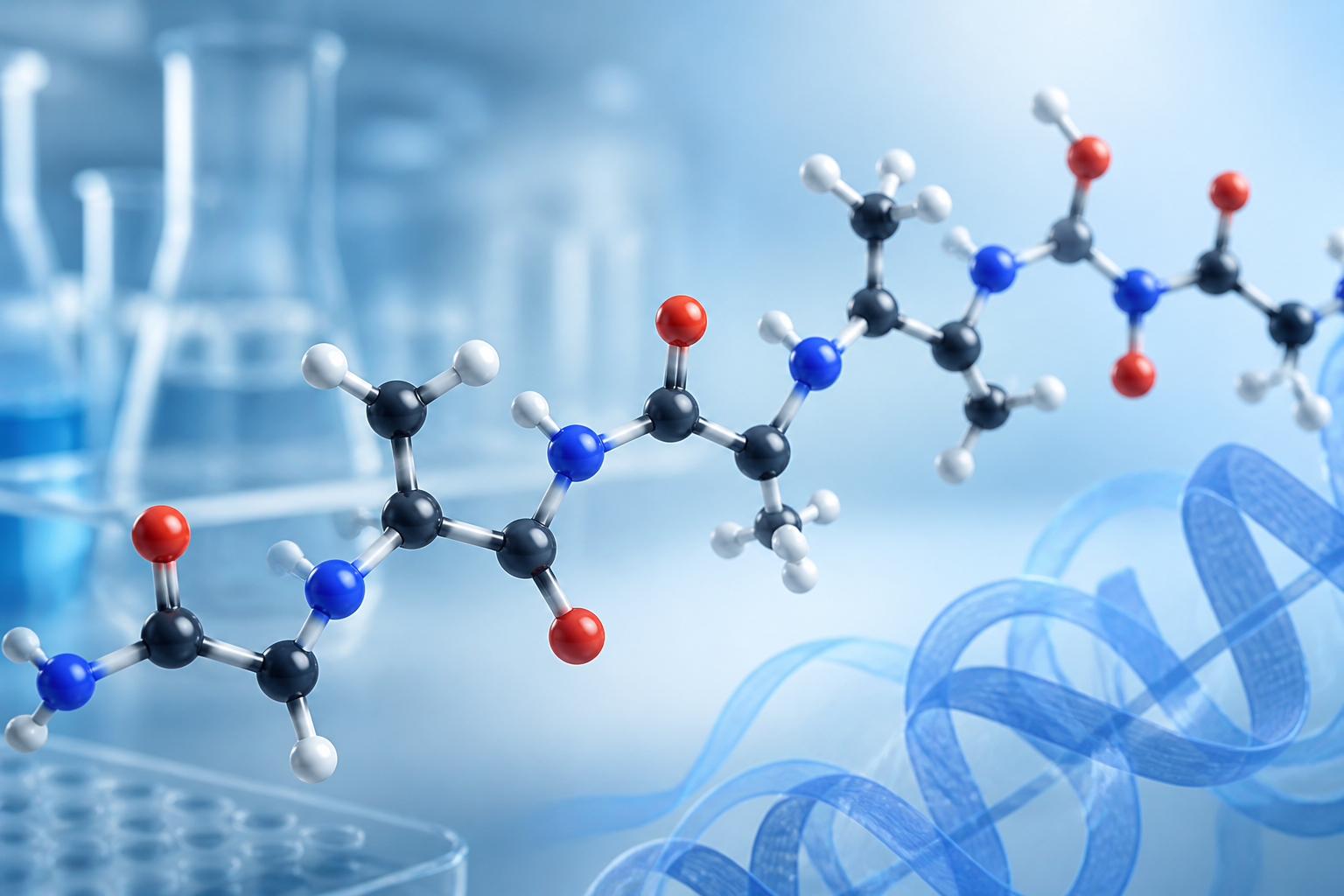
Peptide synthesis is a core technique in modern life science research, supporting applications in biochemistry, pharmacology, immunology, diagnostics, structural biology, and materials science. Synthetic peptides are used as enzyme substrates, receptor ligands, antigens, standards for mass spectrometry, epitope-mapping tools, and building blocks for more complex biomolecules. A practical understanding of how peptides are made helps researchers select appropriate specifications, evaluate analytical data, and design sequences that can be manufactured reproducibly.
At its simplest, peptide synthesis is the stepwise formation of amide bonds between amino acids. In practice, it requires careful control of protecting groups, coupling chemistry, resin or solution conditions, purification, and analytical verification. The final product quality depends not only on the target sequence, but also on length, composition, solubility, modifications, and the intended research use.
What Is Peptide Synthesis?
Peptide synthesis is the chemical assembly of amino acids into a defined sequence. Each amino acid contains an amino group, a carboxyl group, and a side chain. To form a peptide bond selectively, chemists must activate one functional group while preventing unwanted reactions at others. This is achieved through protecting groups and controlled coupling reagents.
Synthetic peptides generally range from short sequences of a few residues to longer chains of 50 amino acids or more. Longer sequences can be produced chemically, but complexity increases with each additional residue. Side-chain functionality, hydrophobicity, aggregation tendency, and steric hindrance can all affect synthesis efficiency and final purity.
Main Approaches to Peptide Synthesis
Solid-Phase Peptide Synthesis
Solid-phase peptide synthesis, commonly abbreviated SPPS, is the dominant method for producing research peptides. In SPPS, the growing peptide chain is attached to an insoluble resin. Reagents and solvents pass through the resin bed, while the peptide remains anchored until synthesis is complete. This format allows repeated cycles of deprotection, washing, coupling, and washing with relative efficiency.
SPPS is typically performed from the C-terminus to the N-terminus. The first amino acid is attached to the resin, and additional amino acids are added one at a time. After the final residue is coupled, the peptide is cleaved from the resin and side-chain protecting groups are removed. The crude product is then purified and characterized.
Solution-Phase Peptide Synthesis
Solution-phase peptide synthesis is an older but still relevant approach in which reactions occur in homogeneous solution rather than on a solid support. It can be useful for small peptides, peptide fragments, or large-scale manufacture when intermediate isolation and characterization are advantageous. However, solution-phase synthesis often requires more extensive purification after each step, which can make it less practical for routine preparation of diverse research peptides.
Hybrid and Fragment Condensation Strategies
For longer or difficult peptides, chemists may prepare shorter protected fragments and join them through fragment condensation or ligation methods. These strategies can reduce the number of sequential coupling steps on a single resin-bound chain and may improve the feasibility of preparing complex sequences. Native chemical ligation and related chemoselective methods are also used to assemble longer peptides or small proteins from purified fragments.
Protecting Group Strategies
Fmoc Chemistry
Fmoc chemistry is widely used in SPPS because it employs base-labile N-terminal protection and acid-labile side-chain protection. The Fmoc group is typically removed with piperidine or another base in an appropriate solvent, while side-chain protecting groups remain intact until final cleavage. This orthogonal strategy supports repeated cycles under relatively mild conditions and is compatible with many common peptide modifications.
Boc Chemistry
Boc chemistry uses an acid-labile N-terminal protecting group. Deprotection is commonly performed with trifluoroacetic acid, while final cleavage from certain resins may require strong acid conditions such as hydrogen fluoride. Boc chemistry has historical importance and remains useful in selected contexts, but Fmoc-based SPPS is more common for routine custom research peptides due to operational convenience and broader compatibility with many laboratory workflows.
Typical Solid-Phase Peptide Synthesis Workflow
Resin Selection and Initial Loading
The synthesis begins with selection of a resin that determines the C-terminal functionality of the peptide. For example, certain resins yield C-terminal acids, while others yield C-terminal amides. Resin loading, expressed as millimoles of reactive sites per gram of resin, influences reaction efficiency, aggregation, and scale. Lower-loading resins may improve synthesis outcomes for long or aggregation-prone sequences by reducing intermolecular interactions within the resin matrix.
Deprotection
During each cycle, the temporary N-terminal protecting group is removed to expose a free amine for the next coupling reaction. In Fmoc SPPS, this step is usually monitored indirectly by established process controls or by test reactions that indicate free amine availability. Complete deprotection is important because residual protected chains cannot participate in the next coupling step, leading to deletion impurities.
Amino Acid Coupling
After deprotection, the next protected amino acid is activated with coupling reagents and added to the resin. Common coupling systems include carbodiimide-based reagents and uronium or phosphonium salts, often used with additives that reduce racemization and improve efficiency. The goal is to drive the formation of the desired peptide bond while minimizing side reactions. Difficult residues may require double coupling, extended reaction times, elevated temperature, or alternative reagents.
Washing and Cycle Repetition
Washing steps remove excess reagents, byproducts, and deprotection solutions before the next step. Efficient washing is essential because carryover can reduce coupling efficiency or cause undesired reactions. The deprotection and coupling cycle is repeated until the full sequence has been assembled.
Cleavage and Global Deprotection
Once chain assembly is complete, the peptide is cleaved from the resin and side-chain protecting groups are removed. In Fmoc workflows, this is commonly performed with trifluoroacetic acid mixtures containing scavengers. Scavengers help capture reactive species generated during deprotection and reduce side-chain damage. The crude peptide is then precipitated, collected, dissolved, and prepared for purification.
Purification and Analytical Characterization
Preparative HPLC
Crude synthetic peptides contain the target molecule along with deletion sequences, truncated chains, protecting group remnants, and other synthesis-related impurities. Preparative reversed-phase high-performance liquid chromatography is commonly used to enrich the desired peptide. Separation is based largely on hydrophobicity, with gradients of aqueous buffer and organic solvent. Purity requirements vary by application; screening studies may tolerate lower purity, while quantitative assays, structural studies, and in vivo research often require higher purity specifications.
Mass Spectrometry
Mass spectrometry is a key identity test for synthetic peptides. Techniques such as MALDI-TOF or electrospray ionization mass spectrometry can confirm that the observed molecular mass is consistent with the expected sequence and modifications. For modified peptides, isotopically labeled peptides, or peptides containing nonstandard residues, mass confirmation is especially important.
Analytical HPLC and Additional Tests
Analytical HPLC is commonly used to estimate peptide purity by monitoring chromatographic peak area. Depending on the intended use, additional tests may include amino acid analysis, water content, counterion analysis, residual solvent testing, endotoxin testing, or disulfide bond verification. The appropriate level of characterization should be matched to the scientific question and downstream application.
Common Peptide Modifications
Peptide synthesis can incorporate a wide range of modifications. Common terminal modifications include N-terminal acetylation and C-terminal amidation, which can alter charge, stability, and resemblance to native protein fragments. Fluorescent labels, biotin, lipid groups, polyethylene glycol spacers, and cell-penetrating motifs may be introduced for detection, immobilization, solubility, or delivery studies.
Post-translational modification mimics are also frequently synthesized, including phosphorylated, methylated, acetylated, glycosylated, or hydroxylated residues. Disulfide bonds may be formed through controlled oxidation of cysteine residues, while cyclic peptides can be prepared through head-to-tail cyclization or side-chain linkages. Each modification can introduce additional synthetic and analytical considerations.
Design Factors That Affect Synthesis Success
Sequence Length and Composition
Longer peptides generally present a greater risk of incomplete coupling and accumulated impurities. Sequences rich in bulky, hydrophobic, or beta-branched residues may be more difficult to assemble. Repetitive motifs and regions prone to secondary structure formation can also reduce resin accessibility during synthesis.
Solubility
Peptide solubility is influenced by net charge, hydrophobic residues, terminal modifications, and pH. Poor solubility can complicate purification, handling, concentration determination, and biological testing. When possible, researchers may consider adding charged residues, using solubilizing tags, adjusting terminal groups, or selecting appropriate counterions. Any design change should be evaluated in relation to the biological or analytical purpose of the peptide.
Cysteine, Methionine, and Other Sensitive Residues
Cysteine-containing peptides may form disulfide-linked dimers or incorrect disulfide isomers if oxidation is not controlled. Methionine and tryptophan can be susceptible to oxidation under some conditions. Aspartimide formation, diketopiperazine formation, and racemization are additional sequence-dependent side reactions that may require adjusted chemistry or process conditions.
Applications in Research and Development
Synthetic peptides are used across many scientific disciplines. In immunology, they serve as antigens for antibody production and epitope mapping. In enzymology, they function as substrates or inhibitors. In analytical chemistry, stable isotope-labeled peptides support targeted proteomics and quantitative mass spectrometry. In drug discovery, peptides are studied as ligands, leads, pharmacodynamic tools, or models for protein-protein interactions.
Peptides are also important in vaccine research, biomaterials, diagnostics, and cell signaling studies. Because performance depends on purity, identity, and formulation, peptide selection should consider not only the amino acid sequence but also the required documentation, analytical methods, storage conditions, and compatibility with the planned experiment.
Storage and Handling Considerations
Most purified peptides are supplied as lyophilized solids and should be stored under conditions that limit moisture, heat, and repeated freeze-thaw cycles. Reconstitution solvent should be selected based on sequence properties and experimental requirements. Acidic, basic, aqueous, or organic solvent systems may be appropriate depending on solubility and stability. Once dissolved, peptides are generally less stable than in lyophilized form, so aliquoting can help maintain consistency across experiments.
Conclusion
Peptide synthesis combines organic chemistry, analytical science, and practical process control to generate defined amino acid sequences for research use. SPPS, particularly Fmoc-based chemistry, is the most widely used approach, while purification and identity testing are essential for reliable application. By understanding synthesis strategy, sequence-related challenges, modifications, and quality control methods, researchers can make better-informed decisions when designing, ordering, and using synthetic peptides.