High-performance liquid chromatography, commonly abbreviated as HPLC, is one of the most widely used analytical techniques for separating, identifying, and quantifying chemical compounds in complex samples. It is used across pharmaceutical development, food and beverage testing, environmental monitoring, clinical research, materials science, and quality control laboratories. The method is valued because it can analyze many types of molecules, including small organic compounds, APIs, impurities, metabolites, preservatives, pigments, peptides, and some biomolecules.
At its core, HPLC testing works by moving a liquid sample through a packed column under high pressure. Different compounds interact with the column material and the liquid mobile phase to different extents. These differences cause compounds to leave the column at different times, allowing the instrument to detect and measure them individually. While the concept is straightforward, reliable HPLC testing depends on careful control of sample preparation, chromatographic conditions, calibration, detection, and quality assurance.
What Is HPLC Testing?
HPLC testing is an instrumental analytical method used to separate components in a liquid mixture and generate measurable data about those components. A sample is dissolved or extracted into a suitable solvent, introduced into the HPLC system, transported through a column by a mobile phase, and detected as individual peaks in a chromatogram.
The term high-performance reflects the use of small, uniform stationary-phase particles and controlled high-pressure pumping. These features improve separation efficiency compared with older forms of liquid chromatography. Modern HPLC systems can operate under pressures of thousands of psi, depending on the column, particle size, mobile phase viscosity, and flow rate. Ultra-high-performance liquid chromatography, or UHPLC, uses smaller particles and higher pressures to achieve faster or higher-resolution separations, but the working principles are similar.
The Basic Principle: Separation by Differential Interactions
HPLC separates compounds because each analyte has a distinct balance of interactions with two phases: the mobile phase and the stationary phase. The mobile phase is the liquid solvent or solvent mixture that carries compounds through the system. The stationary phase is the material packed inside the analytical column.
If a compound interacts strongly with the stationary phase, it moves more slowly and elutes later. If it prefers the mobile phase, it moves more quickly and elutes earlier. The time required for a compound to travel from injection to detection is called its retention time. Under controlled conditions, retention time can help identify a compound, although confirmation often requires comparison with reference standards or additional detection methods.
Common Separation Modes
Several HPLC separation modes are used depending on the chemistry of the analytes and sample matrix. In reversed-phase HPLC, the stationary phase is nonpolar, often C18-bonded silica, and the mobile phase is relatively polar, commonly water mixed with acetonitrile or methanol. This is the most common mode for pharmaceuticals, natural products, and many organic compounds.
Normal-phase HPLC uses a polar stationary phase and a less polar mobile phase, making it useful for certain isomers, lipids, and compounds that are difficult to retain by reversed-phase methods. Ion-exchange HPLC separates compounds based on charge interactions, while size-exclusion chromatography separates molecules primarily by hydrodynamic size. Hydrophilic interaction liquid chromatography, or HILIC, is often used for very polar compounds that are poorly retained on reversed-phase columns.
Main Components of an HPLC System
An HPLC instrument is a coordinated system of fluidic, separation, detection, and data-processing components. Each part influences analytical performance, reproducibility, and sensitivity.
Solvent Reservoirs and Mobile Phase
Solvent reservoirs hold the mobile phase components used during analysis. These solvents must be compatible with the analytes, column, detector, and method requirements. Mobile phases are commonly filtered and degassed to remove particulates and dissolved gases that can contribute to pressure instability, baseline noise, or pump cavitation.
Mobile phases may contain buffers, acids, bases, or salts to control pH, improve peak shape, or stabilize ionization state. In methods coupled to mass spectrometry, volatile additives such as formic acid, acetic acid, ammonium formate, or ammonium acetate are typically preferred.
Pump
The pump delivers the mobile phase through the system at a precise and consistent flow rate. HPLC pumps may operate isocratically, using a constant mobile-phase composition, or in gradient mode, changing the solvent composition over time. Gradient elution is commonly used when a sample contains compounds with a broad range of polarities or retention behaviors.
Stable pump performance is essential because fluctuations in flow rate or solvent composition can shift retention times, alter peak areas, and affect quantitative accuracy.
Injector or Autosampler
The injector introduces a defined volume of sample into the flowing mobile phase. Modern systems commonly use autosamplers, which can inject multiple samples from vials or plates with controlled volume, sequence, and temperature. Injection volume must be selected carefully. Too much sample can overload the column, broaden peaks, or distort quantification, while too little may reduce sensitivity.
Analytical Column
The column is the central separation device. It contains packed particles coated or bonded with a stationary phase. Column dimensions, particle size, pore size, and stationary-phase chemistry determine much of the method’s selectivity and efficiency. For example, a C18 reversed-phase column may retain hydrophobic compounds strongly, while a phenyl-hexyl phase may provide different selectivity for aromatic molecules.
Column temperature is often controlled because temperature affects solvent viscosity, analyte diffusion, retention, and selectivity. Even small temperature changes can influence retention time in sensitive methods.
Detector
After compounds elute from the column, they pass through a detector. The detector converts a chemical or physical property into an electrical signal. Common HPLC detectors include ultraviolet-visible detectors, photodiode array detectors, fluorescence detectors, refractive index detectors, evaporative light scattering detectors, charged aerosol detectors, electrochemical detectors, and mass spectrometers.
UV and photodiode array detectors are widely used when analytes absorb ultraviolet or visible light. Fluorescence detection can offer high sensitivity for naturally fluorescent compounds or derivatized analytes. Mass spectrometry provides molecular mass and structural information, making LC-MS particularly useful for trace analysis, impurity profiling, bioanalysis, and confirmatory testing.
Data System
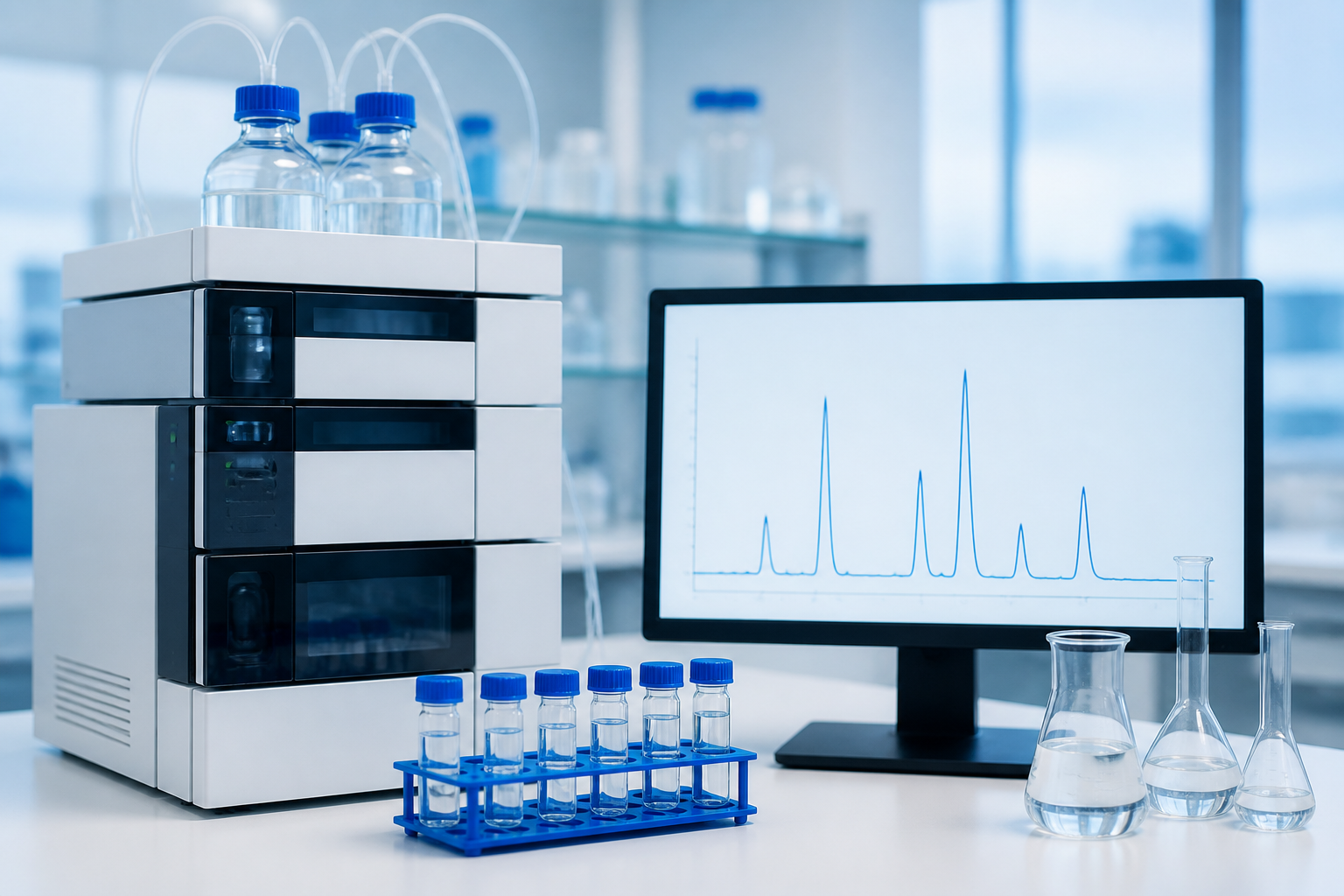
The data system records detector response over time and displays it as a chromatogram. Peaks represent compounds detected as they elute from the column. Software is used to integrate peak area or peak height, compare retention times, apply calibration curves, calculate concentrations, and generate reports. In regulated environments, data integrity, audit trails, user permissions, and validated software workflows are important considerations.
Step-by-Step: How an HPLC Test Is Performed
1. Defining the Analytical Objective
Before testing begins, the laboratory defines what the method must measure. The objective may be assay of an active ingredient, impurity profiling, residual solvent analysis, preservative quantification, degradation study support, contaminant screening, or identity confirmation. The intended purpose affects sample preparation, detector choice, calibration range, acceptance criteria, and validation requirements.
2. Sample Preparation
Sample preparation is often one of the most important parts of HPLC testing. The analyte must be transferred into a solution compatible with the HPLC method while minimizing interferences from the sample matrix. Common procedures include dilution, filtration, centrifugation, liquid-liquid extraction, solid-phase extraction, protein precipitation, or derivatization.
For solid samples, the compound of interest may need to be extracted with a solvent, sonicated, shaken, heated, or otherwise processed to ensure adequate recovery. For biological samples, proteins and salts may need to be removed to protect the column and reduce matrix effects. For pharmaceutical dosage forms, excipients may require specific extraction and cleanup procedures.
Prepared samples are usually filtered through membranes, often 0.45 micrometer or 0.22 micrometer, to remove particulates that could block the injector or column. The filter material must be compatible with the solvent and should not adsorb the analyte.
3. System Equilibration
Before analysis, the HPLC system and column are equilibrated with the mobile phase. Equilibration ensures that the stationary phase, solvent composition, temperature, and pressure are stable. In gradient methods, sufficient re-equilibration between injections is required so that each sample begins under comparable chromatographic conditions.
4. Injection and Chromatographic Separation
A precise volume of the prepared sample is injected into the mobile-phase stream. The pump pushes the sample through the column. As the sample components move through the stationary phase, they separate according to their chemical properties and interactions with the column.
The separation may use isocratic elution or gradient elution. In isocratic elution, the mobile-phase composition remains constant throughout the run. This can be suitable for simple mixtures with analytes of similar retention. In gradient elution, the proportion of strong solvent increases or changes during the run, helping elute strongly retained compounds and improving analysis of complex mixtures.
5. Detection and Signal Generation
As separated compounds exit the column, the detector records their response. For UV detection, the compound absorbs light at a selected wavelength, and the detector measures the reduction in transmitted light. For fluorescence detection, the compound is excited at one wavelength and emits light at another. For mass spectrometric detection, compounds are ionized, separated by mass-to-charge ratio, and detected according to ion abundance.
The resulting detector signal is plotted against time to produce a chromatogram. Ideally, each analyte of interest appears as a well-resolved peak, separated from neighboring peaks and background matrix components.
6. Identification and Quantification
Compound identification in HPLC often begins with retention time comparison to a reference standard analyzed under the same method conditions. In photodiode array detection, UV spectra across a peak may help assess peak purity or support identification. In LC-MS, mass-to-charge ratio, isotope pattern, fragmentation data, and retention time can provide stronger evidence of identity.
Quantification is typically based on peak area, which is proportional to the amount of analyte reaching the detector within the validated range of the method. The laboratory prepares calibration standards at known concentrations and constructs a calibration curve. Sample peak areas are then compared with the curve to calculate concentration. Internal standards may be used to correct for injection variability, sample preparation losses, or matrix effects.
Understanding the Chromatogram
A chromatogram is the main visual output of an HPLC test. The x-axis represents time, and the y-axis represents detector response. Each peak corresponds to a component or group of unresolved components leaving the column at a particular time.
Key chromatographic parameters include retention time, peak area, peak height, resolution, tailing factor, theoretical plates, and signal-to-noise ratio. Resolution describes how well two peaks are separated. Tailing factor indicates peak symmetry. Theoretical plates estimate column efficiency. Signal-to-noise ratio is important for determining detection and quantitation limits, particularly in trace-level testing.
Accurate peak integration is essential. Co-eluting peaks, drifting baselines, shoulder peaks, or unresolved impurities can complicate interpretation. For this reason, chromatograms are reviewed by trained analysts, and integration settings are controlled by laboratory procedures.
Method Development and Validation
HPLC methods must be developed to provide adequate selectivity, sensitivity, precision, and robustness for the intended application. Method development may involve selecting the column chemistry, mobile-phase pH, buffer strength, organic solvent type, gradient profile, flow rate, injection volume, column temperature, and detection wavelength.
Once developed, methods used for regulated or critical testing are typically validated. Validation characteristics may include specificity, linearity, range, accuracy, precision, limit of detection, limit of quantitation, robustness, and system suitability. The exact requirements depend on the application, regulatory framework, and laboratory quality system.
System Suitability Testing
System suitability testing verifies that the HPLC system and method are performing acceptably before or during sample analysis. Suitability criteria may include retention time reproducibility, peak area precision, resolution between critical pairs, tailing factor, theoretical plates, and standard response. Failure to meet suitability requirements indicates that the run may not be reliable without investigation and correction.
Quality Controls in HPLC Testing
Reliable HPLC testing requires controls throughout the analytical sequence. Blank injections can reveal carryover or contamination. Calibration standards define the quantitative relationship between concentration and response. Quality control samples at known concentrations assess accuracy during the run. Replicate injections evaluate instrumental precision. Spike recovery experiments may be used to assess extraction efficiency and matrix effects.
Good laboratory practice also includes documentation of reagent lot numbers, column history, instrument maintenance, sample handling, environmental conditions where relevant, and any deviations from approved procedures. In regulated laboratories, traceability and data integrity are as important as the chromatographic result itself.
Common Applications of HPLC Testing
HPLC testing is used in many laboratory settings because it can be adapted to a wide range of analytes and matrices. In pharmaceutical analysis, it is used for assay, content uniformity, impurity testing, dissolution testing, stability studies, and cleaning verification. In food and beverage laboratories, HPLC can measure vitamins, preservatives, sweeteners, organic acids, mycotoxins, colors, and residues.
Environmental laboratories use HPLC for pollutants, pesticides, phenols, and other organic contaminants in water, soil, and waste samples. Clinical and bioanalytical laboratories may use HPLC or LC-MS methods to measure drugs, metabolites, biomarkers, and endogenous compounds. Research laboratories use HPLC for purification monitoring, reaction tracking, compound characterization, and method development.
Limitations and Practical Considerations
Although HPLC is highly versatile, it is not universally suitable for every analytical problem. Some compounds lack detectable UV absorption and may require alternative detectors, derivatization, or mass spectrometry. Very volatile compounds may be better suited to gas chromatography. Highly complex matrices may require extensive cleanup or orthogonal confirmation. Salts, particulates, proteins, and incompatible solvents can damage columns or interfere with results.
Method performance also depends on reference standards, column condition, mobile-phase preparation, instrument maintenance, and analyst training. A well-designed method can still produce unreliable results if sample preparation is inconsistent or if system suitability failures are overlooked.
Conclusion
HPLC testing works by using controlled liquid flow, a chemically selective column, and a suitable detector to separate and measure compounds in a sample. The technique depends on differential interactions between analytes, the mobile phase, and the stationary phase, producing chromatographic peaks that can be identified and quantified. When supported by appropriate sample preparation, calibration, validation, and quality controls, HPLC provides a reliable analytical approach for many scientific and regulated testing applications.