Introduction
Lyophilized peptides are widely used in biochemical research, assay development, cell biology, structural studies, and early-stage drug discovery. In most laboratory catalogs and custom synthesis workflows, peptides are supplied as dry powders produced by lyophilization, also known as freeze-drying. This presentation format is common because many peptides are more stable in a dry state than in aqueous solution, where hydrolysis, oxidation, aggregation, and microbial contamination can occur more readily.
Despite their routine use, lyophilized peptides require careful handling. The dry material may be hygroscopic, electrostatic, or difficult to dissolve depending on the sequence and formulation. In addition, the apparent mass in a vial does not always equal the exact amount of active peptide because counterions, residual water, and salts can contribute to gross weight. Understanding what lyophilization does, how peptide properties affect behavior, and how to reconstitute and store peptides can improve experimental reproducibility and reduce avoidable sample loss.
What Are Lyophilized Peptides?
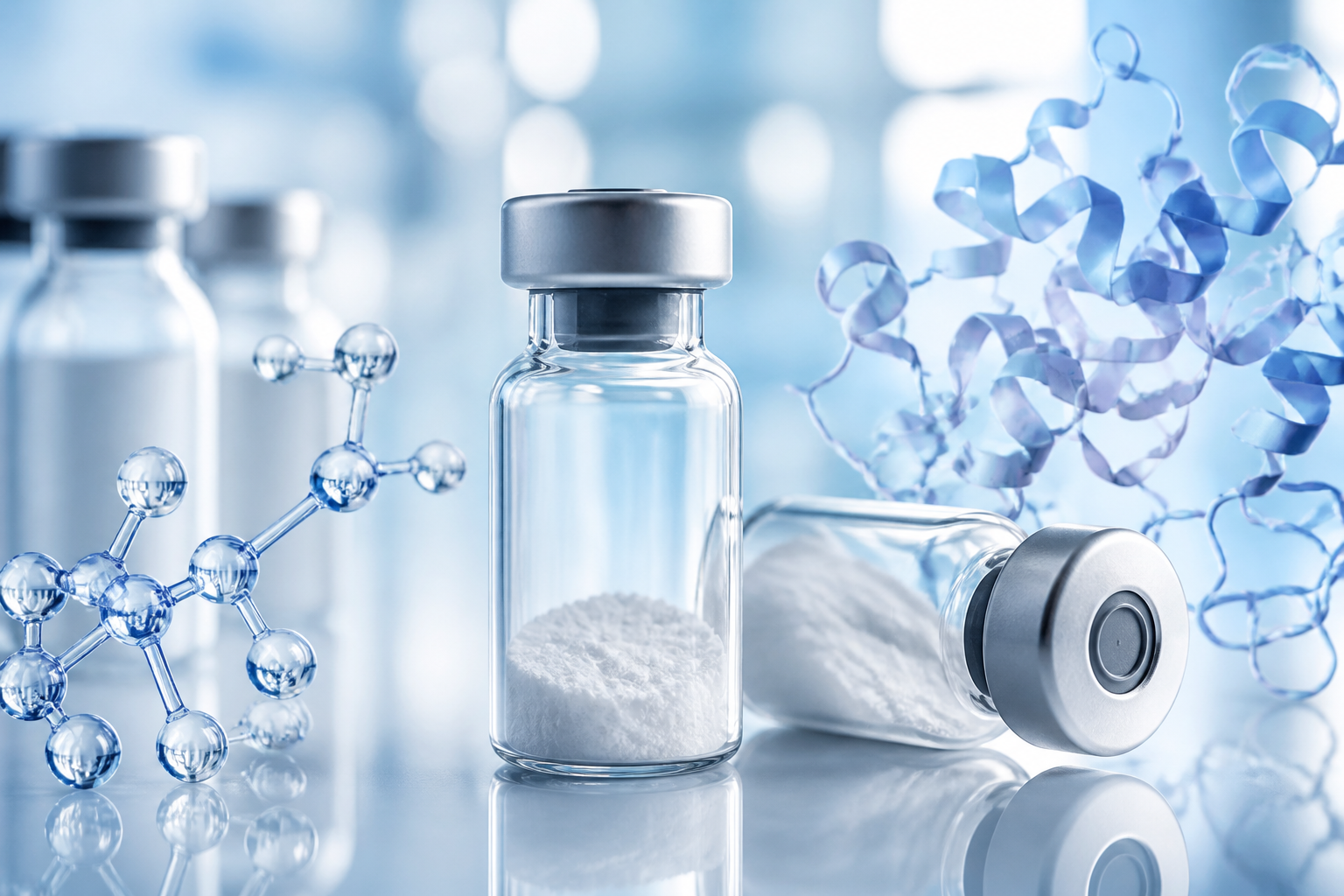
A lyophilized peptide is a peptide preparation that has been frozen and dried under reduced pressure to remove water and volatile solvents. The resulting solid is typically supplied as a powder, film, or porous solid residue. Its appearance can vary from a fine white powder to an off-white or translucent film, depending on the peptide sequence, concentration during drying, vial geometry, residual salts, and excipients if present.
Peptides are short chains of amino acids joined by peptide bonds. They can range from a few residues to several dozen residues or more. Their physicochemical behavior is determined by amino acid composition, terminal modifications, charge state, hydrophobicity, disulfide bonds, post-translational modifications, and associated counterions. Because these features differ substantially between peptides, there is no single universal handling method that applies to every lyophilized peptide.
Lyophilized Versus Peptide in Solution
Dry peptides generally have improved long-term stability compared with peptides stored in solution. In solution, chemical reactions such as deamidation, oxidation, hydrolysis, and disulfide exchange may be accelerated by pH, temperature, buffer composition, dissolved oxygen, and repeated freeze-thaw cycles. Dry storage reduces molecular mobility and limits water-driven degradation pathways. However, lyophilization does not make peptides indefinitely stable. Moisture uptake, elevated temperature, light exposure, and oxygen can still degrade sensitive sequences over time.
How Lyophilization Works
Lyophilization is a controlled drying process that removes water primarily by sublimation. The peptide solution is first frozen. Under vacuum, ice transitions directly from solid to vapor during primary drying. A secondary drying phase then removes more tightly bound water. The goal is to obtain a dry product with acceptable residual moisture and physical characteristics while minimizing degradation during processing.
Freezing
During freezing, water forms ice crystals and solutes become concentrated in the unfrozen fraction. This concentration step can influence pH, ionic strength, and aggregation risk. Some peptides are sensitive to freeze-concentration effects, especially if they contain hydrophobic regions or reactive residues. The freezing rate can affect the final cake structure and drying efficiency, although these parameters are more relevant to industrial formulation development than to routine research purchasing.
Primary and Secondary Drying
In primary drying, vacuum and controlled heat input allow frozen water to sublime. In secondary drying, temperature is often increased to remove residual bound water. Excessive heat or prolonged drying may affect labile sequences, while insufficient drying can leave higher residual moisture and reduce shelf stability. Research-grade peptide suppliers typically optimize the process sufficiently for dry shipment and storage, but the exact residual water content may vary unless specified by analytical documentation.
Why Peptides Are Commonly Supplied as Lyophilized Powders
Lyophilization offers several practical advantages for research laboratories. Dry peptides are usually easier to ship, often tolerate short periods at ambient temperature better than aqueous solutions, and can be stored in small vials until needed. The format also allows researchers to choose the reconstitution solvent and concentration appropriate for a specific assay.
For custom peptides, lyophilized delivery is especially useful because sequence-dependent solubility can be difficult to predict precisely. A peptide intended for a cell-based assay may require sterile aqueous buffer, while a hydrophobic peptide used in biophysical studies may require an organic co-solvent or staged dissolution. Supplying the peptide dry gives the end user flexibility, but it also places responsibility on the laboratory to select suitable handling conditions.
Composition and Mass Considerations
One of the most important concepts for researchers is the difference between gross peptide weight and net peptide content. A vial labeled as containing a given mass may include the target peptide along with residual water, counterions, salts, and other non-peptide components from synthesis and purification. Common counterions include trifluoroacetate, acetate, chloride, or ammonium, depending on purification and salt-exchange methods.
Purity, Net Peptide Content, and Counterions
Peptide purity typically describes the percentage of the target peptide relative to peptide-related impurities, often determined by analytical high-performance liquid chromatography. This is not the same as net peptide content or peptide assay, which estimates the actual peptide mass fraction in the dry material. For quantitative work, such as preparing molar standards, receptor binding assays, or potency comparisons, researchers should review the certificate of analysis and determine whether calculations should be based on gross weight, purity-adjusted weight, or net peptide content.
For example, a peptide with high chromatographic purity may still contain counterions and residual water. If the exact active amount is critical, amino acid analysis, elemental analysis, quantitative nitrogen analysis, or supplier-provided peptide content data may be needed. For less quantitative applications, such as screening or qualitative detection experiments, gross mass-based preparation may be adequate, but this should be documented consistently.
Storage Best Practices
Storage conditions should be selected according to peptide stability, intended duration of storage, and supplier recommendations. As a general practice, unopened lyophilized peptides are stored tightly sealed, protected from light when appropriate, and kept dry at low temperature. Many research peptides are stored at -20 °C for routine medium-term use, while long-term storage or particularly sensitive peptides may benefit from -80 °C storage.
Moisture Control
Lyophilized peptides can absorb moisture quickly when exposed to ambient air, particularly in humid environments. Moisture uptake may increase degradation and can make the powder sticky or difficult to weigh. To reduce condensation, allow sealed vials removed from a freezer to equilibrate to room temperature before opening. This step helps prevent atmospheric moisture from condensing directly onto the cold peptide. After opening, minimize exposure time, recap promptly, and use desiccated storage when practical.
Temperature, Light, and Oxygen
Temperature affects degradation kinetics. Lower temperatures generally slow chemical degradation, but repeated temperature cycling should be avoided. Light-sensitive peptides, including those containing certain chromophores or photo-labile modifications, should be protected from light. Peptides containing methionine, cysteine, tryptophan, or other oxidation-prone residues may be susceptible to oxygen exposure; storage under inert gas can be useful for some highly sensitive materials, although it is not required for all peptides.
Reconstitution Principles
Reconstitution should be planned before opening the vial. The appropriate solvent depends on the peptide sequence, required stock concentration, downstream assay compatibility, and sterility requirements. Common solvents include sterile water, bacteriostatic water for certain non-cell-culture uses, phosphate-buffered saline, dilute acetic acid, dilute ammonium hydroxide, dimethyl sulfoxide, and other aqueous or organic mixtures. The supplier’s solubility guidance should be followed when available.
Start With Sequence Properties
Peptide charge is a useful starting point. Acidic peptides may dissolve better in a mildly basic solution, while basic peptides may dissolve better in a mildly acidic solution. Hydrophilic peptides often dissolve readily in water or buffer. Hydrophobic peptides may require a small amount of organic solvent such as DMSO, dimethylformamide, acetonitrile, or alcohol before dilution into aqueous buffer. However, organic solvents can affect biological assays, protein interactions, and cell viability, so the final solvent concentration must be compatible with the experiment.
Use Gentle Mixing
After adding solvent, allow the peptide to wet fully and mix gently. Avoid vigorous vortexing for peptides prone to aggregation, foaming, or oxidation unless the protocol specifically supports it. Brief sonication or gradual warming to room temperature may help some difficult peptides, but elevated temperatures should be used cautiously for unstable sequences. If particulate material remains, it may represent undissolved peptide, insoluble impurities, or aggregation. Filtration can remove particulates, but it can also cause peptide adsorption and concentration loss, especially at low concentrations.
Prepare Practical Stock Concentrations
Stock solutions should be concentrated enough to minimize storage volume but not so concentrated that precipitation occurs. For molar preparations, calculate concentration using molecular weight and, when needed, net peptide content. It is useful to record solvent, concentration, date of reconstitution, lot number, and freeze-thaw history. When sterility is required, use sterile solvents and aseptic technique. Unless a peptide is specifically supplied sterile, lyophilization alone should not be assumed to provide sterility.
Aliquoting and Solution Storage
Once reconstituted, peptides are usually less stable than in the dry state. Aliquoting into single-use volumes helps avoid repeated freeze-thaw cycles and reduces contamination risk. Low-binding microcentrifuge tubes or vials can reduce adsorption losses, especially for hydrophobic peptides or dilute solutions. The suitability of polypropylene, glass, or other container materials depends on the peptide and solvent.
Short-term storage of peptide solutions may be possible at 2 to 8 °C for some sequences, but many peptide solutions are best stored frozen in aliquots. Long-term solution storage should be validated for critical assays. Buffers, pH, antioxidants, chelators, carrier proteins, or inert atmosphere may improve stability for selected peptides, but additives can interfere with downstream applications and should be evaluated carefully.
Common Challenges and Troubleshooting
Poor Solubility
Poor solubility is a common issue, especially for peptides with high hydrophobicity, long sequences, multiple aromatic residues, or strong self-association tendencies. A stepwise approach is recommended: first assess charge and hydrophobicity, then test small-scale dissolution in compatible solvents. Acidic or basic pre-solubilization can help charged peptides, while hydrophobic peptides may require organic co-solvent. Avoid adding concentrated buffer salts before the peptide has dissolved, as salts can sometimes reduce solubility.
Unexpected Low Activity
Low activity may result from degradation, incomplete dissolution, incorrect concentration calculation, adsorption to plastic, oxidation, aggregation, or assay interference from solvent or counterions. Confirm that the peptide was fully dissolved, that the correct molecular weight and peptide content were used, and that storage conditions were appropriate. For sensitive assays, analytical confirmation by HPLC or mass spectrometry may be warranted.
Visible Residue After Reconstitution
Residue may indicate incomplete dissolution, but some lyophilized material can adhere to vial walls and dissolve slowly. Gentle rinsing of the vial walls with solvent and allowing sufficient time can help. If insoluble material persists, changing pH, using a compatible co-solvent, or reducing target concentration may be necessary. Centrifugation can clarify a solution, but any removal of solid material may reduce final peptide concentration.
Quality Control and Documentation
Reliable peptide use depends on clear documentation. A certificate of analysis commonly includes peptide sequence, molecular weight, purity by HPLC, identity confirmation by mass spectrometry, appearance, quantity, and sometimes water content, counterion information, or net peptide content. Researchers should retain these documents and link them to experimental records.
For regulated, translational, or highly quantitative workflows, additional controls may be needed. These can include independent concentration determination, stability studies under intended storage conditions, endotoxin testing for cell-based or in vivo research contexts, sterility testing when relevant, and lot-to-lot comparison. The required level of characterization should match the risk and purpose of the experiment.
Safety and Handling Considerations
Peptides should be handled according to institutional safety procedures and the relevant safety data sheet. Many research peptides have limited toxicological data, so standard laboratory precautions are appropriate. Avoid inhalation of dry powder, skin or eye contact, and aerosol generation. Use gloves, eye protection, and a lab coat, and work in a suitable containment device when handling powders or biologically active sequences. Disposal should follow local chemical and biological waste policies.
Conclusion
Lyophilized peptides provide a stable and flexible format for many laboratory applications, but their performance depends on informed storage, reconstitution, and documentation practices. Key considerations include moisture control, correct interpretation of peptide mass and purity, solvent selection based on sequence properties, and minimizing degradation after reconstitution. By treating each peptide as a sequence-specific material rather than a generic powder, laboratories can improve reproducibility and preserve sample integrity.