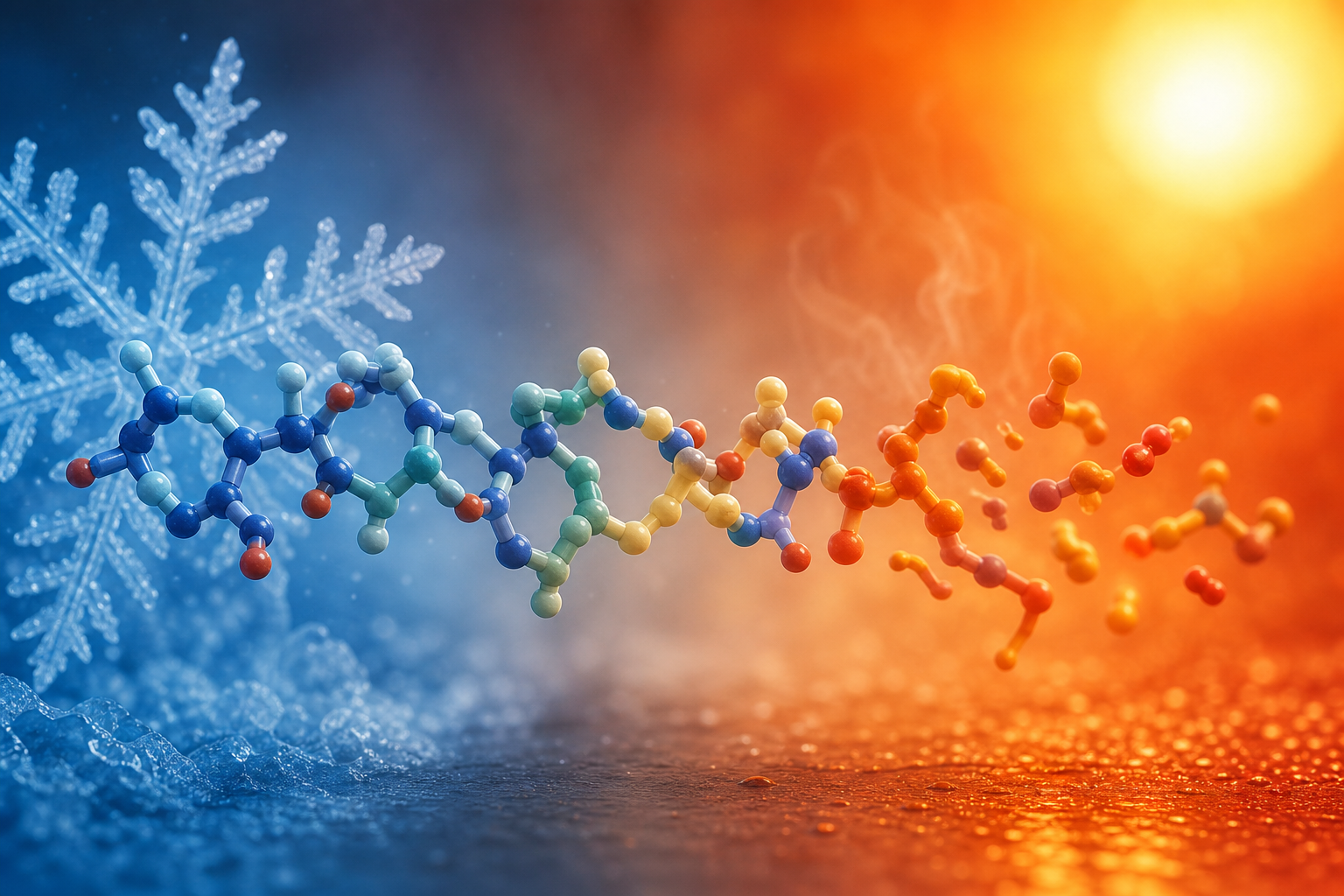
Temperature is one of the most important environmental variables affecting peptide stability. For laboratories, biopharmaceutical developers, diagnostic manufacturers, and research institutions, temperature control influences peptide integrity during synthesis, purification, formulation, shipment, storage, and use. Because peptides vary widely in sequence, length, charge, hydrophobicity, and modification state, their temperature sensitivity is not uniform. However, the underlying principles are well established: elevated temperature generally increases chemical reaction rates and molecular mobility, while very low temperature can reduce degradation but may introduce risks related to freezing, concentration changes, and repeated freeze-thaw cycling.
Understanding temperature effects helps researchers select appropriate storage conditions, design stability studies, interpret analytical data, and reduce variability in peptide-based experiments. The following sections summarize how temperature affects peptide degradation pathways, how lyophilized and solution-state peptides differ, and which handling practices are commonly used to preserve peptide quality.
Why Temperature Matters for Peptide Stability
Peptides are polymers of amino acids linked by amide bonds. Although the peptide backbone is generally robust under mild conditions, many side chains and terminal groups are chemically reactive. Temperature influences peptide stability because most degradation processes are thermally activated. As temperature increases, molecules collide more frequently and with greater energy, leading to faster rates of hydrolysis, oxidation, deamidation, racemization, aggregation, and other transformations.
The relationship between temperature and degradation rate is often described using the Arrhenius equation, which relates reaction rate to activation energy and absolute temperature. In practical terms, a peptide that is stable for months at refrigerated or frozen conditions may degrade substantially faster at room temperature or above. This principle is used in accelerated stability testing, where samples are stored at elevated temperatures to estimate likely degradation pathways and support shelf-life projections. However, extrapolation must be performed carefully because some degradation mechanisms change with physical state, pH, concentration, excipients, and water content.
Temperature Effects Are Sequence Dependent
Not all peptides respond to temperature in the same way. A peptide rich in oxidation-prone residues such as methionine, cysteine, tryptophan, or tyrosine may show different thermal sensitivity than a peptide containing asparagine, glutamine, aspartic acid, or N-terminal glutamine, which can participate in deamidation, isomerization, or cyclization. Peptides with hydrophobic regions may aggregate more readily as temperature changes, while peptides containing disulfide bonds may be vulnerable to reduction, scrambling, or oxidative changes under certain conditions.
Sequence length also matters. Short peptides may behave more like small molecules, while longer peptides can adopt secondary structure or self-associate. Modifications such as amidation, acetylation, phosphorylation, PEGylation, lipidation, glycosylation, or incorporation of non-natural amino acids can substantially alter thermal behavior and solubility.
Major Temperature-Influenced Degradation Pathways
Hydrolysis of Peptide Bonds and Side Chains
Hydrolysis involves cleavage of chemical bonds by water. Peptide bond hydrolysis is typically slow at neutral pH and moderate temperatures, but rates increase under acidic or basic conditions and at elevated temperature. Side-chain hydrolysis can also occur, particularly in labile modifications or ester-containing residues. In solution, water activity is high, so hydrolytic degradation is often more relevant than in dry, lyophilized material. Increased temperature accelerates these reactions and may also change local pH or buffer behavior, further affecting stability.
Deamidation and Isomerization
Asparagine and glutamine residues can undergo deamidation, generating aspartic acid or glutamic acid residues and releasing ammonia. Asparagine deamidation is especially common and may proceed through a cyclic succinimide intermediate. This can lead not only to conversion to aspartic acid but also to isoaspartic acid formation, which inserts an extra methylene group into the peptide backbone and may significantly alter biological activity. Deamidation is affected by temperature, pH, neighboring residues, buffer type, and peptide conformation. Higher temperatures generally accelerate the process, particularly in aqueous formulations.
Aspartic acid residues can also undergo isomerization through similar intermediates. These reactions may be difficult to detect by simple mass measurement because some products have minimal or no mass shift. Chromatography and specialized analytical methods may be required.
Oxidation
Oxidation is a common temperature-sensitive degradation route for peptides containing methionine, cysteine, tryptophan, histidine, or tyrosine. Methionine oxidation to methionine sulfoxide is frequently observed. Cysteine residues can form disulfides, undergo disulfide scrambling, or be further oxidized to sulfinic or sulfonic acid forms. Elevated temperature can accelerate oxidation by increasing reaction rates and by promoting interactions with dissolved oxygen, trace metals, peroxides, or reactive impurities in excipients and containers.
Oxidation is not controlled by temperature alone. Light exposure, oxygen headspace, metal ion contamination, pH, and the presence of oxidizing agents can be equally important. Nevertheless, lower temperature storage often helps slow oxidative degradation when combined with appropriate packaging and handling controls.
Aggregation and Precipitation
Aggregation occurs when peptide molecules associate with one another, sometimes reversibly and sometimes irreversibly. Temperature can influence aggregation through changes in solubility, hydrophobic interactions, electrostatic interactions, and conformational mobility. Some peptides become less soluble at lower temperature, while others aggregate more rapidly at elevated temperature. The direction of the effect depends on peptide composition and formulation conditions.
Aggregation may present as visible precipitation, turbidity, chromatographic changes, or loss of biological activity. It is especially relevant for longer peptides, amphipathic sequences, and peptides with hydrophobic modifications. Agitation, freeze-thaw stress, concentration, ionic strength, and pH can interact with temperature to increase aggregation risk.
Racemization and Epimerization
Racemization refers to conversion of an L-amino acid residue to its D-form, while epimerization describes stereochemical inversion at a specific chiral center. These reactions are often slower than oxidation or deamidation under typical storage conditions, but they can be accelerated by high temperature, extreme pH, and certain sequence contexts. Even small amounts of stereochemical impurity may be relevant for peptides used in pharmacological, immunological, or receptor-binding studies.
Lyophilized Peptides Versus Peptides in Solution
Lyophilized Peptides
Lyophilization removes most water from a peptide preparation, greatly reducing molecular mobility and hydrolytic reactions. For many peptides, the dry solid form is more stable than solution, particularly when stored cold and protected from moisture. Refrigerated storage at 2–8 °C or frozen storage at −20 °C is commonly used for lyophilized research peptides, though the optimal condition depends on the peptide and intended storage duration.
Even lyophilized peptides are not immune to degradation. Residual moisture, hygroscopicity, oxygen exposure, and elevated temperature can still promote chemical change. Some peptides absorb atmospheric water quickly after vial opening, which can increase mobility and accelerate degradation. For this reason, vials are often allowed to equilibrate to room temperature before opening to reduce condensation. Desiccants, inert gas, tight sealing, and minimizing repeated openings can support stability.
Peptides in Solution
Once dissolved, peptides generally become less stable because water-mediated reactions and molecular motion increase. Solution stability is strongly influenced by pH, buffer composition, concentration, ionic strength, preservatives, antioxidants, cosolvents, and container material. Many peptide solutions are stored at low temperature for short-term use, often at 2–8 °C or frozen in aliquots at −20 °C or below for longer storage. However, some peptides may precipitate or aggregate upon freezing or refrigeration, so empirical confirmation is important.
The solvent used for reconstitution matters. Sterile water, buffers, dilute acid, dilute base, dimethyl sulfoxide, acetonitrile-water mixtures, or other solvents may be appropriate depending on peptide solubility and downstream application. Temperature effects should be evaluated in the selected formulation rather than inferred solely from data in another solvent.
Effects of Freezing and Freeze-Thaw Cycles
Benefits and Limitations of Freezing
Freezing can substantially slow chemical degradation by reducing molecular mobility and decreasing the fraction of liquid water. For many peptide solutions, storage at −20 °C, −80 °C, or lower is useful for long-term preservation. However, freezing is not simply a pause button. During ice formation, solutes can become concentrated in unfrozen regions, causing local changes in pH, ionic strength, and peptide concentration. These changes can promote aggregation, precipitation, or chemical reactions in the freeze-concentrated phase.
Cooling and thawing rates can also affect stability. Slow freezing may allow larger ice crystals and greater solute concentration effects, while rapid freezing may reduce some stresses but can introduce others. The best approach is peptide-specific and formulation-dependent.
Repeated Freeze-Thaw Stress
Repeated freeze-thaw cycles are a common source of peptide instability in laboratory workflows. Each cycle exposes the sample to changing temperature, concentration gradients, ice-liquid interfaces, and potential aggregation stress. Repeated opening may also introduce oxygen, moisture, or contamination. A standard mitigation strategy is to divide peptide solutions into single-use or limited-use aliquots immediately after reconstitution. Aliquot volumes should match expected experimental needs to reduce unnecessary thawing.
When thawing is required, gentle thawing at controlled temperature and mixing after complete thaw can improve sample uniformity. Vigorous vortexing, excessive heat, or repeated warming above the required temperature should be avoided unless validated for the specific peptide.
High-Temperature Exposure During Handling and Shipping
Short-Term Excursions
Peptides may experience temperature excursions during weighing, reconstitution, sample preparation, instrument autosampler storage, or shipment. The significance of a short-term excursion depends on peptide stability, moisture state, formulation, and temperature reached. A lyophilized peptide may tolerate brief room-temperature handling better than a dilute aqueous solution, but this should not be assumed for highly labile sequences.
In experimental settings, it is useful to distinguish between cumulative thermal exposure and a single brief event. A peptide repeatedly left at room temperature during multiple experiments may accumulate more degradation than expected from any individual handling step. Documented handling procedures help reduce variability across users and studies.
Shipping Conditions
Shipping temperature should be selected based on the peptide form and stability information. Lyophilized peptides are often shipped under ambient or cool conditions if data support stability, whereas solution-state peptides and highly labile materials may require cold packs, dry ice, or controlled temperature logistics. Temperature indicators or data loggers may be appropriate for critical materials, regulated studies, or long transit routes.
Designing Temperature Stability Studies
Study Conditions
A well-designed stability study evaluates the peptide under conditions relevant to actual use. Typical comparisons may include frozen, refrigerated, room temperature, and accelerated temperatures such as 25 °C, 37 °C, or 40 °C. For solutions, studies should examine the intended buffer, concentration, container, headspace, and light exposure. For lyophilized material, residual moisture and reconstitution performance may be important endpoints.
Time points should be selected to capture both early changes and longer-term trends. For research-use peptides, a pragmatic study might compare initial purity with results after days, weeks, and months under defined conditions. For regulated or clinical applications, formal stability protocols, validated methods, and predefined acceptance criteria are required.
Analytical Methods
High-performance liquid chromatography is commonly used to monitor peptide purity and detect degradation products. Mass spectrometry can identify mass changes associated with oxidation, deamidation, truncation, or hydrolysis. However, some modifications, such as isomerization or racemization, may require specialized approaches including chiral chromatography, peptide mapping, ion mobility, or enzymatic assays. Additional techniques such as UV spectroscopy, circular dichroism, dynamic light scattering, size-exclusion chromatography, or bioassays may be useful depending on peptide properties and intended function.
No single assay fully characterizes stability for every peptide. A combination of purity, identity, potency, appearance, and solubility measurements often provides a more complete picture.
Practical Temperature Control Recommendations
General Storage Practices
- Store lyophilized peptides cold, dry, and protected from light unless stability data support alternative conditions.
- Allow sealed vials to reach room temperature before opening to reduce condensation on the peptide.
- Reconstitute using a solvent and pH appropriate for the peptide sequence and application.
- Store peptide solutions in aliquots to limit repeated freeze-thaw cycles.
- Use low-binding containers when adsorption or low concentration may be a concern.
- Record storage temperature, thaw history, preparation date, and concentration.
- Avoid unnecessary exposure to elevated temperature during handling, shipping, and autosampler runs.
When to Generate Peptide-Specific Data
General recommendations are useful starting points, but peptide-specific stability data are important when the peptide is expensive, biologically critical, difficult to synthesize, used in quantitative assays, or part of a regulated workflow. Stability testing is also advisable for peptides containing oxidation-prone residues, labile modifications, disulfide bonds, unusual amino acids, or known aggregation-prone motifs. Small changes in peptide integrity can affect receptor binding, enzyme inhibition, immunogenicity, calibration accuracy, or assay reproducibility.
Conclusion
Temperature affects peptide stability by altering reaction rates, molecular mobility, solubility, and physical state. Elevated temperatures generally accelerate degradation, while cold storage can slow many chemical processes but may introduce freezing and freeze-thaw stresses. The most appropriate storage and handling conditions depend on peptide sequence, formulation, concentration, container, and intended use. By combining controlled temperature management with peptide-specific analytical evaluation, laboratories can improve reproducibility and maintain confidence in peptide-based research and development workflows.