Peptide Degradation Explained
Peptides are widely used in biochemical research, drug discovery, diagnostics, materials science, and analytical method development. Their value depends heavily on molecular integrity: a peptide that has partially degraded may show altered biological activity, different binding behavior, misleading chromatographic profiles, or reduced reproducibility between experiments. Understanding peptide degradation is therefore essential for researchers who synthesize, purchase, store, formulate, or analyze peptide materials.
Peptide degradation refers to chemical, enzymatic, or physical changes that modify the peptide sequence, structure, purity, or functional properties over time. These changes can occur during synthesis, purification, lyophilization, shipping, reconstitution, storage, sample preparation, or experimental use. The rate and pathway of degradation depend on peptide sequence, environmental conditions, formulation, and handling practices.
What Is Peptide Degradation?
At its simplest, peptide degradation is the loss of the original peptide species and the formation of modified or fragmented products. Degradation may involve cleavage of peptide bonds, oxidation of susceptible side chains, deamidation, racemization, aggregation, or other chemical transformations. Some degradation products differ from the parent peptide by only a small mass shift, while others may be truncated, crosslinked, or insoluble.
Not all changes are immediately visible. A peptide solution can appear clear while containing oxidized or deamidated variants. Conversely, visible precipitation does not always mean covalent degradation has occurred; it may reflect solubility limitations or aggregation. For this reason, peptide stability is typically assessed using analytical techniques such as high-performance liquid chromatography, mass spectrometry, capillary electrophoresis, amino acid analysis, or bioassays.
Major Mechanisms of Peptide Degradation
Hydrolysis and Peptide Bond Cleavage
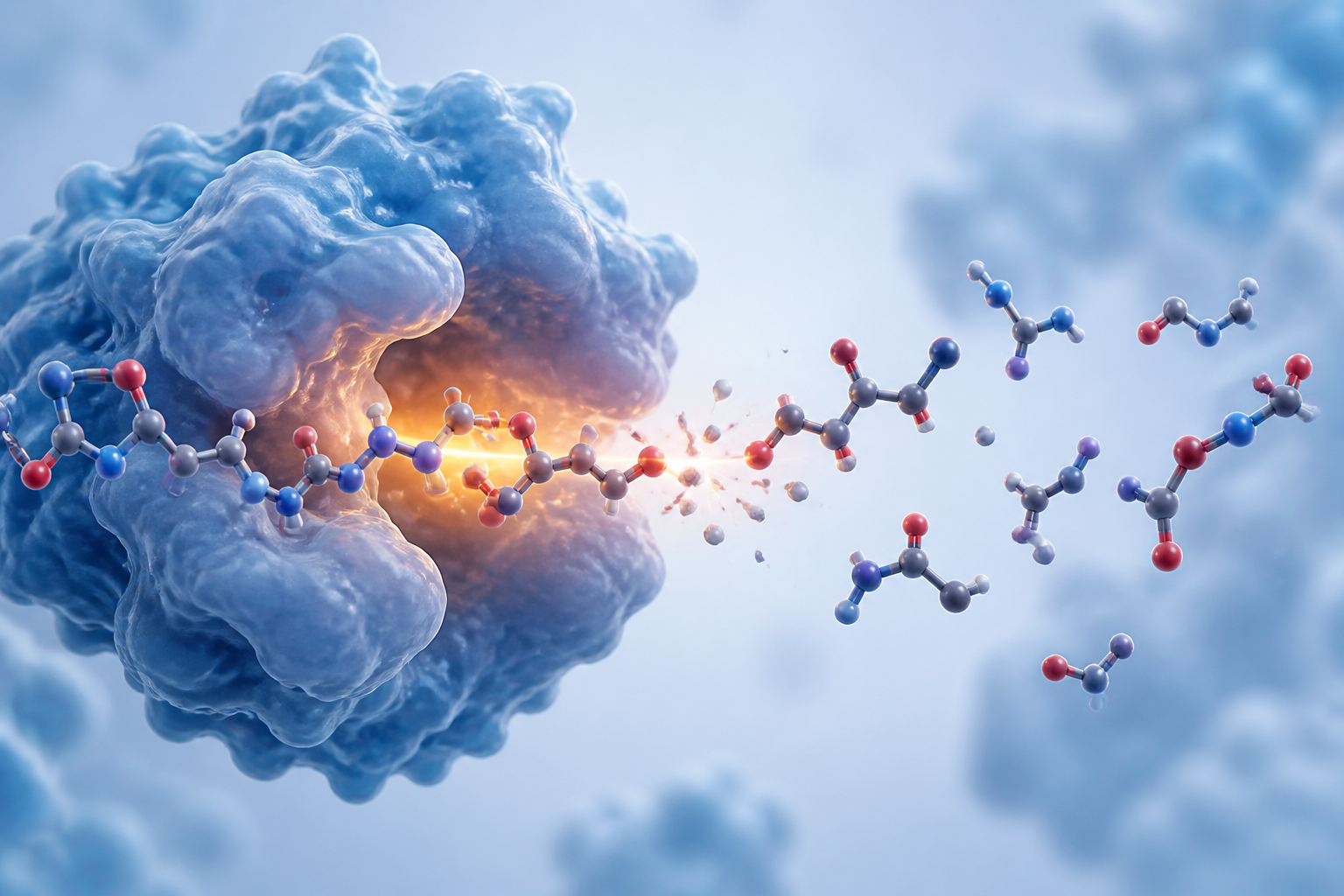
Hydrolysis is the cleavage of peptide bonds by water. Although peptide bonds are relatively stable under many laboratory conditions, hydrolysis can occur more rapidly at extreme pH, elevated temperature, or in the presence of catalytic residues or impurities. Acidic or alkaline conditions may promote backbone cleavage, particularly during prolonged storage in solution.
Hydrolysis leads to shorter peptide fragments that may retain, lose, or alter biological activity. In analytical chromatograms, hydrolytic fragments often appear as additional peaks with lower molecular mass than the parent peptide.
Oxidation
Oxidation is one of the most common degradation pathways for peptides containing methionine, cysteine, tryptophan, tyrosine, or histidine. Methionine can oxidize to methionine sulfoxide and, under stronger conditions, methionine sulfone. Cysteine can form disulfides, sulfenic, sulfinic, or sulfonic acid derivatives depending on the environment.
Oxidation may be accelerated by dissolved oxygen, light, trace metals, peroxides in solvents, repeated freeze-thaw cycles, and exposure to air-liquid interfaces. Even small oxidative changes can affect receptor binding, enzyme susceptibility, or immunogenic recognition, particularly when the modified residue is in a functional region of the peptide.
Deamidation
Deamidation is the conversion of asparagine or glutamine residues into acidic forms, most commonly aspartic acid, isoaspartic acid, or glutamic acid. Asparagine deamidation is generally faster than glutamine deamidation. The reaction is influenced by sequence context, pH, temperature, ionic strength, and buffer composition.
Asparagine followed by glycine, serine, or small flexible residues can be especially susceptible. Deamidation changes charge and may alter peptide conformation or biological recognition. Because the mass change is small, careful analytical method selection is required to distinguish deamidated species from the native peptide.
Disulfide Bond Scrambling and Reduction
Peptides containing cysteine residues may form intramolecular or intermolecular disulfide bonds. Correct disulfide pairing can be essential for structure and activity. Under certain pH or redox conditions, disulfide bonds can rearrange, producing mispaired isomers. Reducing agents, metal contamination, or inappropriate buffer systems can also alter disulfide status.
Disulfide scrambling can be difficult to detect by mass alone because isomers may have identical molecular weights. Chromatographic separation, peptide mapping, and functional assays are often needed to confirm correct disulfide connectivity.
Aggregation and Precipitation
Aggregation occurs when peptide molecules associate through hydrophobic interactions, electrostatic interactions, hydrogen bonding, or beta-sheet formation. Aggregates may be reversible or irreversible. Precipitation is commonly observed when a peptide exceeds its solubility limit or when solution conditions promote self-association.
Aggregation is not always a covalent degradation mechanism, but it can reduce the concentration of soluble active peptide and complicate dosing or assay interpretation. Hydrophobic peptides, amphipathic sequences, and peptides with high beta-sheet propensity are often more aggregation-prone.
Racemization and Isomerization
Racemization is the conversion of an L-amino acid residue to its D-form, while isomerization involves structural rearrangements such as formation of isoaspartate. These reactions can occur during synthesis, storage, or exposure to unfavorable pH and temperature conditions. Aspartic acid, asparagine, and certain activated intermediates may be particularly susceptible.
Although racemization may not substantially change molecular mass, it can profoundly influence biological function because stereochemistry is central to molecular recognition.
Factors That Influence Peptide Stability
Amino Acid Sequence
The peptide sequence is the primary determinant of stability. Residues susceptible to oxidation, deamidation, hydrolysis, or disulfide rearrangement create potential degradation sites. Sequence length, net charge, hydrophobicity, terminal residues, and secondary-structure tendencies also influence solubility and aggregation behavior.
For example, a peptide containing methionine and tryptophan may require more attention to oxidation control, while a peptide rich in hydrophobic residues may require careful solvent selection to maintain solubility.
pH and Buffer Composition
pH has a strong effect on many degradation pathways. Deamidation often increases near neutral to alkaline pH, while acid-catalyzed hydrolysis may increase under strongly acidic conditions. Buffers may also influence stability through ionic strength, catalytic effects, or interactions with peptide side chains.
Researchers should select buffers based on both assay compatibility and stability data. A buffer that is suitable for an immediate experiment may not be appropriate for long-term storage of a peptide solution.
Temperature
Temperature affects chemical reaction rates and physical stability. Higher temperatures generally increase degradation rates, while colder storage slows many reactions. Lyophilized peptides are commonly stored frozen or refrigerated, depending on stability data and supplier recommendations. Reconstituted peptides are usually less stable than dry material and often require aliquoting and frozen storage.
Repeated freeze-thaw cycles can accelerate degradation indirectly by promoting concentration gradients, pH shifts, air exposure, or aggregation. Preparing single-use aliquots is a practical way to reduce this risk.
Light, Oxygen, and Moisture
Light can promote photooxidation, particularly in peptides containing aromatic residues or sulfur-containing residues. Oxygen contributes to oxidative degradation, while moisture can accelerate hydrolysis and other reactions in lyophilized powders. Hygroscopic peptides may absorb water from the atmosphere if containers are repeatedly opened or left unsealed.
For sensitive materials, amber containers, inert gas headspace, desiccants, and minimized exposure time can help preserve integrity.
Concentration and Container Effects
Peptide concentration influences aggregation, adsorption, and oxidation. Very dilute peptide solutions may adsorb to plastic or glass surfaces, reducing apparent concentration. Highly concentrated solutions may aggregate or precipitate. Container material, headspace volume, closure integrity, and surface treatment can all affect stability and recovery.
How Peptide Degradation Is Detected
HPLC and UPLC Analysis
Reverse-phase HPLC and UPLC are widely used to monitor peptide purity and detect degradation products. New peaks, reduced parent peak area, peak broadening, or retention time shifts may indicate chemical modification, fragmentation, or aggregation. Gradient conditions, column chemistry, detection wavelength, and sample preparation all influence sensitivity.
Mass Spectrometry
Mass spectrometry helps identify degradation products by measuring mass changes. Oxidation of methionine typically adds 16 Da, while deamidation adds approximately 1 Da. Fragmentation patterns can provide sequence-level information. However, isomers and stereochemical changes may require specialized methods beyond intact mass measurement.
Functional and Binding Assays
Analytical purity does not always predict biological performance. A small modification at a critical residue may reduce activity, while a chromatographically detectable impurity may have little functional effect. Functional assays, receptor binding studies, enzymatic assays, or cell-based assays can provide complementary information when peptide activity is the critical quality attribute.
Practical Strategies to Minimize Peptide Degradation
Store Lyophilized Peptides Appropriately
Lyophilized peptides are generally more stable than peptides in solution. They should be stored tightly sealed, protected from moisture, and at the recommended temperature. Before opening a frozen vial, allow it to equilibrate to room temperature while still sealed to reduce condensation inside the container.
Use Suitable Solvents and Buffers
Solvent selection should consider peptide solubility and stability. Some peptides dissolve readily in aqueous buffer, while hydrophobic peptides may require small amounts of organic solvent or pH adjustment. Avoid unnecessary exposure to strong acid, strong base, oxidizing agents, or metal-contaminated reagents unless required by the protocol.
Prepare Aliquots
Once reconstituted, peptides should often be divided into aliquots sized for single or limited use. This reduces freeze-thaw cycles and limits repeated exposure to air and potential contaminants. Label aliquots with peptide identity, concentration, solvent, date of preparation, and storage conditions.
Control Oxidation and Contamination
Use high-purity solvents and buffers, avoid peroxide-containing reagents, and minimize exposure to light and air for oxidation-sensitive peptides. Metal chelators may be considered in some formulations, although compatibility with the peptide and assay must be confirmed. Sterile filtration or aseptic handling may be necessary for biological assays, but filtration can also cause adsorption losses for some peptides.
Conclusion
Peptide degradation is a multifactorial process involving chemical, enzymatic, and physical pathways. The most relevant degradation mechanisms depend on the peptide sequence, formulation, storage conditions, and intended use. By understanding common pathways such as hydrolysis, oxidation, deamidation, disulfide scrambling, and aggregation, laboratories can make more informed decisions about handling, storage, analytical testing, and experimental design. Careful control of temperature, moisture, pH, light exposure, and freeze-thaw history helps preserve peptide integrity and improves the reliability of peptide-based research.