Research laboratories are complex environments where scientific quality, personnel safety, regulatory expectations, and operational efficiency intersect. Whether the work involves basic research, translational studies, analytical testing, or product development, consistent laboratory practices are essential for producing reliable data and maintaining a safe workplace. Best practices are not limited to technical procedures; they also include documentation, training, equipment management, sample handling, data governance, and a culture of accountability.
This guide summarizes core research laboratory best practices that can support reproducibility, reduce preventable errors, and strengthen confidence in experimental outcomes. Individual laboratories should adapt these principles to their research area, institutional policies, biosafety level, chemical hazards, applicable regulations, and quality management requirements.
Establish a Strong Laboratory Safety Culture
Safety is a foundational requirement in every research laboratory. A strong safety culture is built through clear expectations, regular training, accessible procedures, and consistent reinforcement by laboratory leadership. Safety should not be treated as a separate administrative task; it should be integrated into experimental planning, procurement, waste handling, and daily work.
Conduct Risk Assessments Before Work Begins
Before initiating a new procedure, researchers should assess the hazards associated with chemicals, biological materials, sharps, radiation, compressed gases, cryogens, high temperatures, electrical equipment, and mechanical systems. A risk assessment should consider the likelihood and severity of harm, exposure routes, emergency response needs, and required controls. For higher-risk work, written approvals or institutional review may be necessary.
Control measures should follow the hierarchy of controls: elimination or substitution where possible, engineering controls such as fume hoods or biosafety cabinets, administrative controls such as standard operating procedures, and personal protective equipment as the final layer of protection.
Use Appropriate Personal Protective Equipment
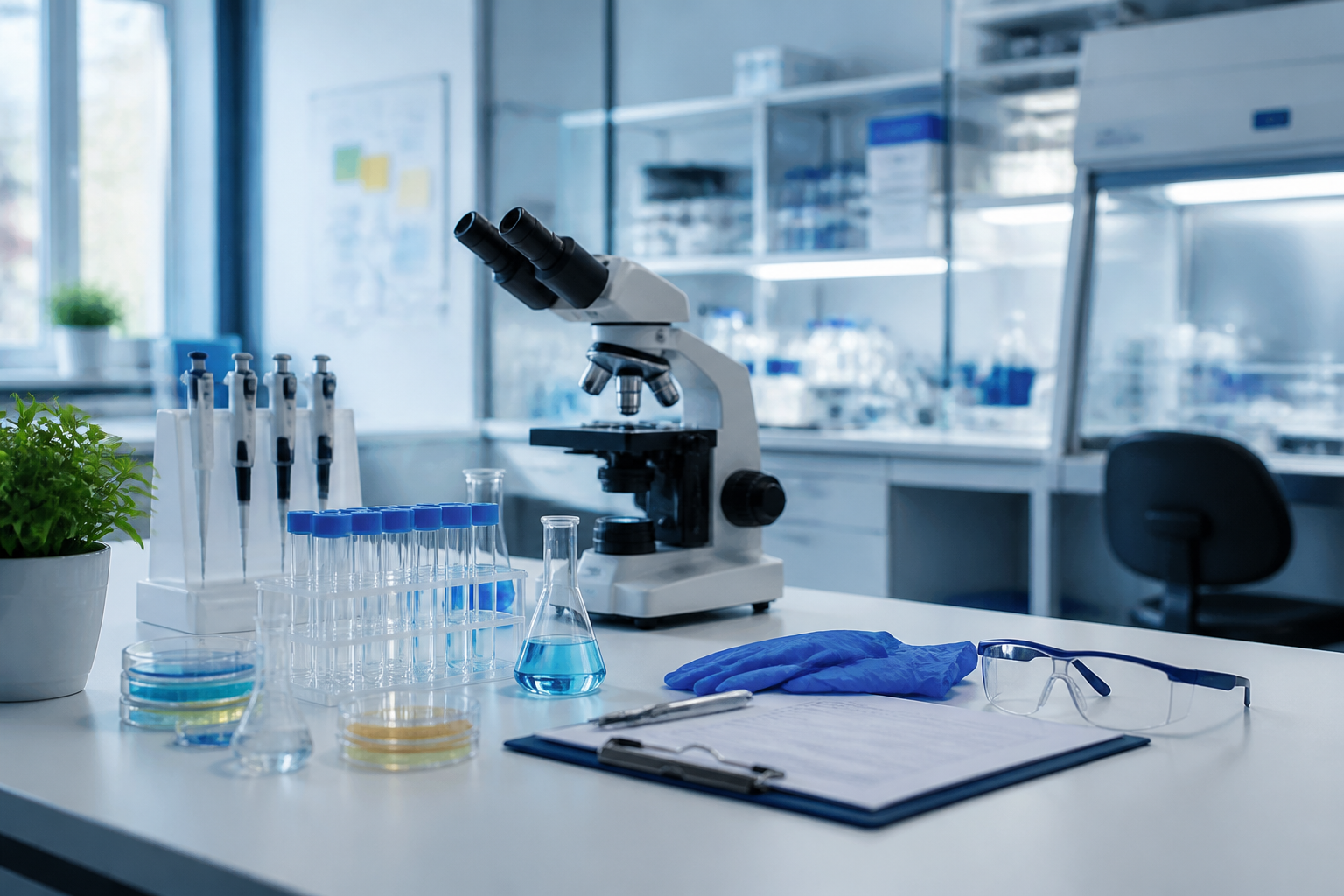
Personal protective equipment should match the hazards of the task. Common laboratory PPE includes lab coats, gloves, safety glasses, goggles, face shields, and respiratory protection when required by institutional policy. Gloves should be selected based on chemical compatibility and changed regularly to prevent contamination. Eye and face protection should be used when there is a risk of splashes, aerosols, flying particles, or exposure to UV radiation.
PPE is effective only when used correctly. Laboratories should train personnel on proper donning, doffing, storage, disposal, and limitations of protective equipment.
Maintain Clear Emergency Procedures
Emergency response procedures should be visible, current, and understood by all laboratory personnel. This includes spill response, fire response, exposure management, evacuation routes, emergency contacts, eyewash and safety shower locations, first aid resources, and incident reporting processes. Spill kits and other emergency supplies should be accessible and inspected at defined intervals.
Implement Robust Documentation Practices
Accurate documentation is central to scientific integrity. Laboratory records should allow another qualified person to understand what was done, when it was done, who performed the work, which materials were used, and what results were obtained. Good documentation supports reproducibility, troubleshooting, audits, intellectual property management, and publication readiness.
Use Standardized Laboratory Notebooks or Electronic Systems
Laboratories should define approved systems for recording experimental work, such as bound laboratory notebooks, electronic laboratory notebooks, or validated digital platforms. Entries should be timely, legible, complete, and attributable. Records should include objectives, protocols, deviations, reagent and sample identifiers, instrument settings, raw observations, calculations, results, and interpretation where appropriate.
For electronic systems, access control, audit trails, data backup, and version control are important. Institutions should ensure that electronic records comply with relevant data integrity and retention requirements.
Develop and Maintain Standard Operating Procedures
Standard operating procedures provide consistent instructions for routine and critical activities. SOPs should be written in clear language, reviewed by subject matter experts, approved before use, and updated when methods or requirements change. Each SOP should include its purpose, scope, responsibilities, required materials, safety considerations, step-by-step procedure, acceptance criteria where relevant, and references.
Personnel should be trained on SOPs before independently performing related tasks. Obsolete SOPs should be removed from active use to prevent confusion.
Record Deviations and Unexpected Events
Unexpected events are common in research, but they must be documented. Deviations may include temperature excursions, instrument errors, reagent substitutions, sample handling anomalies, missed protocol steps, or contamination events. Recording deviations supports transparent interpretation of results and helps identify recurring process weaknesses.
Promote Experimental Reproducibility
Reproducibility is a core principle of reliable research. While some biological and analytical variability is unavoidable, laboratories can reduce avoidable variation through careful study design, validated methods, appropriate controls, and transparent reporting.
Design Experiments with Appropriate Controls
Controls should be selected during experimental planning, not after data collection. Positive controls, negative controls, vehicle controls, blank samples, internal standards, reference materials, and replicate measurements may all be relevant depending on the method. Controls help distinguish true experimental effects from background noise, contamination, instrument drift, or procedural artifacts.
Researchers should also define inclusion and exclusion criteria in advance when feasible. For studies involving statistical analysis, sample size, randomization, blinding, and appropriate statistical methods should be considered early in the design process.
Validate and Verify Methods
Methods should be fit for purpose. In regulated or quality-controlled environments, formal validation may be required to demonstrate accuracy, precision, linearity, specificity, sensitivity, robustness, and range. In exploratory research, method verification may be less formal but should still confirm that the procedure performs adequately under local laboratory conditions.
When adopting published methods, laboratories should not assume that results will transfer directly. Differences in equipment, reagents, operator technique, environmental conditions, and sample matrix can affect performance.
Report Materials and Conditions Precisely
Reproducibility depends on precise reporting. Records should include reagent supplier and catalog number, lot number, preparation date, storage conditions, cell line passage number, antibody clone, instrument model, software version, incubation time, temperature, pH, and other variables that could affect outcomes. Small details often explain differences between experiments or between laboratories.
Manage Samples and Reagents Carefully
Sample and reagent management directly affects data quality. Mislabeling, degradation, contamination, and improper storage are common sources of laboratory error. A reliable inventory and tracking system reduces these risks and supports efficient laboratory operations.
Use Clear Labeling and Chain of Custody
Samples and reagents should be labeled with durable, unambiguous identifiers. Labels should remain readable under storage conditions such as freezing, refrigeration, exposure to solvents, or liquid nitrogen vapor. At minimum, labels should include an identifier, date, and relevant hazard or storage information when practical.
For critical samples, laboratories should maintain chain-of-custody records documenting collection, transfer, processing, storage, and disposal. This is especially important for clinical specimens, regulated studies, environmental testing, forensic work, and collaborative projects.
Control Storage Conditions
Storage conditions should match manufacturer recommendations, validated stability data, or established laboratory procedures. Refrigerators, freezers, incubators, and controlled-temperature rooms should be monitored, maintained, and equipped with alarms where necessary. Temperature-sensitive materials should not be repeatedly exposed to room temperature or freeze-thaw cycles unless stability has been demonstrated.
When aliquoting reagents or samples, researchers should use sterile or contamination-controlled techniques as appropriate and document preparation details. Expiration dates and retest dates should be visible and enforced.
Prevent Cross-Contamination
Cross-contamination can compromise results and may be difficult to detect. Laboratories should separate pre-amplification and post-amplification areas for molecular work, use aerosol-resistant pipette tips when appropriate, clean work surfaces regularly, and implement unidirectional workflows for sensitive assays. Cell culture laboratories should routinely monitor for mycoplasma and authenticate cell lines where relevant.
Maintain and Calibrate Laboratory Equipment
Laboratory equipment must perform consistently to generate trustworthy results. Preventive maintenance, calibration, qualification, and performance checks should be planned rather than reactive. Equipment failures can lead to lost samples, invalid data, safety incidents, and costly delays.
Create an Equipment Inventory
A complete inventory should include equipment name, model, serial number, location, responsible owner, service provider, calibration schedule, maintenance history, and status. Equipment that is out of service should be clearly labeled and prevented from use until repaired and released.
Schedule Calibration and Preventive Maintenance
Balances, pipettes, thermometers, centrifuges, incubators, freezers, spectrophotometers, chromatographs, and other instruments may require periodic calibration or performance verification. The frequency should be based on manufacturer recommendations, risk, usage, regulatory requirements, and historical performance. Calibration records should be retained and traceable to recognized standards when applicable.
Train Users on Proper Operation
Incorrect equipment use is a common source of error and damage. Users should be trained on startup, shutdown, cleaning, routine checks, acceptable operating ranges, software use, troubleshooting, and reporting of problems. Complex instruments may require authorization before independent use.
Strengthen Data Management and Integrity
Research data should be accurate, complete, secure, and retrievable. Data integrity principles apply across paper records, instrument files, spreadsheets, images, databases, and cloud-based systems. Poor data management can undermine otherwise well-designed experiments.
Follow ALCOA Principles
The ALCOA framework is widely used to describe data integrity expectations: data should be attributable, legible, contemporaneous, original, and accurate. Expanded versions also emphasize completeness, consistency, endurance, and availability. These principles help ensure that records reflect what actually occurred and can be reviewed later.
Control Access and File Versions
Laboratories should define where data are stored, who has access, how files are named, and how versions are controlled. Shared drives, laboratory information management systems, and electronic notebooks can reduce fragmentation when implemented with appropriate permissions and backup procedures. Spreadsheets used for calculations should be protected from accidental changes and reviewed when they affect critical results.
Back Up Data Regularly
Data loss can occur through hardware failure, user error, malware, or accidental deletion. Laboratories should use institutionally approved backup systems and avoid relying solely on local instrument computers or personal devices. Backup restoration should be periodically verified for critical systems.
Train and Competently Supervise Laboratory Personnel
Laboratory competence develops through structured training, supervised practice, and ongoing evaluation. New personnel should not be expected to rely on informal instruction alone, particularly for safety-critical or technically complex procedures.
Define Training Requirements
Training programs should cover general laboratory safety, chemical hygiene, biosafety where applicable, waste management, emergency response, equipment use, documentation expectations, and role-specific procedures. Institutions should maintain training records, including completion dates and retraining intervals.
Assess Competency
Training completion does not always demonstrate competence. For critical methods, supervisors should assess whether personnel can perform the procedure correctly and interpret expected outcomes. Competency assessment may include observation, proficiency testing, replicate analysis, written evaluation, or review of documentation.
Encourage Communication and Reporting
Personnel should feel comfortable reporting errors, near misses, safety concerns, and unexpected findings without fear of inappropriate blame. A constructive reporting culture allows laboratories to address root causes and improve processes. Regular group meetings, method reviews, and safety discussions support shared learning.
Control Laboratory Cleanliness and Workflow
Orderly laboratories are safer and more efficient. Good housekeeping reduces the risk of contamination, misplaced materials, accidental exposure, and workflow interruptions.
Maintain Organized Work Areas
Bench space should be kept clear of unnecessary materials. Chemicals and biological materials should be stored in designated locations, not accumulated at workstations. Walkways, emergency equipment, eyewash stations, fume hoods, and electrical panels should remain unobstructed.
Clean and Decontaminate Surfaces
Cleaning and decontamination procedures should be appropriate for the work performed. Disinfectants should be selected based on target organisms, contact time, compatibility, and safety considerations. Chemical residues should be removed using suitable methods. Cleaning schedules should be documented for shared spaces and critical areas.
Separate Incompatible Activities
Workflows should minimize conflict between incompatible activities. For example, sample preparation, reagent preparation, high-copy nucleic acid handling, and waste processing may need spatial or temporal separation. Clean-to-dirty workflow principles can reduce contamination risk.
Manage Chemical, Biological, and General Waste Responsibly
Waste management must comply with institutional procedures and applicable local, regional, and national regulations. Improper waste handling can create safety hazards, environmental harm, and regulatory noncompliance.
Segregate Waste at the Point of Generation
Waste should be segregated into appropriate categories, such as chemical waste, biohazardous waste, sharps, glass, radioactive waste, and general laboratory trash. Mixing incompatible wastes can create hazardous reactions or increase disposal complexity. Containers should be compatible, closed when not in use, and labeled clearly.
Do Not Overfill Containers
Sharps containers, solvent waste bottles, and biohazard bags should be replaced before reaching unsafe fill levels. Overfilled containers increase the risk of punctures, spills, and exposure. Secondary containment should be used for liquid waste when required or when spill risk is significant.
Document Waste Handling Where Required
Some waste streams require accumulation logs, pickup records, manifests, or treatment documentation. Laboratories should understand which records are required and maintain them in accessible locations.
Support Continuous Improvement
Laboratory best practices should evolve with new methods, lessons learned, regulatory changes, and advances in instrumentation. Continuous improvement helps laboratories identify inefficiencies and reduce recurring errors.
Review Incidents and Near Misses
Incidents and near misses should be investigated to identify contributing factors, not simply individual mistakes. Root causes may include unclear procedures, inadequate training, poor equipment design, insufficient labeling, workload pressure, or environmental constraints. Corrective actions should be practical, assigned to responsible persons, and followed to completion.
Perform Periodic Internal Reviews
Routine internal reviews can assess documentation quality, reagent storage, equipment status, safety compliance, inventory control, and data management. Findings should be documented and used to guide improvement rather than treated as punitive exercises.
Update Practices as Work Changes
New assays, materials, collaborators, or equipment may introduce new risks and requirements. Laboratories should review procedures whenever significant changes occur and ensure personnel are informed before implementation.
Conclusion
Effective research laboratory practices combine safety, documentation, reproducibility, equipment reliability, sample control, data integrity, training, and continuous improvement. These elements support high-quality research and help laboratories generate results that are traceable, interpretable, and reliable. By applying structured and well-documented practices, laboratories can reduce preventable errors, protect personnel, and strengthen confidence in scientific outcomes.