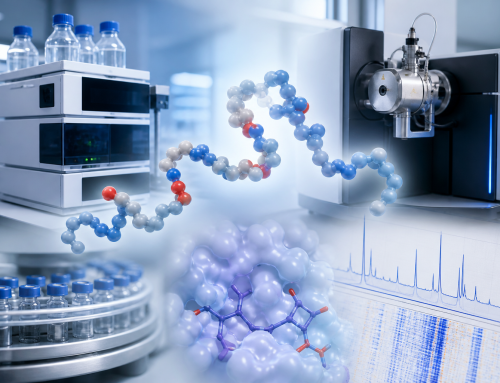
Synthetic peptides are short chains of amino acids produced by chemical or enzymatic methods rather than isolated directly from biological sources. They are widely used in life science research, analytical method development, immunology, structural biology, diagnostics development, and pharmaceutical discovery. Because peptide sequence, length, purity, and modifications can be specified in detail, synthetic peptides provide researchers with controlled materials for studying protein function, molecular recognition, and biological signaling.
Although peptides are often discussed alongside proteins, they are typically smaller and less structurally complex. Their manageable size makes them suitable for custom synthesis, systematic sequence variation, and targeted chemical modification. At the same time, peptides can be chemically and biologically sensitive, so appropriate design, quality control, and handling are essential for reliable experimental results.
What Are Synthetic Peptides?
A peptide is a molecule composed of amino acids linked by peptide bonds. In biological systems, peptides can act as hormones, neurotransmitters, antimicrobial agents, enzyme substrates, receptor ligands, and fragments of larger proteins. Synthetic peptides reproduce natural sequences or introduce designed changes for specific research purposes.
Peptides, Polypeptides, and Proteins
The distinction between peptides and proteins is partly based on size and function. Peptides usually contain a small to moderate number of amino acids, often from 2 to around 50 residues, although definitions vary. Proteins are generally longer chains that fold into stable three-dimensional structures and may contain multiple domains or subunits. Polypeptide is a broader term that can describe longer amino acid chains, including those that approach protein length.
In practical laboratory use, the term synthetic peptide commonly refers to a chemically synthesized sequence that can be purified, characterized, and supplied in milligram to gram quantities. These materials may be linear or cyclic, unmodified or modified, and intended for analytical, biochemical, cellular, or immunological studies.
Natural Versus Designed Sequences
Some synthetic peptides exactly match regions of naturally occurring proteins. These are useful for epitope mapping, antibody production, enzyme assays, and receptor binding studies. Other peptides are designed to test hypotheses about sequence-function relationships. Researchers may substitute amino acids, truncate termini, add labels, introduce non-natural residues, or stabilize conformations to evaluate how structural features influence activity or recognition.
How Synthetic Peptides Are Made
The most common approach for laboratory-scale peptide production is solid-phase peptide synthesis. Liquid-phase peptide synthesis and recombinant expression are also used in certain situations, particularly for specialized or longer sequences. The choice of method depends on peptide length, complexity, required purity, scale, and modifications.
Solid-Phase Peptide Synthesis
Solid-phase peptide synthesis, often abbreviated SPPS, is a stepwise chemical method in which the growing peptide chain is assembled on an insoluble resin. The process begins with the C-terminal amino acid attached to the solid support. Protected amino acids are then added one at a time, typically from the C-terminus toward the N-terminus.
Each synthesis cycle usually includes three main steps: removal of a temporary protecting group, coupling of the next protected amino acid, and washing to remove excess reagents and by-products. Side-chain protecting groups prevent unwanted reactions during assembly. After the full sequence is completed, the peptide is cleaved from the resin and side-chain protecting groups are removed. The crude product is then purified and analyzed.
SPPS is well suited for many peptides because excess reagents can be washed away after each cycle, allowing relatively efficient assembly. However, synthesis difficulty increases with peptide length, hydrophobicity, aggregation tendency, and sequence motifs that reduce coupling efficiency.
Fmoc and Boc Chemistry
Two major protection strategies are used in peptide synthesis: Fmoc and Boc chemistry. Fmoc chemistry uses a base-labile protecting group for the N-terminus and is common in modern peptide synthesis because final cleavage can be performed under acidic conditions that are generally compatible with many side-chain protections. Boc chemistry uses acid-labile N-terminal protection and typically requires stronger acid for final cleavage.
The selection of chemistry affects resin choice, side-chain protection, cleavage conditions, and compatibility with sensitive modifications. For many routine research peptides, Fmoc-based SPPS is the standard method, but specialized sequences may require modified protocols.
Purification and Analytical Characterization
After synthesis and cleavage, the crude peptide mixture may contain the desired product, deletion sequences, truncated products, side products, salts, protecting group remnants, and other impurities. Purification is commonly performed using preparative reversed-phase high-performance liquid chromatography. The purified fractions are collected, analyzed, combined when appropriate, and lyophilized to produce a dry peptide powder.
Analytical characterization usually includes mass spectrometry to confirm molecular weight and analytical HPLC or UPLC to estimate purity. Additional methods may be used when required, such as amino acid analysis, elemental analysis, peptide content determination, circular dichroism, or nuclear magnetic resonance. The appropriate characterization package depends on the intended application and regulatory context.
Key Specifications for Ordering or Evaluating Peptides
Clear specifications are important because the same peptide sequence can be supplied in different forms that affect experimental performance. Researchers should define not only the amino acid sequence but also purity, quantity, modifications, counterion, solubility expectations, and analytical documentation.
Sequence and Length
The peptide sequence should be provided from N-terminus to C-terminus using one-letter or three-letter amino acid notation. Ambiguities in termini, stereochemistry, disulfide bonds, and non-standard residues should be resolved before synthesis. Longer peptides are generally more difficult to synthesize and purify, and sequences above 50 residues may require special evaluation.
Some motifs can create synthetic challenges. Highly hydrophobic stretches, multiple consecutive difficult residues, repeated sequences, oxidation-prone residues, and sequences that aggregate during synthesis or purification may reduce yield or purity. In these cases, sequence redesign, solubilizing tags, altered protecting groups, or segment ligation strategies may be considered.
Purity Grade
Peptide purity is commonly reported as the percentage of the main peak by analytical HPLC at a specified wavelength. Typical research grades may range from crude material to greater than 95 percent purity. The required purity depends on the application. Screening assays, immunogen preparation, and preliminary binding studies may tolerate lower purity in some contexts, whereas quantitative biochemical assays, structural studies, and cell-based functional assays often require higher purity.
It is important to distinguish chromatographic purity from peptide content. A lyophilized peptide powder may include water, salts, and counterions, so the actual peptide content by weight can be lower than the net mass. For accurate molar concentration, peptide content or amino acid analysis may be necessary, particularly for quantitative assays.
Terminal Modifications
Common terminal modifications include N-terminal acetylation and C-terminal amidation. These modifications can mimic the charge state of a peptide within a full-length protein or improve stability against exopeptidases. They can also influence solubility, conformation, receptor interaction, and biological activity. Whether terminal modifications are appropriate should be determined by the experimental objective.
Labels and Functional Groups
Synthetic peptides can be modified with fluorescent dyes, biotin, affinity tags, linkers, lipid groups, phosphorylation, methylation, glycosylation, or reactive handles. These modifications allow detection, immobilization, conjugation, or investigation of post-translational regulation. The placement of a label matters because it may interfere with binding or activity. When possible, researchers should consider whether an N-terminal, C-terminal, side-chain, or linker-spaced modification best preserves the desired function.
Common Types of Synthetic Peptides
Linear Peptides
Linear peptides have a continuous chain with free or modified termini. They are commonly used as antigens, enzyme substrates, receptor ligands, standards, and inhibitors. Linear peptides are generally simpler to synthesize than cyclic or heavily modified peptides, although sequence composition still strongly affects difficulty.
Cyclic Peptides
Cyclic peptides contain a covalent linkage that constrains the molecule. Cyclization can occur through disulfide bonds, head-to-tail amide bonds, side-chain-to-side-chain bonds, or other chemistries. Conformational constraint may improve resistance to proteolysis or stabilize a biologically relevant structure. However, cyclic peptide synthesis requires careful design and analytical confirmation because incomplete cyclization or incorrect disulfide pairing can complicate purification.
Peptide Libraries
Peptide libraries contain collections of related sequences used for screening binding, activity, or specificity. Examples include alanine scanning libraries, truncation libraries, positional scanning libraries, overlapping peptide libraries, and randomized libraries. Such libraries can help identify critical residues, map epitopes, or characterize enzyme substrate preferences.
Applications in Research and Development
Antibody Production and Epitope Mapping
Synthetic peptides are frequently used as immunogens or screening antigens for antibody development. A selected peptide sequence from a target protein may be conjugated to a carrier protein to improve immunogenicity. Peptides are also used to map antibody epitopes by testing binding to overlapping or mutated sequences. Proper antigen selection is essential, including consideration of surface exposure, uniqueness, conservation, and post-translational modifications.
Enzyme Assays and Substrate Studies
Peptides can serve as substrates for kinases, phosphatases, proteases, methyltransferases, acetyltransferases, and other enzymes. Modified or labeled peptides can enable quantitative detection by fluorescence, absorbance, mass spectrometry, or affinity capture. Sequence variants are often used to determine specificity and kinetic parameters.
Cell Signaling and Receptor Binding
Many signaling molecules are peptides or contain peptide recognition motifs. Synthetic peptides can be used to study receptor activation, antagonist behavior, protein-protein interactions, and intracellular signaling pathways. For cellular experiments, peptide purity, stability, aggregation, and delivery method should be considered carefully.
Analytical Standards
Peptides are used as reference materials in mass spectrometry, chromatography, and bioanalytical method development. Isotopically labeled peptides are particularly useful as internal standards for targeted proteomics because they can closely match the behavior of endogenous peptide analytes while remaining distinguishable by mass.
Solubility, Storage, and Handling
Peptide handling can influence reproducibility. Many peptides are supplied lyophilized and should be stored according to the stability profile of the sequence and modifications. In general, dry peptides are often stored at low temperature, protected from moisture and light when appropriate. Repeated freeze-thaw cycles of peptide solutions should be minimized by preparing aliquots.
Solubility Considerations
Peptide solubility depends on sequence charge, hydrophobicity, length, modifications, counterion, and pH. Acidic peptides may dissolve better in basic buffers, while basic peptides may dissolve better in dilute acid. Hydrophobic peptides may require organic solvents such as dimethyl sulfoxide, acetonitrile, or alcohols before dilution into aqueous buffer. Compatibility with downstream assays should always be verified, especially for cell-based systems where solvent concentration can affect results.
Stability Factors
Some amino acids and modifications are susceptible to oxidation, deamidation, hydrolysis, or photodegradation. Methionine, cysteine, tryptophan, and certain phosphorylated or fluorescently labeled peptides may require additional care. Buffers, pH, temperature, oxygen exposure, and metal ions can affect stability. When stability is uncertain, small-scale tests and time-course analytical measurements can help establish appropriate conditions.
Quality Control and Documentation
For research use, a typical peptide documentation package includes the stated sequence, molecular weight, purity result, mass spectrum, and HPLC chromatogram. More demanding applications may require additional identity, content, residual solvent, endotoxin, bioburden, or sterility testing. Institutions should align documentation requirements with intended use, risk level, and internal quality systems.
Interpreting HPLC and Mass Spectrometry Data
Analytical HPLC provides an estimate of chromatographic purity under the conditions used. A single main peak supports purity but does not alone prove identity. Mass spectrometry confirms that the observed mass is consistent with the expected peptide. Together, these methods provide strong evidence for identity and purity, although they may not fully characterize isomers, disulfide connectivity, or all minor impurities.
Research Use Versus Clinical or GMP Use
Peptides intended for exploratory research are typically produced under research-grade quality systems. Peptides for clinical manufacturing, diagnostics, or therapeutic use may require good manufacturing practice controls, validated methods, traceability, stability programs, and more extensive release testing. Researchers should define the required quality level early, especially when a peptide may transition from discovery work to regulated development.
Design Considerations for Reliable Results
Good peptide design begins with the experimental question. For antibody generation, the goal may be immunogenicity and specificity. For enzyme assays, the goal may be a substrate sequence with measurable turnover. For receptor studies, native conformation and terminal charge may be important. For analytical standards, accurate mass, isotopic labeling, and quantification are central concerns.
Researchers should consider including appropriate controls, such as scrambled peptides, inactive mutants, unlabeled analogs, or known positive and negative sequences. When studying biological activity, it is also important to assess aggregation, cytotoxicity, solvent effects, and batch-to-batch consistency. Small design choices can meaningfully affect interpretation.
Conclusion
Synthetic peptides are versatile research tools that allow precise control over amino acid sequence, chemical modification, and analytical quality. Understanding how peptides are synthesized, purified, characterized, and handled helps researchers select appropriate specifications and design more reliable experiments. By considering sequence properties, purity requirements, modifications, solubility, stability, and documentation needs, laboratories can use synthetic peptides effectively across a wide range of scientific applications.