Peptides are widely used in biochemical research, assay development, drug discovery, structural biology, immunology, and analytical method development. Because many peptides are chemically and physically sensitive, appropriate storage is essential for preserving identity, purity, solubility, and biological activity over the intended period of use. Storage conditions should be selected based on peptide sequence, modification state, formulation, reconstitution solvent, and the requirements of the downstream application.
This article summarizes practical, laboratory-focused best practices for storing lyophilized and reconstituted peptides. It is intended for researchers, laboratory managers, and scientific purchasers who need to establish robust handling procedures and minimize avoidable degradation.
Why Peptide Storage Conditions Matter
Peptides are generally more stable as dry, lyophilized solids than in solution, but they are still vulnerable to environmental stressors. Common degradation pathways include hydrolysis, oxidation, deamidation, disulfide scrambling, aggregation, adsorption to container surfaces, and microbial contamination after reconstitution. The likelihood of these processes depends on the amino acid sequence, terminal modifications, counterion or salt form, purity, residual moisture, and storage environment.
For example, methionine, cysteine, and tryptophan residues can be susceptible to oxidation. Asparagine and glutamine may undergo deamidation, especially at unfavorable pH or elevated temperature. Peptides containing multiple hydrophobic residues may aggregate in aqueous media. Cysteine-containing peptides can form disulfides or undergo disulfide exchange if not handled carefully. These changes may reduce assay reproducibility, alter potency, or introduce impurities that interfere with analytical interpretation.
A well-defined storage plan helps maintain consistency between experiments, especially when a peptide is used over weeks or months. It also supports traceability, inventory control, and compliance with institutional quality systems.
Store Lyophilized Peptides Under Dry, Cold, and Protected Conditions
Recommended temperature for dry peptides
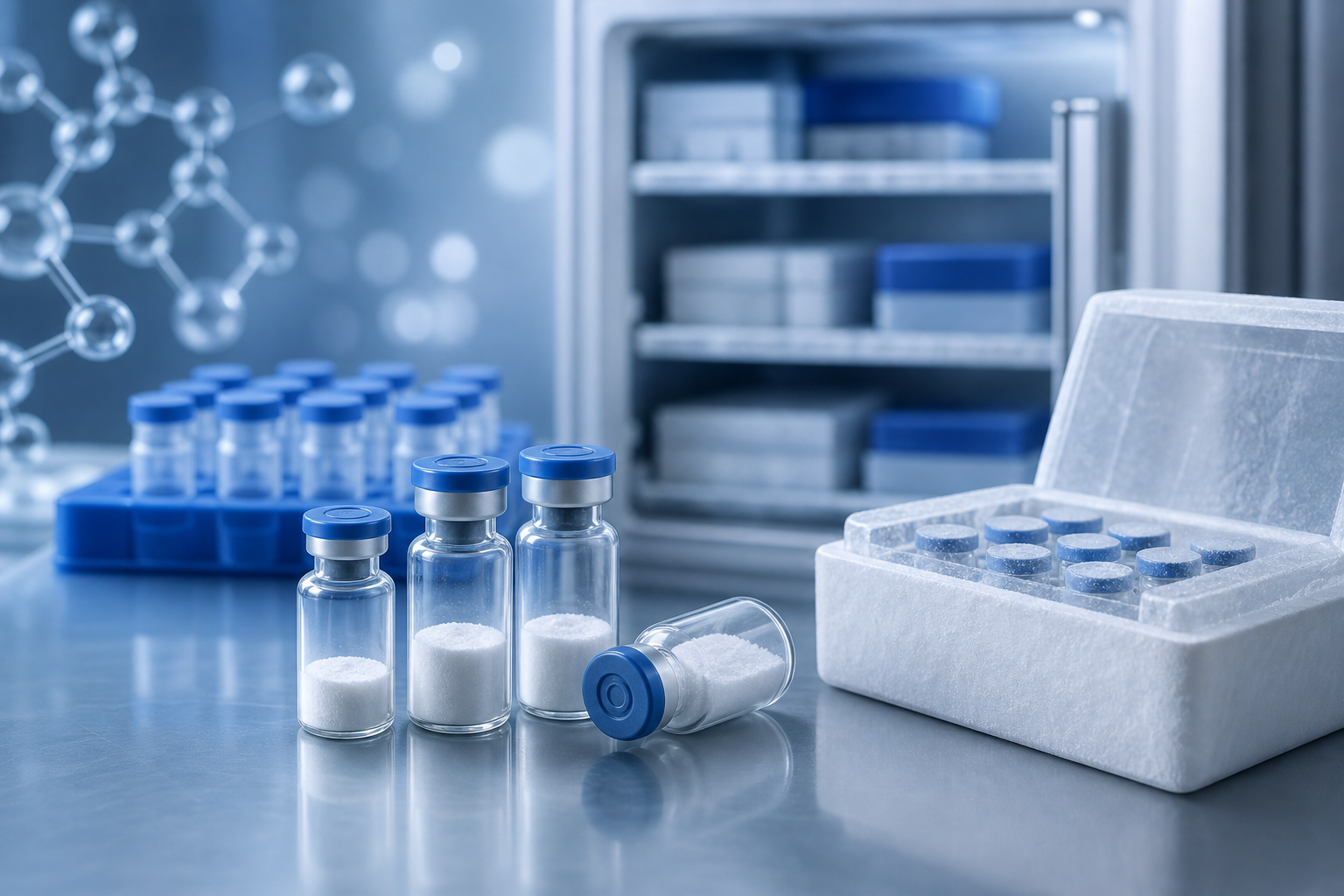
Most lyophilized peptides should be stored at low temperature in a tightly sealed container. For short-term storage, many dry peptides are stable at 2 to 8 °C when protected from moisture and light. For longer-term storage, -20 °C is commonly recommended. Some particularly labile peptides, such as certain oxidation-sensitive, cyclic, or modified sequences, may benefit from storage at -80 °C, depending on the supplier documentation or internal stability data.
Room-temperature storage should generally be limited to brief handling periods unless the peptide has been specifically demonstrated to be stable under those conditions. Elevated temperatures accelerate many chemical degradation pathways and can increase the risk of moisture uptake.
Control moisture exposure
Moisture is one of the most important factors affecting peptide stability in the lyophilized state. Even small amounts of water can increase molecular mobility and promote hydrolysis, deamidation, or aggregation. Vials should remain tightly sealed, and desiccant should be used when appropriate. If a peptide is supplied in a sealed vial or pouch with desiccant, keep it in the original packaging until use whenever possible.
Before opening a vial removed from cold storage, allow it to equilibrate to room temperature while still sealed. This step helps prevent condensation from forming on the peptide powder. Condensation can introduce localized moisture and compromise stability. The equilibration time will vary with vial size and storage temperature, but 30 to 60 minutes is often sufficient for small laboratory vials.
Protect light-sensitive peptides
Some peptides, particularly those containing fluorescent labels, photosensitive protecting groups, certain chromophores, or oxidation-sensitive residues, should be protected from light. Store these materials in amber vials or secondary light-protective packaging. Minimize exposure to laboratory lighting during weighing, dissolution, and aliquoting.
Reconstituted Peptides Require More Stringent Handling
Use solutions promptly when possible
Peptides are typically less stable in solution than as dry solids. Once reconstituted, degradation reactions often proceed more readily because water, oxygen, pH effects, and trace contaminants can interact with the peptide. For this reason, reconstituted peptide solutions should be used as soon as practical. If immediate use is not possible, prepare single-use aliquots and store them under validated or recommended conditions.
As a general practice, short-term storage of peptide solutions may be performed at 2 to 8 °C for hours to several days, depending on the peptide and solvent system. Longer-term storage usually requires freezing at -20 °C or -80 °C. However, not all peptides tolerate freezing equally well, and repeated freeze-thaw cycles should be avoided.
Avoid repeated freeze-thaw cycles
Freeze-thaw cycling can accelerate aggregation, precipitation, oxidation, and adsorption losses. It can also lead to concentration variability if material precipitates or adheres to the vial wall. The most reliable approach is to divide the reconstituted peptide into small aliquots sized for a single experiment or a defined short use period.
When thawing aliquots, thaw gently and mix by careful inversion or low-speed pipetting. Avoid vigorous vortexing unless the peptide is known to tolerate it, as shear and foaming may contribute to aggregation for some sequences. Once thawed, keep the aliquot cold if compatible with the application and discard unused material according to laboratory policy unless stability has been established.
Consider oxygen exposure
Oxygen can contribute to oxidation of sensitive residues, especially methionine, cysteine, and tryptophan. For oxidation-sensitive peptides, consider using degassed solvents, minimizing headspace, and storing aliquots in tightly sealed containers. In some workflows, inert gas overlay may be appropriate, although this should be evaluated based on the peptide and experimental requirements.
Select an Appropriate Reconstitution Solvent
Start with peptide solubility and application compatibility
The best storage condition for a peptide solution begins with choosing an appropriate reconstitution solvent. Solubility is influenced by net charge, hydrophobicity, length, secondary structure tendency, and modifications. Many peptides dissolve readily in sterile water or aqueous buffer. Highly hydrophobic peptides may require an organic cosolvent such as dimethyl sulfoxide, acetonitrile, or a small amount of alcohol before dilution into the final assay buffer. Acidic or basic peptides may dissolve better with pH adjustment.
The reconstitution solvent should also be compatible with the downstream method. A solvent that improves solubility may interfere with cell-based assays, enzyme reactions, mass spectrometry, chromatography, or binding studies. Keep final solvent concentrations within validated limits for the assay system.
Manage pH carefully
pH strongly affects peptide stability and solubility. Extreme pH can accelerate hydrolysis, deamidation, racemization, or other chemical changes. However, some peptides require mildly acidic or basic conditions for dissolution. If pH adjustment is needed, use the mildest effective condition and document it in the storage record.
Buffers should be selected with attention to stability and analytical compatibility. Phosphate, acetate, citrate, Tris, and HEPES buffers are common, but each has limitations depending on temperature, pH range, metal interactions, and downstream detection methods. Avoid introducing unnecessary salts or additives unless their effects are understood.
Use sterile technique when biological assays are involved
For peptides used in cell culture, immunology, or other biological assays, microbial contamination can affect results even if the peptide itself remains chemically intact. Reconstitute using sterile solvents, sterile tubes, and aseptic technique. Where suitable, filtration through a low-protein-binding sterile filter may reduce contamination risk. However, filtration can cause peptide loss through adsorption, particularly for low-concentration or hydrophobic peptides, so recovery should be evaluated when quantitative accuracy is important.
Aliquoting and Container Selection
Prepare practical aliquot sizes
Aliquoting is one of the most effective ways to preserve peptide quality after reconstitution. Select aliquot volumes based on actual experimental use, expected concentration, and acceptable thaw frequency. For high-value or low-volume peptides, consider preparing concentrated stock aliquots and diluting freshly into working solutions immediately before use.
During aliquoting, work efficiently and keep solutions on ice if appropriate. Use calibrated pipettes and low-retention tips for small volumes. Record the concentration, solvent, date of reconstitution, operator, and storage location.
Use suitable vials and tubes
Container material can influence peptide recovery. Some peptides adsorb to glass or plastic surfaces, especially at low concentrations. Low-binding polypropylene tubes are often suitable for many peptide solutions, while glass vials may be preferred for certain organic solvents. Ensure that the container is chemically compatible with the solvent and stable at the intended storage temperature.
Seal integrity is also important. Poorly sealed tubes can allow evaporation, moisture ingress, or contamination. For long-term frozen storage, use vials designed for low-temperature conditions and avoid overfilling, as liquids expand during freezing.
Special Considerations for Sensitive Peptide Classes
Cysteine-containing and disulfide-rich peptides
Peptides containing free cysteine residues may oxidize to form disulfides, while disulfide-rich peptides may undergo disulfide exchange under inappropriate conditions. Store these peptides under conditions that minimize oxidation and pH-driven rearrangement. If the biological activity depends on a specific disulfide pattern, analytical verification by HPLC, LC-MS, or functional assay may be necessary after storage.
Modified, labeled, and conjugated peptides
Peptides with fluorescent labels, biotin, lipid groups, phosphorylation, glycosylation, or other modifications may have storage requirements driven by both the peptide sequence and the modification. Fluorophore-labeled peptides often require light protection. Lipidated peptides may be more prone to aggregation or adsorption. Phosphopeptides may require careful pH and buffer selection. Always review the certificate of analysis, product sheet, or internal development data for modification-specific recommendations.
Very dilute peptide solutions
Dilute peptide solutions can be vulnerable to adsorption losses and concentration drift. If possible, store peptides as concentrated stocks and prepare dilute working solutions fresh. When low-concentration storage is unavoidable, low-binding containers and validated carrier systems may improve recovery. Any carrier protein, surfactant, or additive should be compatible with the analytical or biological assay.
Documentation, Labeling, and Inventory Control
Label all materials clearly
Good labeling reduces the risk of misidentification and supports reproducibility. Labels should include peptide name or identifier, lot number, concentration, solvent or buffer, date received, date reconstituted, storage temperature, and operator initials where appropriate. For aliquots, include enough information to trace each tube back to the original material and preparation record.
Maintain a storage log
A storage log or electronic inventory system should track freeze-thaw events, aliquot use, location, and expiration or review dates. This is particularly important for shared laboratories and regulated or quality-controlled environments. If a peptide is critical to a long-term study, consider assigning a maximum number of permitted freeze-thaw events and a defined period of use after reconstitution.
Review stability periodically
Published or supplier-provided stability information may not fully represent the conditions in a specific laboratory. When a peptide is central to a program, stability should be confirmed under actual storage and use conditions. Analytical methods such as HPLC, LC-MS, capillary electrophoresis, or activity assays can help detect degradation, aggregation, or potency loss over time.
Shipping and Receiving Practices
Inspect shipments promptly
Peptide storage begins at receipt. Upon arrival, inspect packaging, verify the identity and lot number, confirm that temperature-sensitive materials were shipped appropriately, and record the receipt date. If the peptide arrives with a certificate of analysis or handling instructions, store these documents with the inventory record.
Lyophilized peptides may be shipped at ambient temperature when stability supports it, but they should be transferred to the recommended storage condition promptly. Reconstituted or highly labile materials may require cold packs, dry ice, or other controlled shipping conditions. If shipping conditions were compromised, quarantine the material and assess suitability before use.
Common Storage Mistakes to Avoid
- Opening cold vials immediately: This can allow condensation to form on the powder. Let sealed vials equilibrate to room temperature before opening.
- Storing reconstituted peptide in one large stock: This increases freeze-thaw exposure. Prepare single-use aliquots instead.
- Using an incompatible solvent: Solvent choice can affect solubility, stability, and assay performance.
- Leaving peptides at room temperature unnecessarily: Minimize time outside recommended storage conditions.
- Failing to protect light-sensitive materials: Use amber containers or secondary packaging when appropriate.
- Neglecting documentation: Incomplete records make it difficult to interpret variability or investigate unexpected results.
Conclusion
Effective peptide storage is based on controlling temperature, moisture, light, oxygen exposure, solvent conditions, and handling frequency. In general, lyophilized peptides should be stored dry, sealed, and cold, while reconstituted peptides should be aliquoted and used promptly or frozen under appropriate conditions. Because stability is sequence- and formulation-dependent, laboratories should combine supplier recommendations with internal documentation and, when necessary, analytical verification. Consistent storage practices help preserve peptide quality and improve the reliability of experimental results.