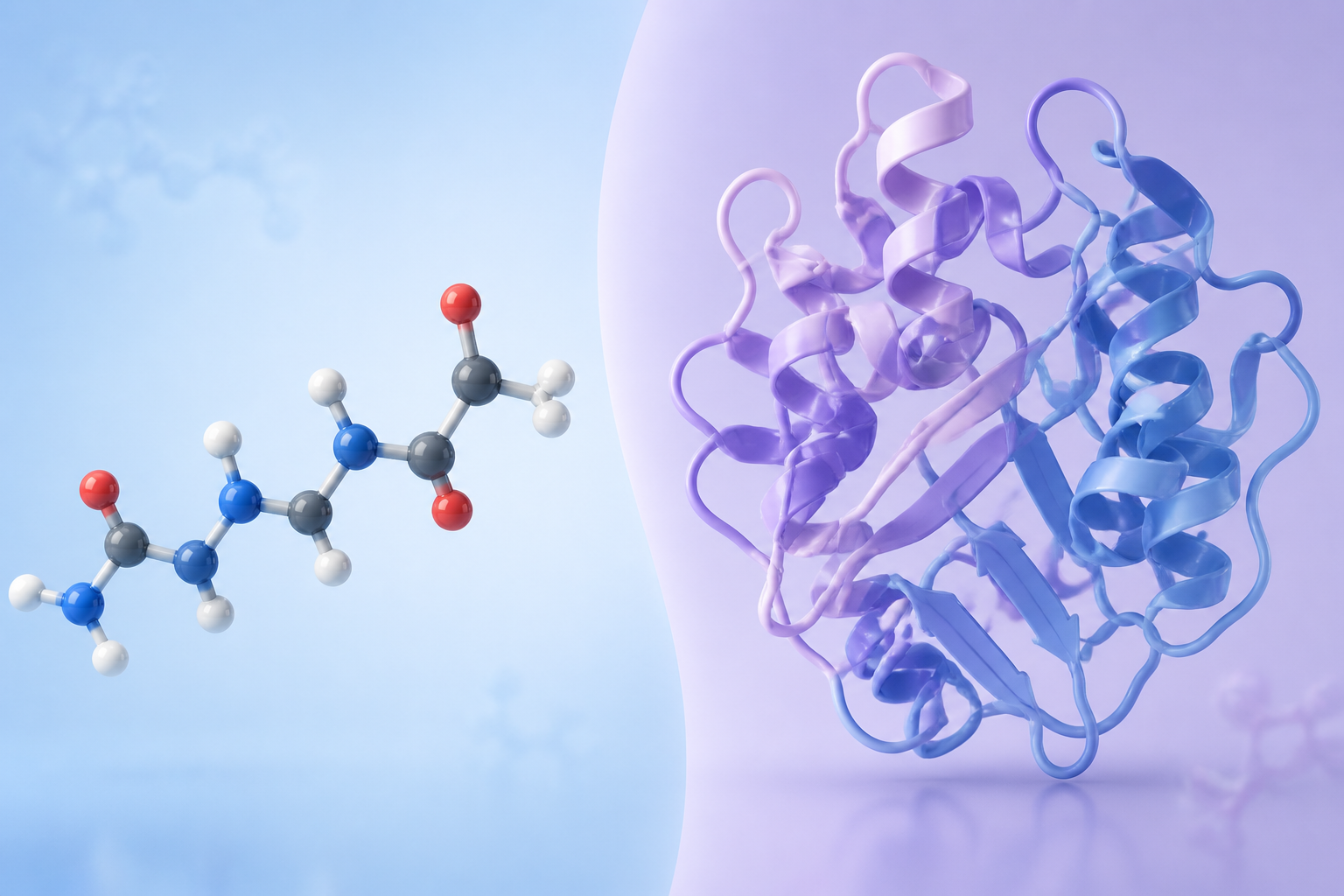
Peptides and proteins are both composed of amino acids linked by peptide bonds, and the two terms are sometimes used imprecisely in scientific and commercial settings. However, they are not interchangeable. In laboratory research, biomanufacturing, analytical chemistry, and procurement, understanding the distinction is important for selecting appropriate materials, methods, storage conditions, and quality specifications.
The primary differences between peptides and proteins relate to chain length, molecular weight, structural complexity, biological function, production method, and analytical characterization. These differences are not always absolute, but they provide a practical framework for classifying amino acid-based molecules.
Defining Peptides and Proteins
What Is a Peptide?
A peptide is a short chain of amino acids joined by peptide bonds. Peptides typically contain fewer amino acid residues than proteins and often have simpler three-dimensional structures. Common scientific usage often classifies chains of approximately 2 to 50 amino acids as peptides, although some definitions extend this range to about 100 residues.
Peptides may be linear or cyclic, naturally occurring or synthetic, and unmodified or chemically modified. Examples include small signaling molecules, peptide hormones, antimicrobial peptides, enzyme substrates, and synthetic research tools. Some peptides are biologically active in their own right, while others are designed for assays, immunization, structural studies, or drug discovery programs.
What Is a Protein?
A protein is generally a larger, more structurally complex polymer of amino acids. Proteins are usually composed of one or more polypeptide chains that fold into defined three-dimensional conformations. Many proteins contain more than 50 to 100 amino acids, and their molecular weights can range from a few kilodaltons to several hundred kilodaltons or more.
Proteins perform a broad range of biological roles, including catalysis, structural support, transport, signaling, immune recognition, and regulation of gene expression. Examples include enzymes, antibodies, receptors, transport proteins, collagen, albumin, and transcription factors.
Length and Molecular Weight
Typical Size Ranges
One of the most common ways to distinguish peptides from proteins is by amino acid length. Peptides are shorter chains, while proteins are longer chains that usually fold into stable functional structures. A dipeptide contains two amino acids, a tripeptide contains three, and oligopeptides contain a small number of residues. Longer peptides may be referred to as polypeptides, especially when the chain approaches the lower size range of proteins.
Molecular weight follows from chain length. Short peptides may have molecular weights of a few hundred daltons, while larger peptides may reach several kilodaltons. Proteins often have molecular weights above 10 kDa, though there are exceptions. Some small proteins overlap in size with larger peptides, so molecular weight alone is not always sufficient for classification.
The Boundary Is Not Absolute
The distinction between a large peptide and a small protein can be context-dependent. For example, insulin contains 51 amino acids arranged in two chains linked by disulfide bonds. It is frequently described as a peptide hormone, but its structured, multi-chain nature also gives it protein-like characteristics. Similarly, some cytokines and growth factors are relatively small proteins that fall near the peptide-protein boundary.
For this reason, researchers often consider multiple criteria together: residue count, folding behavior, biological role, post-translational modifications, and method of production.
Structural Complexity
Primary Structure
Both peptides and proteins have primary structure, meaning the linear sequence of amino acids. This sequence determines chemical properties such as charge, hydrophobicity, solubility, and potential sites for modification. In peptides, the primary sequence often accounts for much of the molecule’s behavior because the chain is short and may not form a stable tertiary structure.
For proteins, primary structure is also essential, but it is only the first level of organization. The amino acid sequence directs folding into higher-order structures that are frequently required for biological activity.
Secondary, Tertiary, and Quaternary Structure
Proteins commonly form secondary structures such as alpha helices, beta sheets, and turns. These elements then assemble into tertiary structures stabilized by hydrogen bonds, hydrophobic interactions, ionic interactions, van der Waals forces, and disulfide bonds. Some proteins also have quaternary structure, consisting of multiple protein subunits arranged into functional complexes.
Peptides can also adopt secondary structure, and some form stable helices, beta hairpins, or cyclic conformations. However, many peptides are flexible in solution and do not maintain a single folded state under physiological or experimental conditions. Cyclic peptides, stapled peptides, and disulfide-constrained peptides are examples of peptide formats designed to increase conformational stability.
Functional Differences
Peptides as Signals, Ligands, and Research Tools
Peptides often function as signaling molecules or binding ligands. Many peptide hormones and neuropeptides act by binding to cell surface receptors and triggering downstream responses. Examples include oxytocin, vasopressin, glucagon-like peptides, and substance P. In immunology, short peptides are used as epitopes for antibody generation or as antigens presented by major histocompatibility complex molecules.
In research laboratories, synthetic peptides are commonly used as enzyme substrates, inhibitors, standards for mass spectrometry, affinity ligands, or tools for mapping protein-protein interactions. Their defined sequence and relatively accessible synthesis make them useful for controlled experimental design.
Proteins as Enzymes, Structural Elements, and Complex Machines
Proteins generally carry out more complex and diverse biological functions. Enzymes catalyze biochemical reactions with high specificity. Structural proteins such as collagen, keratin, and actin support cells and tissues. Transport proteins move molecules across membranes or through blood. Antibodies recognize antigens with high affinity and specificity, while receptors transmit extracellular signals into cells.
Many protein functions depend on precise folding, dynamic conformational changes, cofactors, glycosylation, or assembly with other macromolecules. As a result, proteins are often more sensitive to production and handling conditions than short peptides.
Production and Synthesis
Chemical Peptide Synthesis
Peptides are commonly produced by solid-phase peptide synthesis. In this method, amino acids are sequentially added to a growing chain anchored to a solid resin. Protecting groups control reactivity during synthesis, and the finished peptide is cleaved from the resin, deprotected, purified, and characterized.
Solid-phase synthesis is well suited for short to medium-length peptides and allows incorporation of non-natural amino acids, fluorescent labels, isotopic labels, lipid modifications, phosphorylation, acetylation, amidation, and other chemical features. However, synthesis becomes more challenging as peptide length increases, especially due to incomplete coupling, aggregation, side reactions, and purification complexity.
Recombinant Protein Expression
Proteins are commonly produced by recombinant expression in host systems such as bacteria, yeast, insect cells, or mammalian cells. The choice of expression system depends on protein size, folding requirements, solubility, disulfide bond formation, post-translational modifications, and intended application.
Bacterial expression can be efficient for many non-glycosylated proteins, while mammalian expression is often preferred for proteins requiring human-like glycosylation or complex folding. After expression, proteins are typically purified using chromatography and assessed for identity, purity, activity, aggregation, and stability.
Stability and Handling
Peptide Stability
Peptide stability depends on sequence, formulation, purity, terminal modifications, and storage conditions. Some peptides are relatively stable as lyophilized powders, particularly when stored dry and protected from light, moisture, and repeated temperature fluctuations. In solution, peptides may be susceptible to hydrolysis, oxidation, deamidation, aggregation, or adsorption to containers.
Short peptides may also be rapidly degraded by proteases in biological systems. For therapeutic or in vivo research applications, modifications such as cyclization, D-amino acid substitution, N-terminal acetylation, C-terminal amidation, or PEGylation may be used to alter stability and pharmacokinetic behavior.
Protein Stability
Proteins often require stricter handling because their function depends on folded structure. Denaturation can occur through heat, pH extremes, agitation, freeze-thaw cycles, organic solvents, high salt, or surface adsorption. Even if the amino acid sequence remains intact, loss of tertiary structure can reduce or eliminate biological activity.
Protein formulations may include buffers, salts, sugars, surfactants, reducing agents, or stabilizing excipients. For laboratory use, storage conditions should be selected based on empirical stability data, supplier documentation, and the specific requirements of the assay or application.
Analytical Characterization
Common Methods for Peptides
Peptides are frequently characterized by analytical high-performance liquid chromatography and mass spectrometry. HPLC provides information on purity and related impurities, while mass spectrometry confirms molecular mass and can help identify sequence-related variants or modifications. Amino acid analysis and peptide sequencing may be used for additional confirmation when needed.
Because synthetic peptide impurities can include deletion sequences, truncated products, side-chain modifications, and residual synthesis reagents, purity specifications should be interpreted in relation to the intended application. A peptide used as a crude screening reagent may require different specifications than one used as a quantitative analytical standard.
Common Methods for Proteins
Protein characterization typically requires a broader set of methods. Sodium dodecyl sulfate polyacrylamide gel electrophoresis, size-exclusion chromatography, ion-exchange chromatography, western blotting, ELISA, mass spectrometry, circular dichroism, differential scanning fluorimetry, and activity assays may all be relevant depending on the protein.
For proteins, it is often necessary to assess not only molecular weight and purity but also folding, aggregation, glycosylation, disulfide bond status, endotoxin level, host cell protein contamination, and biological activity. These parameters can be critical for reproducibility in cell-based assays, structural studies, diagnostic development, and preclinical research.
Practical Considerations for Laboratory Selection
Choosing a Peptide
Peptides are often appropriate when a defined short sequence is needed, such as an epitope, enzyme substrate, receptor ligand, inhibitor motif, or calibration standard. Researchers should consider sequence length, solubility, purity grade, modification requirements, counterion, net charge, hydrophobicity, and compatibility with the planned assay.
Solubility can be a common challenge, especially for hydrophobic peptides or peptides with strong self-association tendencies. Selection of solvent, buffer, pH, and stock concentration should be based on the peptide’s chemical properties and the tolerance of the experimental system.
Choosing a Protein
A protein may be required when native-like folding, enzymatic activity, antigen recognition, ligand binding, or structural assembly is central to the experiment. Important selection criteria include expression system, species origin, sequence variant, tag placement, purity, endotoxin level, activity data, formulation, and storage conditions.
For reproducibility, researchers should review certificates of analysis, lot-specific activity, method of quantification, and evidence of identity. When working with functional proteins, small differences in production method or formulation can affect assay performance.
Comparison Summary
| Feature | Peptides | Proteins |
|---|---|---|
| Typical length | Usually about 2 to 50 amino acids, with some broader definitions | Often more than 50 to 100 amino acids |
| Structure | Often flexible or locally structured; may be linear or cyclic | Often folded into defined tertiary or quaternary structures |
| Production | Commonly made by chemical synthesis | Commonly made by recombinant expression or extraction |
| Function | Signals, ligands, epitopes, substrates, inhibitors, research tools | Enzymes, antibodies, receptors, transporters, structural components |
| Analysis | Frequently HPLC and mass spectrometry | Often requires purity, identity, folding, aggregation, and activity assays |
| Handling | Often stable as lyophilized material; solution stability varies | Frequently sensitive to denaturation, aggregation, and freeze-thaw cycles |
Conclusion
Peptides and proteins share the same fundamental chemistry: amino acids linked by peptide bonds. Their differences arise mainly from scale and complexity. Peptides are generally shorter, easier to synthesize chemically, and often used as defined sequence-based tools or signaling molecules. Proteins are typically larger, more structurally complex, and dependent on proper folding for function.
For laboratory researchers and scientific purchasers, the distinction has practical implications. It affects production strategy, analytical requirements, storage conditions, quality criteria, and experimental reproducibility. Evaluating amino acid length together with structure, function, and intended application provides the most reliable basis for distinguishing peptides from proteins.