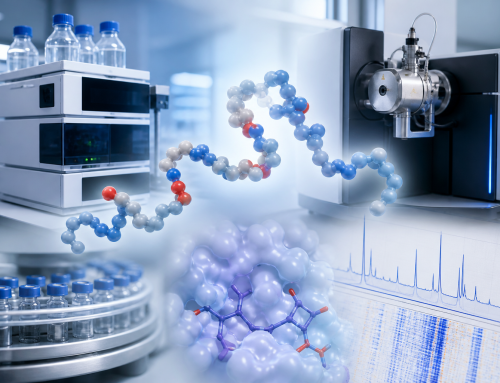
Peptide chains are central to biochemistry, molecular biology, pharmacology, and biotechnology. They form the structural and functional basis of proteins, serve as signaling molecules, and are widely used as research reagents and therapeutic leads. For laboratory researchers and scientific purchasers, understanding how peptide chains are built, named, synthesized, and characterized supports better experimental design and more informed procurement decisions.
What Is a Peptide Chain?
A peptide chain is a linear sequence of amino acids linked by covalent peptide bonds. Each amino acid contributes an amino group, a carboxyl group, a hydrogen atom, and a variable side chain attached to a central α-carbon. The side chain determines the chemical properties of the amino acid, including charge, polarity, hydrophobicity, aromaticity, and reactivity.
Peptide chains range from very short sequences of two or three amino acids to long polypeptides containing hundreds of residues. In many contexts, shorter chains are called peptides, while longer chains that fold into stable functional structures are called proteins. The distinction is practical rather than absolute, and different fields may use slightly different length thresholds.
Amino Acids as Building Blocks
The 20 standard amino acids found in proteins provide a diverse chemical toolkit. Glycine offers conformational flexibility, proline introduces structural constraints, cysteine can form disulfide bonds, and charged residues such as lysine, arginine, aspartate, and glutamate influence solubility and molecular recognition. Nonstandard, modified, or synthetic amino acids may also be incorporated into research peptides to alter stability, binding, fluorescence, or enzymatic resistance.
The Peptide Bond
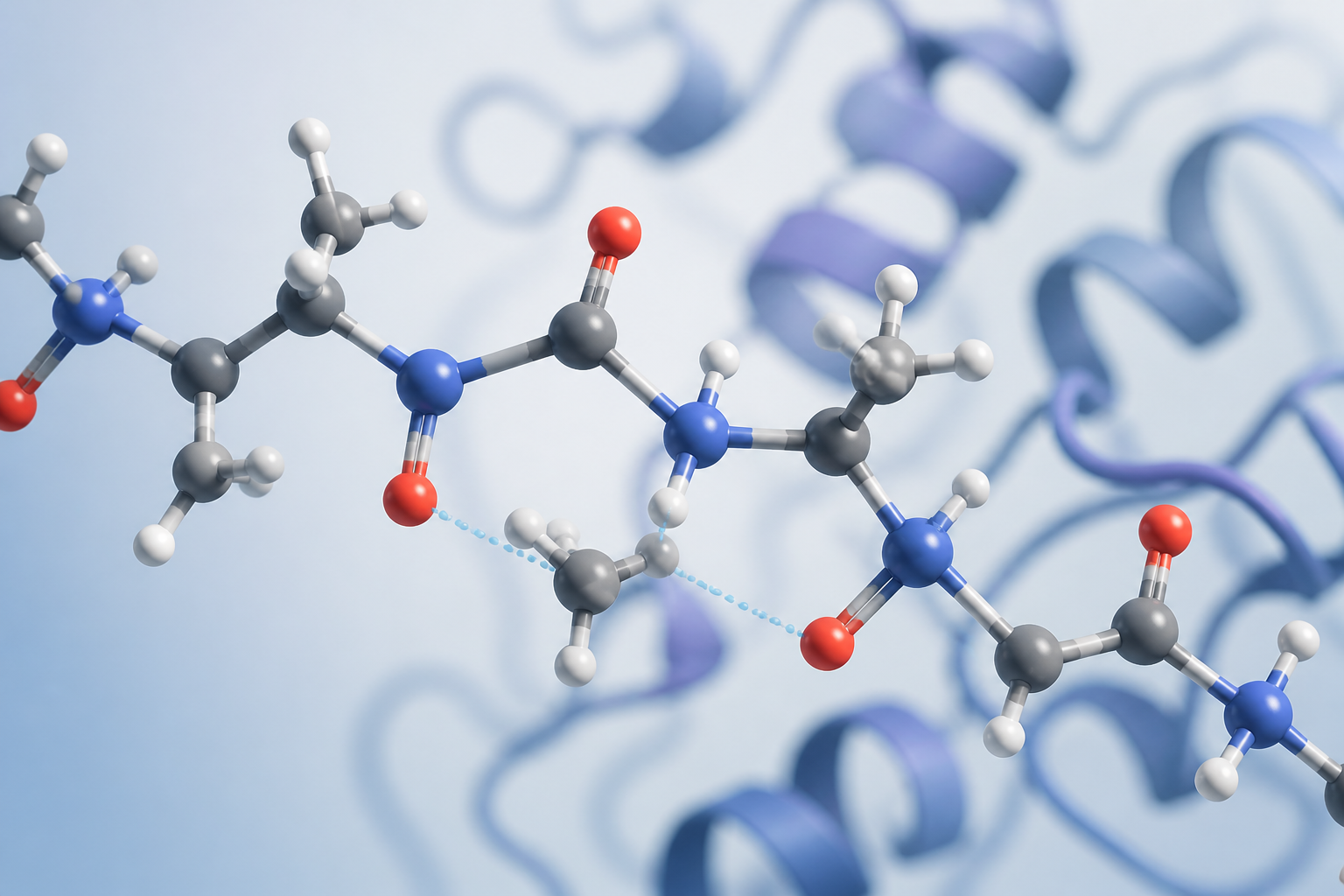
A peptide bond forms between the carboxyl group of one amino acid and the amino group of another, releasing water in a condensation reaction. In living systems, ribosomes catalyze peptide bond formation during translation. In chemical synthesis, coupling reagents and protecting group strategies are used to build peptide chains stepwise. The peptide bond has partial double-bond character, which restricts rotation and contributes to predictable backbone geometry.
Sequence, Directionality, and Notation
Peptide chains have directionality. By convention, sequences are written from the N-terminus, which contains a free or modified amino group, to the C-terminus, which contains a free or modified carboxyl group. This direction is not merely a writing convention; it reflects how peptides are biosynthesized and how enzymes often recognize substrates.
A peptide sequence may be represented using one-letter or three-letter amino acid codes. For example, alanine can be written as A or Ala. One-letter notation is compact and useful for long sequences, while three-letter notation can be clearer when documenting modified residues, unusual amino acids, or synthetic changes. Terminal modifications, such as N-terminal acetylation or C-terminal amidation, should be specified because they can affect charge, stability, and biological activity.
Primary Structure
The primary structure of a peptide is its exact amino acid sequence. Even a single residue substitution can change solubility, receptor binding, enzymatic cleavage, or immunogenicity. For this reason, accurate sequence specification is essential when ordering custom peptides, comparing experimental results, or interpreting structure-function studies.
From Linear Chains to Three-Dimensional Structure
Although peptide chains are linear polymers, their biological behavior depends strongly on three-dimensional conformation. Backbone hydrogen bonding, side-chain interactions, electrostatics, hydrophobic effects, and solvent conditions all influence folding. Some peptides are intrinsically flexible, while others adopt stable secondary structures under appropriate conditions.
Secondary Structure
Common secondary structures include α-helices, β-sheets, turns, and loops. Short peptides may form these structures transiently, particularly in membrane-like environments or when bound to a target protein. Structure-promoting modifications, such as hydrocarbon stapling or cyclization, are sometimes used in research to stabilize specific conformations.
Tertiary and Quaternary Organization
Longer polypeptides may fold into defined tertiary structures, where distant residues in the sequence interact spatially. Multiple peptide or protein chains can also assemble into quaternary structures. While many research peptides do not form stable globular structures on their own, they can participate in complex assemblies, amyloid-like fibrils, receptor-ligand interactions, or antigen-antibody recognition.
Classification of Peptide Chains
Peptides can be classified by length, origin, function, or chemical features. Dipeptides contain two amino acids, tripeptides contain three, and oligopeptides typically refer to short chains. Polypeptides are longer chains and may be part of proteins. Bioactive peptides include hormones, neuropeptides, antimicrobial peptides, enzyme substrates, and signaling motifs.
Peptides may also be linear, cyclic, branched, or conjugated. Cyclic peptides can show increased conformational constraint and resistance to some proteases. Conjugated peptides may include fluorophores, biotin, lipids, polyethylene glycol, cell-penetrating sequences, or carrier proteins. These formats are selected according to the intended assay or application.
Peptide Chain Synthesis
Most custom research peptides are produced by solid-phase peptide synthesis. In this method, the C-terminal amino acid is anchored to an insoluble resin, and the chain is extended one amino acid at a time. Temporary protecting groups prevent unwanted side reactions, and coupling chemistry enables formation of each peptide bond. After assembly, the peptide is cleaved from the resin and deprotected.
Solid-Phase Peptide Synthesis Considerations
Sequence composition has a significant effect on synthesis difficulty. Hydrophobic stretches, repeated residues, aggregation-prone motifs, and sequences rich in sterically hindered amino acids can reduce crude purity or yield. Cysteine-containing peptides require careful handling if defined disulfide pairing is needed. Very long peptides may be more challenging to synthesize chemically and may require specialized strategies or recombinant expression.
Common Modifications
Researchers often request modifications to mimic natural processing or improve assay performance. N-terminal acetylation can neutralize positive charge, while C-terminal amidation can neutralize negative charge and mimic many endogenous peptide hormones. Phosphorylation, methylation, glycosylation, lipidation, and isotope labeling are used to study signaling, metabolism, binding, and quantification. Each modification should be matched to the scientific objective and compatible with downstream methods.
Analytical Characterization
Peptide identity and quality are usually assessed by analytical methods such as mass spectrometry and high-performance liquid chromatography. Mass spectrometry confirms molecular weight, while reversed-phase HPLC estimates purity by separating the target peptide from deletion sequences, truncated products, protecting group remnants, and other impurities.
Additional characterization may be necessary depending on the application. Amino acid analysis can support concentration determination. Circular dichroism can provide information about secondary structure. Nuclear magnetic resonance or X-ray crystallography may be used for detailed structural studies. For biological assays, endotoxin testing, counterion determination, or sterility considerations may be relevant.
Purity and Fit for Purpose
Peptide purity requirements depend on intended use. Crude or lower-purity peptides may be adequate for preliminary screening or antibody generation in some contexts. Higher-purity preparations are typically preferred for quantitative assays, receptor binding studies, structural work, cell-based assays, and in vivo research. Researchers should distinguish analytical purity from biological performance, as solubility, aggregation, and stability also influence experimental outcomes.
Solubility, Stability, and Handling
Peptide chains can vary widely in solubility. Charged and polar peptides are often soluble in aqueous buffers, while hydrophobic peptides may require organic solvents, dilute acid, dilute base, chaotropes, or detergent-containing formulations. Solubility should be evaluated carefully because incomplete dissolution can lead to inaccurate concentration estimates and inconsistent assay results.
Stability is influenced by temperature, pH, oxidation, hydrolysis, enzymatic degradation, and repeated freeze-thaw cycles. Cysteine, methionine, and tryptophan residues are particularly susceptible to oxidation. Peptides containing asparagine, glutamine, or aspartate may undergo deamidation or isomerization under some conditions. Lyophilized peptides are commonly stored at low temperature and protected from moisture. Once dissolved, aliquoting is often advisable to minimize repeated freeze-thaw exposure.
Concentration Determination
Accurate peptide concentration is important for reproducibility. Weighing lyophilized powder can be imprecise if residual water, salts, or counterions are present. UV absorbance can be useful when aromatic residues or chromophores are present, but not all peptides have strong absorbance at common wavelengths. Amino acid analysis or quantitative mass-based methods may be preferred when precise concentration is critical.
Biological Roles of Peptide Chains
In biological systems, peptide chains perform diverse roles. Protein polypeptide chains catalyze reactions, provide structural support, transport molecules, regulate gene expression, and mediate signaling. Shorter peptides act as hormones, neurotransmitters, immune epitopes, antimicrobial agents, and enzyme substrates or inhibitors. Proteolytic processing often generates active peptides from larger precursor proteins.
Peptide chains are also central to immune recognition. Antigen-presenting cells display peptide fragments on major histocompatibility complex molecules, enabling T-cell surveillance. Synthetic peptide libraries are widely used to map epitopes, screen binding motifs, and study immune responses. In enzymology, defined peptide substrates allow researchers to monitor kinase, protease, and phosphatase activity with controlled sequence context.
Key Considerations When Designing or Purchasing Peptides
Effective peptide design begins with the research question. Important parameters include sequence length, terminal groups, purity grade, solubility expectations, labeling strategy, counterion form, and required documentation. If a peptide is intended for cell-based or animal studies, additional quality criteria may be necessary. If it is intended as an antigen, hydrophilicity, surface exposure, uniqueness, and conjugation strategy should be considered.
Documentation can support reproducibility. Useful records include the full sequence, terminal modifications, lot number, molecular weight, purity method, mass spectrometry result, net peptide content if available, storage conditions, and reconstitution procedure. Maintaining these details helps laboratories compare data across experiments and troubleshoot unexpected results.
Conclusion
Peptide chains are chemically defined yet biologically versatile molecules. Their properties arise from amino acid sequence, peptide bond geometry, terminal groups, modifications, and environmental conditions. A clear understanding of peptide structure, synthesis, analysis, and handling enables researchers to select appropriate peptide formats and interpret experimental results more reliably. Whether used as model substrates, signaling molecules, antigens, inhibitors, or structural components, peptide chains remain essential tools in modern life science research.