Peptides are widely used in biochemical assays, cell culture studies, analytical method development, immunology, structural biology, and pharmaceutical research. Their utility depends not only on purity and correct sequence, but also on how they are stored and handled after receipt. Inadequate storage can lead to hydrolysis, oxidation, aggregation, adsorption to containers, microbial contamination, or repeated freeze-thaw damage, all of which may affect experimental reproducibility.
Because peptides vary considerably in amino acid composition, length, modifications, solubility, and sensitivity to environmental conditions, there is no single storage method that applies equally to every material. However, several general principles can help laboratories maintain peptide integrity and establish consistent handling procedures. The recommendations below should be used alongside the supplier certificate of analysis, product-specific documentation, and any internal quality system requirements.
Why Peptide Storage Matters
Peptides are chemically diverse molecules. Some are short and relatively robust, while others contain labile residues, disulfide bonds, fluorescent labels, lipid modifications, phosphorylation, glycosylation, or other sensitive functional groups. Even when supplied at high purity, peptide quality can decline if the material is exposed to moisture, oxygen, heat, light, inappropriate pH, or repeated temperature cycling.
Storage-related degradation may not always be visually apparent. A peptide solution can appear clear while undergoing deamidation, oxidation, or partial cleavage. Similarly, a lyophilized powder may seem unchanged despite moisture uptake that accelerates degradation over time. For quantitative assays, receptor binding studies, calibration standards, or comparative experiments, these changes can introduce variability and complicate interpretation.
Good storage practice supports data reliability by minimizing uncontrolled changes between receipt, aliquoting, reconstitution, and experimental use. It also helps laboratories reduce waste, maintain traceability, and ensure that materials are used within a scientifically justified timeframe.
Understand Peptide Stability Factors
Sequence and composition
A peptide sequence is a major determinant of stability. Residues such as methionine, cysteine, and tryptophan may be susceptible to oxidation. Asparagine and glutamine can undergo deamidation, particularly at elevated pH or temperature. Aspartic acid-containing sequences may be prone to isomerization or cleavage under certain conditions. Peptides containing disulfide bonds may be sensitive to reducing environments or disulfide scrambling.
Hydrophobic peptides can aggregate or adsorb to plastic surfaces, while highly basic or acidic peptides may require specific solvent conditions for dissolution. Modified peptides may have additional sensitivities depending on the chemistry of the modification. For example, fluorescently labeled peptides are often light-sensitive, and phosphorylated peptides may require attention to pH and enzymatic contamination.
Moisture, oxygen, light, and temperature
Lyophilized peptides are generally more stable than peptides in solution, but they are still vulnerable to moisture. Water can facilitate hydrolysis and other degradation pathways. Oxygen can promote oxidation, especially in sequences containing sulfur-containing or aromatic residues. Light can affect certain chromophores, fluorophores, and photosensitive side chains. Temperature influences nearly all degradation reactions, with lower temperatures generally slowing chemical change.
For this reason, peptide storage is often centered on four controls: keeping powders dry, limiting oxygen exposure when appropriate, protecting sensitive compounds from light, and using suitable cold storage conditions.
Storage Forms: Lyophilized vs. Reconstituted Peptides
Lyophilized peptides
Peptides are commonly supplied as lyophilized solids because dry storage typically offers better stability than storage in solution. When kept sealed, desiccated, and cold, many lyophilized peptides remain suitable for extended periods. However, stability depends on the individual peptide and the storage conditions. Laboratory personnel should consult the product documentation for recommended temperature, expiration date, and any special precautions.
Lyophilized material should be protected from repeated exposure to ambient air. Opening and closing a vial multiple times can introduce moisture, especially in humid environments. For peptides that will be used repeatedly, it is often preferable to prepare single-use aliquots soon after receipt or after initial reconstitution.
Reconstituted peptides
Peptides in solution are usually less stable than lyophilized powders because dissolved molecules are more exposed to hydrolysis, oxidation, aggregation, adsorption, and microbial contamination. Reconstituted peptide solutions should therefore be treated as time-sensitive materials. They should be aliquoted promptly, stored at an appropriate temperature, and protected from repeated freeze-thaw cycles.
The working lifetime of a peptide solution can range from hours to weeks or longer depending on sequence, solvent, concentration, sterility, pH, and temperature. Unless product-specific stability data are available, laboratories should take a conservative approach and avoid storing dilute peptide solutions for extended periods.
Best Practices for Lyophilized Peptide Storage
Inspect and equilibrate on receipt
Upon arrival, inspect the shipment for damage, temperature excursion indicators if applicable, and documentation. Confirm the peptide identity, lot number, net peptide content, purity, and recommended storage conditions. If the peptide arrives cold, allow the sealed vial to equilibrate to room temperature before opening. This helps prevent condensation from forming inside the vial when exposed to warmer, humid air.
Condensation is a common but avoidable source of moisture contamination. Even small amounts of water introduced into a lyophilized vial can reduce stability, particularly if the vial will be stored again after opening.
Use cold, dry storage
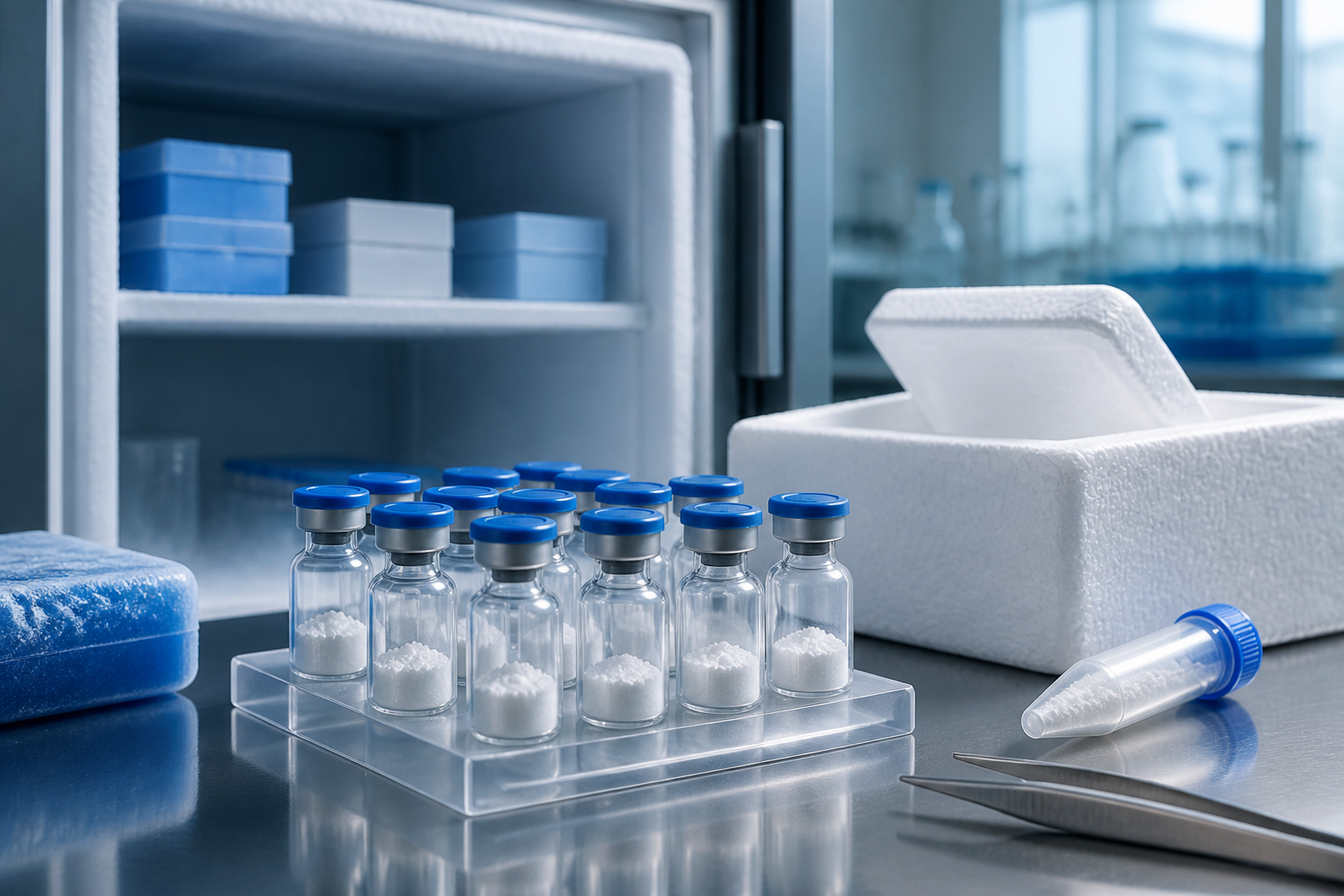
For many lyophilized peptides, storage at -20 degrees Celsius or below is appropriate. Some sensitive materials may require -80 degrees Celsius, while others may be stable at 2 to 8 degrees Celsius for shorter periods. Always follow product-specific guidance when available.
Store vials tightly sealed with desiccant in a secondary container. Avoid frost-prone locations in freezers and minimize door-open time. If the peptide is hygroscopic or used infrequently, consider storing smaller aliquots rather than repeatedly accessing the original vial.
Protect from light and oxygen when needed
Light-sensitive peptides, including many fluorescently labeled peptides, should be stored in amber vials or wrapped in foil. Peptides prone to oxidation may benefit from storage under inert gas or in containers with minimal headspace, depending on the material and laboratory procedures. Reducing unnecessary air exposure is particularly important for peptides containing methionine, cysteine, or tryptophan.
Best Practices for Reconstituted Peptide Storage
Select an appropriate solvent
Solvent choice affects solubility, stability, and downstream compatibility. Sterile water, buffered aqueous solutions, dilute acetic acid, dilute ammonia, dimethyl sulfoxide, and other solvents may be used depending on peptide properties. The best solvent is peptide-specific and should be selected based on supplier recommendations, sequence characteristics, and assay requirements.
As a general approach, acidic peptides may dissolve more readily in basic conditions, while basic peptides may dissolve more readily in acidic conditions. Hydrophobic peptides may require a small amount of organic solvent before dilution into aqueous buffer. However, extreme pH, high organic solvent concentration, or incompatible additives can damage peptides or interfere with biological assays. Solubility testing at small scale is often prudent when working with a new peptide.
Control concentration and container effects
Very dilute peptide solutions are more susceptible to adsorption onto tube walls, pipette tips, and filtration membranes. This is especially relevant for hydrophobic peptides or peptides used at low nanomolar concentrations. Preparing concentrated stock solutions and diluting immediately before use can reduce losses.
Use low-binding tubes when adsorption is a concern. Avoid unnecessary transfers between containers, and validate recovery when peptide concentration is critical. For quantitative applications, container material and handling steps should be consistent across experiments.
Aliquot before freezing
Repeated freeze-thaw cycles can promote aggregation, precipitation, oxidation, and loss of activity. After reconstitution, divide the stock solution into single-use or limited-use aliquots. Aliquot volumes should reflect realistic experimental needs so that thawed material is not repeatedly refrozen.
Use sterile, nuclease-free or appropriate clean tubes when required by the application. Clearly label each aliquot with peptide name or identifier, concentration, solvent, date of reconstitution, lot number, storage temperature, and preparer initials. For light-sensitive peptides, use amber tubes or secondary light protection.
Freeze and thaw consistently
Store frozen peptide aliquots at -20 degrees Celsius or -80 degrees Celsius as appropriate. Avoid self-defrosting freezers for long-term storage because temperature cycling can affect stability. When thawing, use a consistent procedure, such as thawing on ice or at room temperature for a controlled period, depending on the peptide and application. Mix gently after thawing; vigorous vortexing may not be appropriate for aggregation-prone materials.
If visible precipitation occurs after thawing, do not assume the peptide is unusable, but investigate before proceeding. Gentle warming, pH adjustment, or solvent optimization may help in some cases, whereas in others precipitation may indicate degradation or incompatibility with the storage buffer.
Aliquoting, Labeling, and Documentation
Create traceable aliquots
Traceability is essential for reproducible research. Each aliquot should be linked to the original vial and certificate of analysis. Documentation should include peptide sequence or catalog identifier, lot number, purity, net peptide content, molecular weight, date received, storage conditions, reconstitution details, aliquot concentration, and location.
For regulated or quality-controlled laboratories, records should also include balance calibration status, calculation worksheets, solvent lot numbers, sterility measures if applicable, and deviations from standard procedure. Even in non-regulated research settings, consistent records reduce the risk of concentration errors and make troubleshooting easier.
Account for peptide content
Many lyophilized peptides contain counterions, residual water, salts, or other components, so the gross vial mass is not always equal to the amount of active peptide. Quantitative work should account for net peptide content or peptide assay value when provided. Using the certificate of analysis rather than assuming 100 percent active material improves concentration accuracy.
When preparing stock solutions, record calculations carefully. If the peptide is supplied in a very small amount, consider reconstituting the entire vial rather than attempting to weigh a sub-milligram portion, unless suitable microbalance procedures are available.
Temperature Management and Shipping Considerations
Minimize temperature excursions
Peptides should be moved promptly to their recommended storage condition after receipt. During internal transfers between laboratories or facilities, use insulated containers and cold packs or dry ice as appropriate. Avoid leaving peptide vials on benches, in transport carts, or in shared freezer staging areas longer than necessary.
For high-value or sensitive peptides, temperature monitoring may be warranted. If a temperature excursion occurs, assess the duration, maximum temperature, peptide form, and known stability information before use. When uncertainty remains, analytical verification by HPLC, mass spectrometry, or functional assay may be appropriate.
Avoid uncontrolled freeze-thaw during transport
Partially thawed peptide solutions can experience concentration gradients, precipitation, and increased degradation. When shipping reconstituted peptides internally or externally, maintain a continuous frozen state if frozen storage is required. In many cases, shipping lyophilized aliquots is more stable than shipping solutions, provided the material remains dry and sealed.
Common Storage Mistakes to Avoid
Opening cold vials immediately
Opening a vial directly from the freezer can introduce condensation. Allow sealed vials to reach room temperature before opening, especially in humid environments.
Storing one large working stock
A single stock vial that is repeatedly thawed and refrozen is at higher risk of degradation and contamination. Single-use aliquots are preferable for most peptide solutions.
Using incompatible buffers
Buffers that are suitable for an assay may not be optimal for peptide storage. Consider pH, salt concentration, preservatives, reducing agents, metal ions, and enzymatic contaminants. Prepare storage stocks separately from final assay dilutions when needed.
Ignoring light sensitivity
Fluorescent labels and some peptide residues can be affected by light. Routine use of foil wrapping or amber containers is a simple control for sensitive materials.
Assuming all peptides behave alike
Storage conditions should be based on peptide-specific properties. A method that works well for one peptide may be unsuitable for another with different solubility or stability characteristics.
Developing a Peptide Storage SOP
Laboratories that handle peptides regularly benefit from a standard operating procedure. An SOP should define receipt inspection, storage temperature, equilibration before opening, reconstitution workflow, solvent selection guidance, aliquoting requirements, labeling format, documentation, freezer inventory practices, and disposal criteria.
The SOP should also specify when additional verification is needed. Examples include peptides used as reference standards, materials stored beyond the recommended period, vials exposed to temperature excursions, or peptides with known instability. Periodic review of peptide performance data can help refine storage time limits and handling practices.
Training is equally important. Personnel should understand why steps such as room-temperature equilibration before opening, single-use aliquoting, and accurate labeling are required. Clear procedures reduce variability between operators and support more consistent experimental outcomes.
Conclusion
Effective peptide storage requires attention to the physical form of the material, sequence-specific stability, moisture control, temperature, solvent selection, aliquoting, and documentation. In general, lyophilized peptides should be kept sealed, dry, cold, and protected from light when needed, while reconstituted peptides should be aliquoted promptly and stored under conditions that minimize degradation and freeze-thaw exposure.
Because peptide behavior is highly sequence-dependent, product-specific guidance and laboratory validation remain essential. By applying consistent storage practices and maintaining accurate records, researchers can better preserve peptide integrity and improve the reproducibility of peptide-based experiments.