
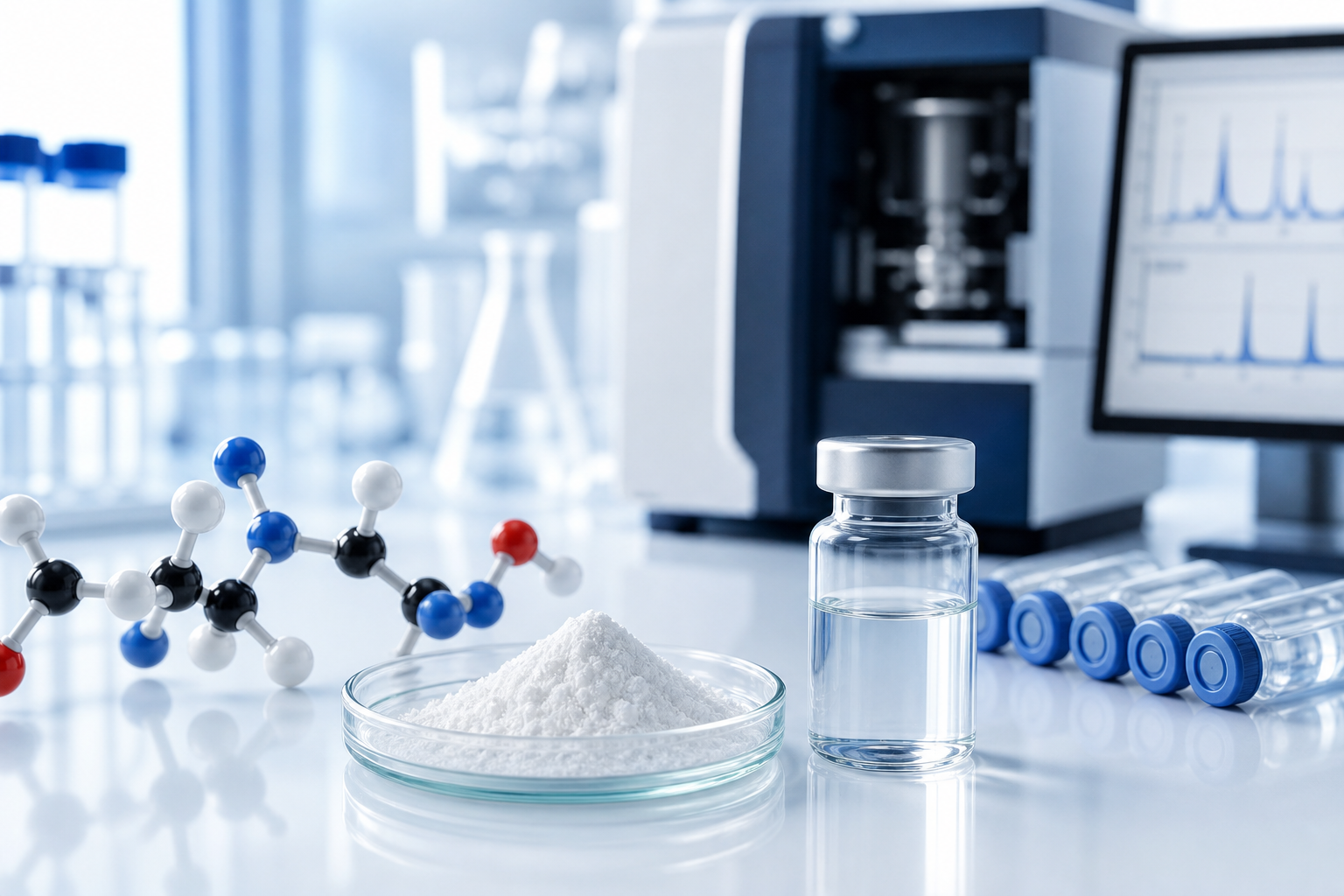
Peptides are used across a wide range of scientific and biomedical applications, including biochemical assays, structural biology, immunology, drug discovery, diagnostics development, and therapeutic manufacturing. Because peptide performance is strongly influenced by sequence fidelity, purity, aggregation state, counterion composition, and residual impurities, quality control is a central part of peptide procurement and use.
Peptide quality control standards are not a single universal checklist. They depend on the peptide sequence, synthesis route, intended application, route of administration if applicable, and regulatory status. A research-grade antigen peptide may require a different control strategy than a GMP-manufactured peptide intended for clinical use. However, the underlying objective is consistent: to verify identity, quantify purity and content, characterize relevant impurities, and provide documentation sufficient for the intended use.
What Peptide Quality Control Standards Aim to Establish
Peptide quality control standards are designed to confirm that a peptide batch meets predefined specifications. These specifications should be scientifically justified, analytically measurable, and appropriate for the intended application. In practice, peptide QC typically evaluates several core attributes: identity, purity, quantity, physical form, impurity profile, and microbiological status where relevant.
Identity
Identity testing confirms that the material corresponds to the intended peptide sequence. Because peptides may contain sequence deletions, insertions, truncations, protecting group remnants, or incorrect modifications, identity testing is essential even when the synthesis route is well controlled. Mass spectrometry is commonly used to confirm molecular weight, while tandem mass spectrometry or sequence-specific approaches may be needed for complex peptides, isobaric residues, or modified sequences.
Purity
Purity describes the proportion of the target peptide relative to related substances and other detectable components under the selected analytical conditions. Reverse-phase high-performance liquid chromatography is frequently used to determine chromatographic purity. However, chromatographic purity does not always equal chemical purity, and a single HPLC method may not resolve all relevant impurities. Orthogonal methods are often needed for peptides with closely related impurities, aggregates, or multiple charge states.
Content and Assay
Content refers to the amount of peptide present in a sample, while assay may refer to the quantitative determination of the active peptide relative to total mass. Peptides are often supplied as salts or hydrates, and the weighed mass may include water, counterions, residual solvents, and inorganic salts. For quantitative biological experiments, it is important to distinguish gross weight from net peptide content.
Core Analytical Tests for Peptide QC
A robust peptide QC package generally includes a combination of identity, purity, and composition tests. The specific selection should be based on risk, sequence characteristics, and intended use.
Mass Spectrometry
Mass spectrometry is one of the most important tools for peptide identity confirmation. Matrix-assisted laser desorption ionization time-of-flight mass spectrometry and electrospray ionization mass spectrometry are commonly used. These methods can verify the expected molecular mass and detect some mass-shifted impurities, such as oxidation, dehydration, deamidation, or incomplete deprotection products.
For peptides with post-translational modifications, non-natural amino acids, disulfide bonds, cyclization, lipidation, pegylation, or conjugated labels, additional method development may be required. Tandem MS can support sequence confirmation and localization of modifications, although it may not always distinguish leucine from isoleucine or fully resolve certain structural isomers without complementary data.
HPLC and UPLC Purity Analysis
Reverse-phase HPLC or UPLC is widely used to assess peptide purity. The method typically relies on a gradient of aqueous mobile phase and organic solvent, often with an acid modifier such as trifluoroacetic acid or formic acid. Detection is commonly performed by UV absorbance at 214 nm, 220 nm, or 280 nm, depending on peptide composition and analytical objective.
Acceptance criteria may be expressed as area percent purity, but this value is method-dependent. Differences in column chemistry, gradient slope, temperature, detection wavelength, and integration parameters can change reported purity. For critical applications, validated or qualified methods and defined integration rules are important.
Amino Acid Analysis
Amino acid analysis can support peptide quantification and composition verification. After hydrolysis, amino acids are separated and quantified, allowing estimation of peptide content based on expected amino acid composition. This approach can be valuable when accurate dosing or molar concentration is required.
Limitations should be considered. Some amino acids are partially degraded during hydrolysis, and modified residues may not be recovered quantitatively. Tryptophan, cysteine, methionine, and asparagine or glutamine can require specific interpretation or specialized conditions.
Water Content and Residual Solvents
Lyophilized peptides may contain variable levels of water. Karl Fischer titration is commonly used to determine water content, which can be important for accurate mass-based calculations and stability assessment. Residual solvents from synthesis, cleavage, purification, or lyophilization may also be assessed, especially for regulated applications.
Residual solvent testing is often guided by ICH Q3C principles. For early research use, solvent testing may be limited or risk-based. For GMP peptides, solvent limits, validated methods, and batch-specific results are typically expected.
Counterion and Salt Analysis
Peptides are commonly supplied as acetate, trifluoroacetate, hydrochloride, or other salt forms. Counterions influence solubility, pH behavior, biological assay compatibility, and mass calculations. Trifluoroacetate can interfere with some cell-based assays or biological systems, while acetate may be preferred in certain applications.
Ion chromatography, elemental analysis, or other appropriate methods can be used to determine counterion content. For quantitative work, net peptide content should account for counterions and water.
Impurity Control in Peptide Manufacturing
Peptide impurity profiles can be complex. Solid-phase peptide synthesis, solution-phase synthesis, enzymatic methods, and recombinant approaches each introduce different impurity risks. Quality standards should address both process-related and product-related impurities.
Product-Related Impurities
Product-related impurities arise from the peptide sequence or chemical transformations during synthesis, cleavage, purification, storage, or handling. Common examples include deletion sequences, truncated sequences, diastereomers, oxidation products, deamidation products, aspartimide-related species, disulfide mispaired variants, and aggregates.
Some impurities may have similar retention times or molecular weights to the target peptide. For example, deamidation can produce a mass shift of approximately 1 Da, while certain stereochemical impurities may not be readily detected by standard mass analysis. When such impurities are relevant, orthogonal chromatographic methods, chiral analysis, peptide mapping, or specialized assays may be necessary.
Process-Related Impurities
Process-related impurities may include residual reagents, coupling agents, scavengers, protecting group byproducts, resin leachables, catalysts, solvents, and inorganic residues. The need for testing depends on the synthesis process and the intended use of the peptide.
For regulated applications, process understanding and impurity clearance data are important. ICH Q3D may be relevant for elemental impurities, particularly if metal catalysts or metal-containing reagents are used. Analytical methods should be capable of detecting impurities at levels consistent with safety and quality requirements.
Microbiological Quality and Endotoxin Testing
Microbiological testing is not required for every peptide, but it becomes critical when peptides are used in cell culture, in vivo research, diagnostic manufacturing, or clinical applications. The required microbiological standard depends on intended use and route of administration.
Bioburden and Sterility
Bioburden testing estimates the viable microbial load in a sample. Sterility testing is a more stringent requirement generally associated with sterile drug products or sterile materials used in critical processes. Sterility testing may be performed according to pharmacopeial methods such as USP <71>, but the applicability depends on product type and regulatory expectations.
It is important to distinguish sterile filtration from confirmed sterility. Filtration through a 0.22 µm filter can reduce microbial contamination, but sterility assurance requires validated processes, suitable packaging, environmental controls, and appropriate testing.
Endotoxin
Endotoxins are lipopolysaccharide components from Gram-negative bacteria and can cause strong biological responses. Endotoxin testing is commonly performed using limulus amebocyte lysate methods or recombinant factor C approaches. USP <85> and related pharmacopeial standards provide guidance for bacterial endotoxins testing.
For peptides used in cell-based assays or animal studies, endotoxin levels can influence experimental outcomes. For parenteral clinical use, endotoxin limits are calculated based on dose and route of administration, and testing must be appropriately validated for sample interference.
Stability, Storage, and Handling Controls
Peptide quality is not fixed at the point of release. Stability depends on sequence, formulation, residual moisture, storage temperature, light exposure, pH, oxidation susceptibility, and reconstitution conditions. QC standards should therefore include appropriate storage recommendations and, when needed, stability data.
Common Degradation Pathways
Peptides can degrade through oxidation of methionine, cysteine, or tryptophan; deamidation of asparagine or glutamine; hydrolysis; diketopiperazine formation; aggregation; disulfide exchange; and adsorption to containers. Peptides containing multiple cysteine residues, hydrophobic segments, or labile modifications may require additional controls.
Lyophilized Versus Reconstituted Peptides
Lyophilized peptides are generally more stable than peptides in solution, although this is sequence-dependent. Once reconstituted, stability may decrease substantially. Researchers should consider aliquoting solutions to avoid repeated freeze-thaw cycles, selecting compatible buffers, controlling pH, and using low-binding containers when adsorption is a concern.
Documentation and Certificates of Analysis
The certificate of analysis is a central QC document. It should provide batch-specific analytical results rather than only general product information. For scientific purchasers, the COA is often the primary evidence that a peptide meets specified requirements.
Essential COA Elements
A useful peptide COA typically includes peptide name or identifier, sequence, molecular formula or molecular weight, batch or lot number, appearance, purity result, analytical method references, mass spectrometry result, peptide content or net peptide content if available, counterion form, water content if tested, storage conditions, retest date or expiry date, and authorized quality review.
For modified peptides, the COA should clearly describe the modification site and chemistry, such as N-terminal acetylation, C-terminal amidation, phosphorylation, cyclization, fluorescent labeling, biotinylation, or disulfide connectivity. Ambiguous documentation can lead to incorrect interpretation or experimental variability.
Chromatograms and Spectra
Supporting chromatograms and mass spectra improve transparency. HPLC chromatograms should include method conditions or sufficient method identifiers, retention time, integration results, and detection wavelength. Mass spectra should show observed mass values and relevant charge states or deconvoluted results.
Standards for Research, Preclinical, and GMP Peptides
Peptide quality expectations increase as the application becomes more regulated. A research-use peptide may be suitable with identity confirmation and chromatographic purity. A preclinical peptide may require additional controls for endotoxin, bioburden, residual solvents, and accurate content. A GMP peptide requires a formal quality system, validated or qualified methods, controlled manufacturing records, change control, and regulatory documentation.
Research-Use Peptides
For routine in vitro research, typical QC may include HPLC purity and mass spectrometry identity. However, researchers should match specifications to experimental sensitivity. For example, receptor-binding studies, quantitative standards, immunological assays, and cell-based experiments may require more stringent purity, endotoxin control, or counterion characterization.
GMP Peptides
GMP peptide production is governed by formal quality requirements, including controlled raw materials, validated processes where appropriate, equipment qualification, deviation management, quality agreements, and batch release procedures. Analytical validation may be guided by ICH Q2(R2), while analytical procedure development may be informed by ICH Q14. Specifications should be justified through development data, impurity qualification, and stability studies.
Setting Appropriate Acceptance Criteria
Acceptance criteria should be established before purchasing or manufacturing a peptide. Common specifications include minimum HPLC purity, confirmed molecular mass, specified salt form, water content limit, residual solvent limits, endotoxin limit, and appearance. More advanced specifications may address individual impurity limits, aggregate content, disulfide pattern, potency, or biological activity.
It is generally not sufficient to request the highest possible purity without considering analytical relevance, cost, yield, and application. A 95 percent pure peptide may be adequate for some screening assays, while a quantitative reference material, immunogen, or clinical intermediate may require tighter and more comprehensive specifications. The critical question is whether the QC package controls the attributes that can affect the intended use.
Practical Considerations for Scientific Purchasers
Before ordering a peptide, purchasers should define the intended application, required purity, scale, salt form, modification details, solubility constraints, and documentation needs. If the peptide will be used in biological systems, endotoxin and counterion requirements should be considered early. If the peptide will support regulated work, the supplier should be able to provide appropriate quality system documentation and batch traceability.
For complex peptides, it is advisable to discuss analytical feasibility before synthesis. Long sequences, hydrophobic peptides, cyclic peptides, multiple disulfide bonds, and heavily modified peptides may require customized purification and QC methods. Early alignment on specifications reduces the risk of receiving material that is analytically acceptable but unsuitable for the intended experiment.
Conclusion
Peptide quality control standards provide the framework for confirming identity, purity, content, impurity profile, and suitability for use. The appropriate QC strategy depends on the peptide structure and application, ranging from basic research documentation to comprehensive GMP release testing. By defining acceptance criteria in advance and reviewing batch-specific analytical data, laboratories and institutions can improve experimental reliability, support regulatory expectations where applicable, and make more informed peptide purchasing decisions.