High-performance liquid chromatography, commonly abbreviated as HPLC, is one of the most widely used analytical techniques for separating, identifying, and quantifying chemical compounds in a liquid sample. It is used across pharmaceutical development, environmental analysis, food and beverage testing, clinical research, forensic science, and materials characterization. HPLC is valued because it can analyze complex mixtures with high precision, often at low concentration levels, without requiring the analytes to be volatile.
At its core, HPLC testing works by moving a liquid sample through a column packed with a stationary phase while a liquid mobile phase flows under high pressure. Different compounds interact with the stationary phase and mobile phase to different extents, causing them to exit the column at different times. These separated compounds are then detected, measured, and reported as chromatographic peaks.
What Is HPLC Testing?
HPLC testing is an instrumental analytical method used to evaluate the composition of a sample. Depending on the method design, it may be used for qualitative identification, quantitative measurement, impurity profiling, assay testing, stability studies, or purity assessment.
The technique is especially useful when a sample contains multiple components that cannot be measured accurately without first being separated. For example, a pharmaceutical tablet may contain an active ingredient, preservatives, degradation products, and excipients. HPLC can separate these components so that the active ingredient and impurities can be evaluated individually.
Although HPLC instruments are sophisticated, the basic analytical question is straightforward: which compounds are present, and how much of each is there?
The Core Principle Behind HPLC
HPLC separates compounds based on their distribution between two phases: the mobile phase and the stationary phase. The mobile phase is a liquid solvent or solvent mixture that carries the sample through the system. The stationary phase is a material packed inside the analytical column.
When a sample enters the column, each compound interacts with the stationary phase differently. Some compounds have stronger affinity for the stationary phase and move more slowly. Others remain more associated with the mobile phase and travel through the column faster. This difference in migration rate produces separation.
Retention Time
The time it takes for a compound to travel from injection to detection is called its retention time. Under controlled method conditions, a compound often has a reproducible retention time. Analysts use retention time as one factor in compound identification, typically in combination with standards, spectral data, or mass information.
Chromatographic Peaks
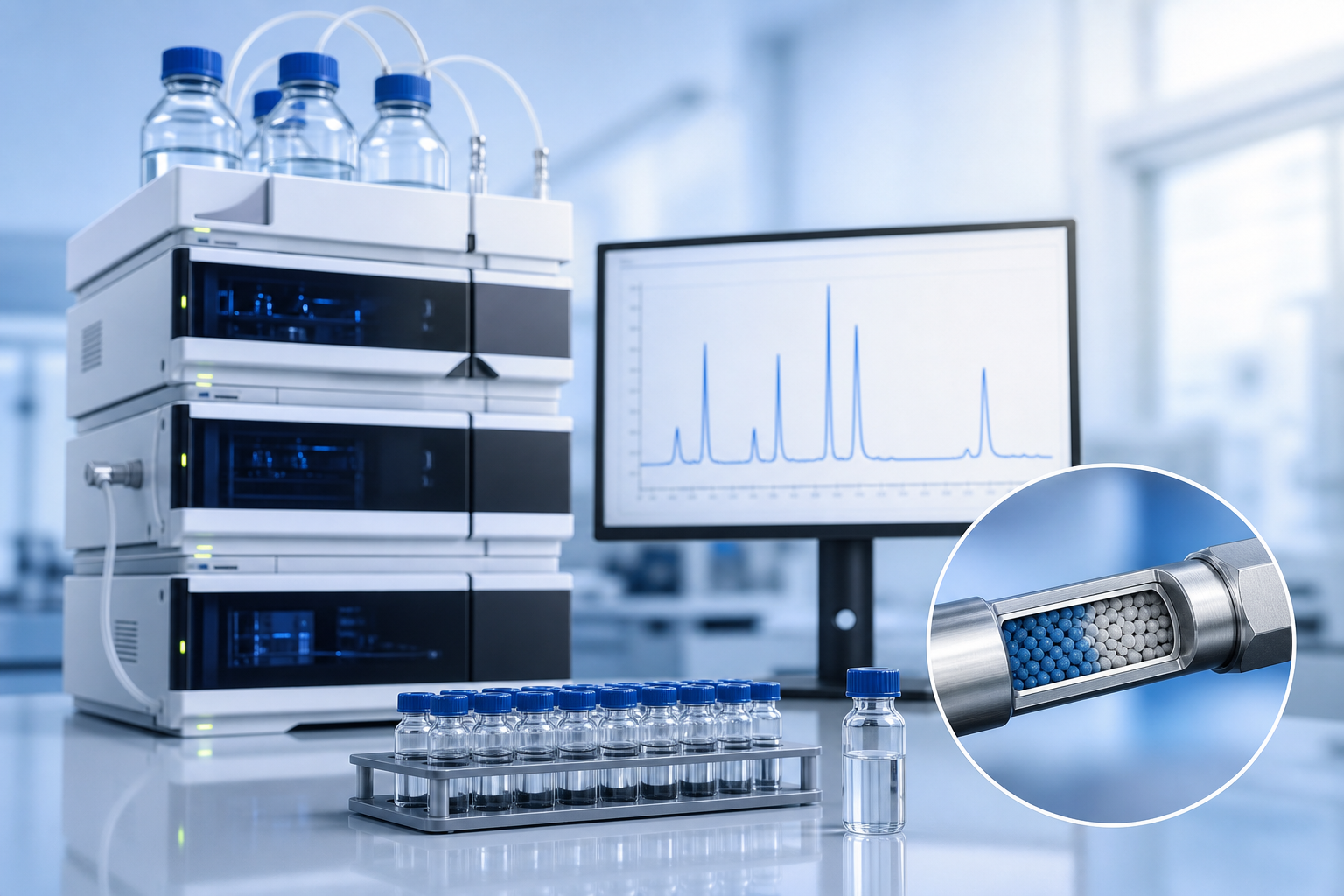
As compounds leave the column, the detector records a signal. Each separated compound appears as a peak on a chromatogram. The position of the peak relates to retention time, while the peak area or height relates to the amount of compound present. Quantitative HPLC methods typically rely on peak area because it is generally more robust than peak height for concentration calculations.
Main Components of an HPLC System
A standard HPLC system contains several modules that work together to deliver the mobile phase, introduce the sample, perform the separation, detect analytes, and process the data.
Solvent Reservoirs
Solvent reservoirs hold the mobile phase components. These solvents may include water, buffers, acetonitrile, methanol, or other compatible liquids. Mobile phases must be selected carefully for analyte solubility, detector compatibility, pH control, and column performance. They are often filtered and degassed to reduce particulates and dissolved gases that can interfere with stable flow or detection.
Pump
The pump moves the mobile phase through the system at a precise flow rate, often under pressures ranging from hundreds to several thousand psi. Consistent flow is essential because changes in flow rate can alter retention times, peak shapes, and quantitation. Modern systems may use binary or quaternary pumps to mix solvents in controlled proportions.
Injector or Autosampler
The injector introduces a defined volume of sample into the mobile phase stream. In routine laboratories, autosamplers are commonly used to improve reproducibility and throughput. Injection volume must be controlled because too much sample can overload the column, distort peaks, and compromise accuracy.
Analytical Column
The column is the central component where separation occurs. It is packed with small particles that carry the stationary phase. Common particle sizes include 3 µm and 5 µm, while ultra-high-performance systems may use smaller particles. Column chemistry is chosen based on the compounds being analyzed and the separation mechanism required.
Detector
The detector measures compounds as they elute from the column. Different detectors respond to different chemical properties. Ultraviolet-visible detectors are common for compounds that absorb UV or visible light. Diode array detectors provide spectral information across multiple wavelengths. Fluorescence detectors offer high sensitivity for fluorescent compounds or derivatized analytes. Refractive index detectors may be used for compounds without strong UV absorbance, although they are generally less compatible with gradient methods. HPLC can also be coupled with mass spectrometry for high-selectivity identification and quantitation.
Data System
The data system collects detector signals and converts them into chromatograms. It is used to integrate peaks, calculate concentrations, apply calibration curves, review system suitability, and generate reports. In regulated environments, the data system must also support traceability, access control, audit trails, and data integrity requirements.
Step-by-Step: How HPLC Testing Works
1. Sample Preparation
Sample preparation is one of the most important steps in HPLC testing. The sample must be converted into a form suitable for injection. This may involve dissolving a solid, diluting a liquid, extracting analytes from a complex matrix, filtering particulates, adjusting pH, or performing cleanup to remove interfering substances.
Good sample preparation improves precision, protects the column, and reduces matrix effects. Inadequate preparation can lead to blocked frits, poor peak shape, inaccurate recovery, or contamination that affects subsequent runs.
2. Mobile Phase Preparation
The mobile phase is prepared according to the method. If buffers are used, pH and concentration must be controlled because they can strongly affect retention and peak shape, especially for ionizable compounds. Solvent proportions must be accurate, and mobile phases should be compatible with the column and detector.
For many methods, the mobile phase is filtered through a membrane and degassed before use. This helps prevent pump issues, pressure fluctuations, and detector noise caused by bubbles or particles.
3. System Equilibration
Before sample analysis, the HPLC system and column are equilibrated with the mobile phase. Equilibration allows the stationary phase and mobile phase to reach stable conditions. Without sufficient equilibration, retention times may drift, which can affect identification and quantitation.
Equilibration time depends on column dimensions, flow rate, mobile phase composition, and whether the method uses isocratic or gradient conditions.
4. Sample Injection
A measured volume of sample is injected into the flowing mobile phase. The sample plug enters the column, where separation begins. Injection precision is essential for repeatable results, especially in quantitative assays. Autosamplers are generally programmed to inject standards, blanks, quality control samples, and unknowns in a defined sequence.
5. Separation in the Column
Inside the column, compounds separate according to their interactions with the stationary and mobile phases. The separation may be performed under isocratic conditions, where the mobile phase composition remains constant, or gradient conditions, where solvent composition changes over time.
Gradient elution is particularly useful for samples containing compounds with a wide range of polarities. Early in the run, weaker solvent conditions may retain compounds long enough for separation. Later, stronger solvent conditions help elute more strongly retained compounds within a practical runtime.
6. Detection and Signal Generation
As each compound exits the column, it passes through the detector. The detector response is converted into an electrical signal and displayed as a peak. Detector selection affects sensitivity, selectivity, and method applicability. For example, UV detection requires analytes to absorb at the selected wavelength, while mass spectrometric detection can provide molecular mass and fragmentation information.
7. Data Analysis and Reporting
After the run, the chromatogram is reviewed. Peaks are integrated, retention times are checked, and results are compared with standards or calibration curves. For quantitative testing, the instrument response from unknown samples is compared with responses from known concentrations.
Analysts also evaluate whether the run meets method criteria. These may include retention time consistency, peak resolution, tailing factor, theoretical plates, signal-to-noise ratio, and calibration performance. Results should be reported with appropriate units, method references, sample preparation details, and any relevant quality control outcomes.
Common HPLC Separation Modes
Reversed-Phase HPLC
Reversed-phase HPLC is the most commonly used mode. It uses a nonpolar stationary phase, such as C18 or C8 bonded silica, and a relatively polar mobile phase. More hydrophobic compounds tend to be retained longer, while more polar compounds elute earlier. This mode is widely applied to pharmaceuticals, natural products, metabolites, and many organic compounds.
Normal-Phase HPLC
Normal-phase HPLC uses a polar stationary phase and a less polar mobile phase. It is often used for separating compounds based on polarity, including certain lipids, isomers, and nonpolar samples. Normal-phase methods are more sensitive to water content in solvents and may require careful control of laboratory conditions.
Ion-Exchange HPLC
Ion-exchange HPLC separates compounds based on charge interactions. It is commonly used for ionic analytes, proteins, peptides, nucleotides, and inorganic ions. Retention is influenced by pH, ionic strength, and the charge properties of both the analyte and the stationary phase.
Size-Exclusion Chromatography
Size-exclusion chromatography separates molecules primarily by size. Larger molecules elute earlier because they are excluded from pores in the stationary phase, while smaller molecules enter the pores and elute later. This approach is used for polymers, proteins, aggregates, and molecular weight distribution studies.
How HPLC Quantifies Compounds
Quantitative HPLC relies on the relationship between analyte concentration and detector response. A calibration curve is prepared by analyzing standards at known concentrations. The peak areas from these standards are plotted against concentration, and the resulting calibration model is used to calculate concentrations in unknown samples.
Many methods also use internal standards. An internal standard is a compound added at a known amount to standards and samples. It helps correct for variability in injection volume, sample preparation, or detector response, provided it behaves consistently and does not interfere with analyte peaks.
Accurate quantitation requires suitable calibration range, adequate peak resolution, stable detector response, and validated sample preparation recovery. In regulated testing, method validation parameters such as accuracy, precision, specificity, linearity, range, limit of detection, limit of quantitation, and robustness may be required.
Key Performance Parameters in HPLC
Several chromatographic parameters are used to judge whether an HPLC method is performing properly.
- Resolution: The degree of separation between two adjacent peaks.
- Retention factor: A measure of how long an analyte is retained relative to an unretained compound.
- Tailing factor: An indicator of peak symmetry; excessive tailing can affect integration and quantitation.
- Theoretical plates: A measure of column efficiency, related to peak sharpness.
- System pressure: A practical indicator of column condition, solvent flow, and potential blockages.
- Baseline noise and drift: Detector stability factors that influence sensitivity and reliable integration.
Monitoring these parameters helps analysts identify issues before they compromise results.
Common Applications of HPLC Testing
HPLC is used in many scientific and industrial settings because it is adaptable to a wide range of compounds and matrices.
- Pharmaceutical testing: Assay of active ingredients, impurity profiling, dissolution testing, and stability studies.
- Biotechnology: Peptide mapping, protein characterization, and aggregate analysis.
- Food and beverage testing: Analysis of vitamins, preservatives, sweeteners, contaminants, and natural compounds.
- Environmental testing: Measurement of pesticides, pollutants, and water contaminants.
- Clinical and research laboratories: Quantitation of biomarkers, drugs, metabolites, and endogenous compounds.
- Forensic analysis: Identification and quantitation of drugs, toxins, and related substances.
Limitations and Practical Considerations
While HPLC is a powerful analytical technique, it has limitations. Method development can be time-consuming, particularly for complex samples or structurally similar compounds. Some analytes may require derivatization or specialized detection if they lack suitable optical or chemical properties. Matrix components can interfere with separation or detection, making sample cleanup important.
Instrument maintenance is also essential. Columns can degrade or become contaminated, pump seals and check valves may wear, and detector lamps have finite lifetimes. Routine preventive maintenance, use of high-purity solvents, proper filtration, and documented system suitability testing support reliable operation.
Finally, HPLC results depend heavily on method suitability. A method that works well for one product, matrix, or analyte class may not be appropriate for another. Laboratories should evaluate method performance in the context of the intended use and applicable regulatory or quality requirements.
Conclusion
HPLC testing works by separating compounds in a liquid sample as they move through a column under controlled high-pressure flow. Differences in chemical interactions with the mobile and stationary phases produce distinct retention times, while detectors convert eluting compounds into measurable chromatographic peaks. With appropriate sample preparation, method conditions, calibration, and quality controls, HPLC provides a reliable framework for identifying and quantifying compounds in complex samples. Its versatility and established performance make it an essential analytical technique in modern laboratory testing.