
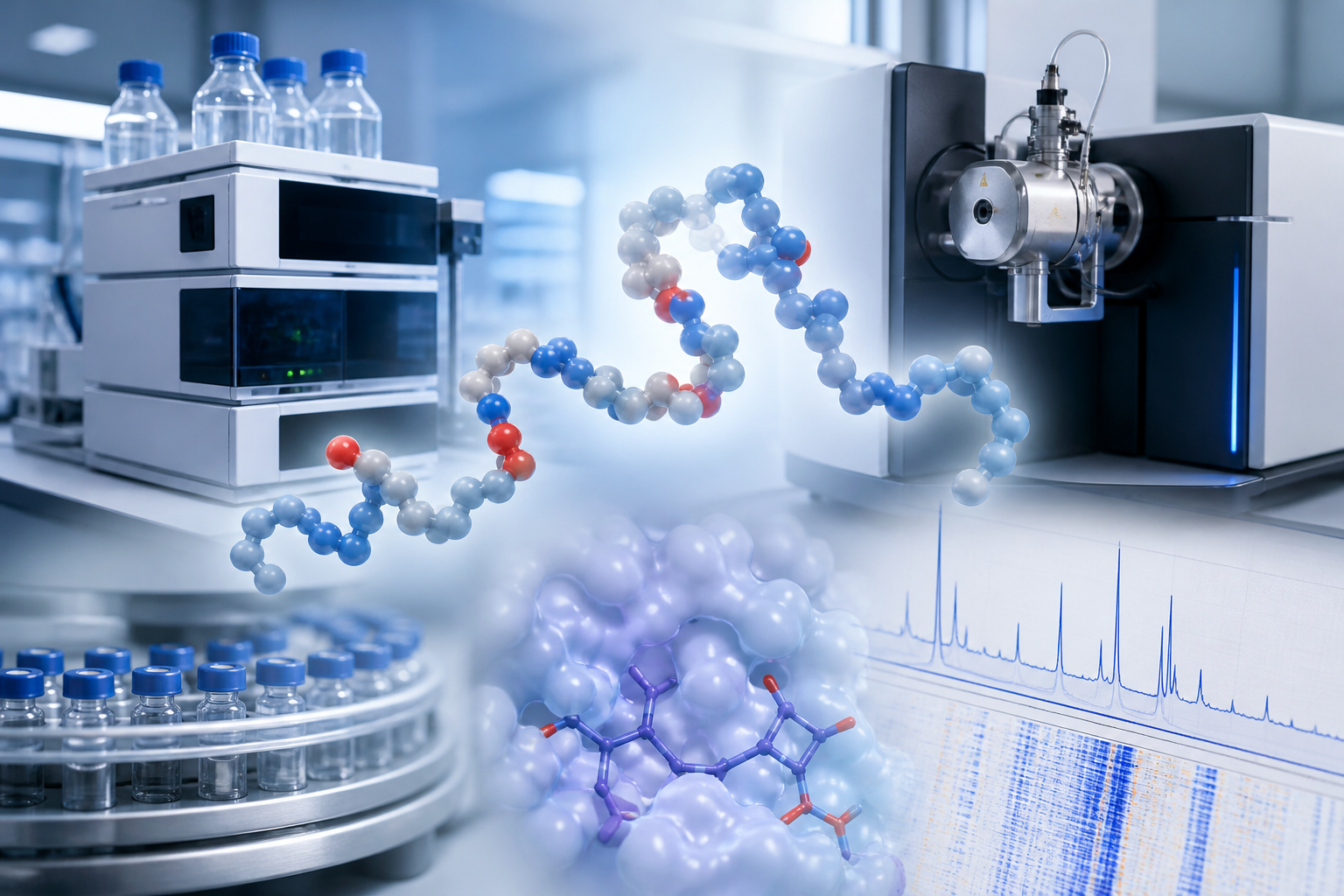
Peptides are widely used in biochemical research, drug discovery, diagnostics, materials science, and standards development. Because peptide properties depend strongly on sequence, modifications, purity, conformation, and stability, characterization is a central part of peptide production and use. A well-designed analytical strategy helps confirm that a peptide is the intended molecule, quantify impurities, assess batch consistency, and determine whether the material is suitable for a specific experimental or regulated application.
No single method provides a complete description of a peptide. Instead, laboratories typically combine orthogonal techniques, such as mass spectrometry, chromatography, sequencing, and spectroscopy. The appropriate workflow depends on the peptide length, composition, modifications, formulation, and required confidence level. This article reviews commonly used peptide characterization techniques and the types of information they provide.
Key Goals of Peptide Characterization
Identity Confirmation
Identity testing verifies that the peptide has the intended molecular composition and, where required, the correct amino acid sequence. For simple synthetic peptides, identity is often assessed using mass spectrometry and chromatographic retention behavior. For longer peptides, modified peptides, or complex mixtures, sequence-based approaches such as tandem mass spectrometry or Edman degradation may be needed.
Purity and Impurity Profiling
Peptide synthesis can generate truncated sequences, deletion products, insertion products, diastereomers, oxidation products, deamidated forms, salt adducts, and residual protecting group-related impurities. Purity assessment therefore requires methods capable of separating closely related species and estimating their relative abundance. Reversed-phase high-performance liquid chromatography is commonly used for this purpose, often supported by mass spectrometric detection.
Structural and Physicochemical Assessment
Beyond identity and purity, researchers may need information on secondary structure, aggregation state, charge heterogeneity, solubility, hydrophobicity, and stability. These properties can influence biological activity, storage conditions, assay performance, and formulation behavior. Spectroscopic and biophysical methods are often used to evaluate these characteristics.
Mass Spectrometry for Peptide Characterization
Molecular Weight Determination
Mass spectrometry is one of the most important tools for peptide characterization because it provides accurate molecular mass information. Matrix-assisted laser desorption/ionization time-of-flight mass spectrometry and electrospray ionization mass spectrometry are widely used. For many synthetic peptides, comparison of the observed molecular mass with the theoretical monoisotopic or average mass is sufficient for preliminary identity confirmation.
High-resolution mass spectrometry can distinguish between closely related species that differ by small mass increments, such as oxidation, deamidation, or amino acid substitutions. Accurate mass measurement is particularly useful for modified peptides, isotopically labeled peptides, and peptides containing non-natural amino acids.
Tandem Mass Spectrometry and Sequence Confirmation
Tandem mass spectrometry, often written as MS/MS, provides sequence-related information by fragmenting peptide ions and analyzing the resulting fragment ions. Fragmentation patterns can confirm the amino acid order, locate post-translational or synthetic modifications, and identify impurity species. Common fragmentation methods include collision-induced dissociation, higher-energy collisional dissociation, and electron-based approaches.
MS/MS is especially valuable when a peptide contains modifications such as phosphorylation, acetylation, methylation, glycosylation, lipidation, disulfide bonds, or stable isotope labels. Data interpretation may be performed manually for short peptides or with specialized software for more complex samples.
Chromatographic Techniques
Reversed-Phase HPLC and UPLC
Reversed-phase high-performance liquid chromatography is a standard method for assessing peptide purity. Peptides are separated primarily by hydrophobic interactions with a nonpolar stationary phase, typically using water-acetonitrile gradients containing an acid modifier such as trifluoroacetic acid or formic acid. Ultraviolet detection at 214 nm or 220 nm is commonly used because peptide bonds absorb strongly in this range.
Ultra-performance liquid chromatography can provide higher resolution and shorter run times compared with conventional HPLC, depending on the column chemistry and instrument pressure capabilities. Chromatographic purity is generally reported as the percentage area of the main peak relative to total detected peak area under specified conditions. Because detector response can vary among impurities, area percent should be interpreted as an estimate rather than an absolute mass percent unless response factors are known.
Ion-Exchange Chromatography
Ion-exchange chromatography separates peptides according to net charge. It is useful for resolving charge variants, including deamidated forms, peptides with different terminal groups, and species that co-elute by reversed-phase HPLC. Cation-exchange or anion-exchange conditions are selected based on peptide isoelectric point and buffer compatibility.
Size-Exclusion Chromatography
Size-exclusion chromatography separates molecules based on hydrodynamic size and is used to evaluate aggregation, oligomerization, or high-molecular-weight impurities. For small peptides, resolution can be limited, but the technique is useful for larger peptides, peptide conjugates, and formulations where aggregation may affect performance.
Amino Acid Analysis
Composition Determination
Amino acid analysis determines the relative or absolute amounts of amino acids present after hydrolysis of the peptide. The sample is typically hydrolyzed under acidic conditions, derivatized if needed, and analyzed by chromatography. The resulting amino acid composition can be compared with the theoretical sequence composition.
This method is particularly useful for peptide content determination, especially when counterions, salts, residual solvents, or water contribute to total sample mass. However, some residues may degrade or be incompletely recovered during hydrolysis. For example, tryptophan can be destroyed under standard acid hydrolysis, and cysteine and methionine may require oxidation or specialized procedures for accurate measurement.
Sequencing Techniques
Edman Degradation
Edman degradation sequentially removes and identifies amino acids from the N-terminus of a peptide. It can provide direct sequence confirmation for peptides with a free N-terminus and is most effective for relatively short, purified peptides. The method is less suitable when the N-terminus is blocked, when the peptide is present in a mixture, or when sample quantity is limited.
Sequence Analysis by LC-MS/MS
Liquid chromatography coupled with tandem mass spectrometry has become a preferred approach for many sequencing applications. LC separates peptide components before mass analysis, while MS/MS provides fragment ion data for sequence assignment. This combination is useful for confirming intended products and identifying sequence-related impurities within the same analytical workflow.
Spectroscopic and Structural Methods
Nuclear Magnetic Resonance Spectroscopy
Nuclear magnetic resonance spectroscopy provides detailed structural and conformational information, especially for peptides in solution. NMR can help determine secondary structure, conformational flexibility, disulfide connectivity, and interactions with solvents, membranes, or binding partners. The method typically requires relatively pure material and sufficient sample concentration. For longer or conformationally heterogeneous peptides, data interpretation can be more complex.
Circular Dichroism Spectroscopy
Circular dichroism spectroscopy is commonly used to evaluate peptide secondary structure. It can identify features associated with alpha-helices, beta-sheets, random coils, and conformational changes under different solvent, pH, temperature, or formulation conditions. CD is rapid and non-destructive, making it useful for comparative studies, although it generally provides less detailed structural information than NMR or crystallographic methods.
Fourier Transform Infrared Spectroscopy
Fourier transform infrared spectroscopy can provide information on functional groups and secondary structural elements, particularly through analysis of the amide I and amide II regions. FTIR may be useful for solid-state peptide characterization, formulation studies, or monitoring structural changes related to aggregation or hydration.
Electrophoretic and Charge-Based Methods
Capillary Electrophoresis
Capillary electrophoresis separates peptides based on charge-to-size ratio and can offer high efficiency for certain analytes. It is useful for evaluating charged impurities, assessing peptide heterogeneity, and complementing chromatographic data. Capillary zone electrophoresis and capillary isoelectric focusing may be selected depending on the analytical question.
Isoelectric Focusing
Isoelectric focusing separates molecules according to isoelectric point. Although more frequently applied to proteins, it can be useful for larger peptides or peptide conjugates with charge variants. This method may help distinguish deamidated or otherwise modified species that alter net charge.
Disulfide Bond and Modification Analysis
Disulfide Mapping
Peptides containing cysteine residues may form intramolecular or intermolecular disulfide bonds. Correct disulfide pairing can be essential for structure and activity. Disulfide mapping typically uses enzymatic or chemical digestion followed by LC-MS or LC-MS/MS analysis under non-reducing and reducing conditions. Comparison of these profiles helps determine whether the intended disulfide connectivity is present.
Post-Translational and Synthetic Modifications
Many peptides contain modifications designed to improve stability, alter binding, support detection, or mimic biological processing. Examples include phosphorylation, glycosylation, amidation, acetylation, PEGylation, lipidation, cyclization, and incorporation of D-amino acids. Characterization should verify both the presence and location of these modifications. High-resolution MS and MS/MS are often central to this process.
Quantitative Assays and Content Determination
UV Absorbance
UV absorbance can estimate peptide concentration when the sequence contains chromophores such as tryptophan, tyrosine, phenylalanine, or specific labels. Accuracy depends on the extinction coefficient, buffer composition, path length, and absence of interfering substances. Peptides lacking aromatic residues may have limited absorbance at 280 nm, although peptide bond absorbance at lower wavelengths can sometimes be used with appropriate controls.
Gravimetric and Counterion Considerations
Dry peptide mass does not always represent active peptide content. Peptide salts can contain water, residual solvents, inorganic salts, and counterions such as trifluoroacetate, acetate, or chloride. For quantitative experiments, peptide content may be better determined by amino acid analysis, quantitative NMR, or validated chromatographic methods rather than weighing alone.
Stability and Degradation Studies
Common Degradation Pathways
Peptides can degrade through oxidation, deamidation, hydrolysis, racemization, aggregation, cyclization, or disulfide exchange. Susceptibility depends on sequence, pH, temperature, oxygen exposure, light, buffer components, and storage format. Methionine, cysteine, tryptophan, asparagine, and glutamine residues are often monitored closely because they are associated with common degradation pathways.
Stress Testing and Storage Assessment
Stability studies may include exposure to heat, light, agitation, freeze-thaw cycles, oxidizing conditions, or different pH environments. Analytical readouts often include HPLC purity, LC-MS identity, aggregation analysis, and activity assays where relevant. These studies help define storage conditions and handling practices, such as lyophilized storage, low-temperature storage, protection from light, or use of inert atmosphere.
Designing a Peptide Characterization Workflow
Use Orthogonal Methods
A robust characterization strategy typically combines methods that measure different attributes. For example, HPLC can estimate purity, mass spectrometry can confirm molecular weight, MS/MS can verify sequence, and amino acid analysis can support content determination. Agreement among orthogonal methods increases confidence in the analytical conclusion.
Match the Method to the Application
Research-grade screening peptides may require a different level of testing than reference standards, diagnostic components, or therapeutic candidates. Factors such as intended use, regulatory expectations, biological risk, required documentation, and acceptable impurity thresholds should guide method selection. Laboratories should also consider method validation parameters such as specificity, linearity, accuracy, precision, limit of detection, and robustness when quantitative or regulated results are required.
Conclusion
Peptide characterization is a multi-method process that supports confidence in peptide identity, purity, composition, structure, and stability. Mass spectrometry and chromatography form the foundation of many workflows, while sequencing, amino acid analysis, spectroscopy, electrophoresis, and stability testing provide complementary information. Selecting appropriate, orthogonal techniques helps laboratories evaluate peptide quality in a manner consistent with the peptide’s complexity and intended use.