Freeze-dried peptides, also known as lyophilized peptides, are peptides that have been dehydrated under controlled low-temperature and vacuum conditions to improve stability during storage and transport. In research and laboratory settings, peptide materials are commonly supplied as dry powders or cakes because many peptide sequences are chemically or physically unstable in aqueous solution over extended periods. Freeze-drying reduces water content while preserving the molecular composition of the peptide as much as possible, helping researchers store, weigh, ship, and reconstitute materials with greater consistency.
Understanding how freeze-dried peptides are prepared and handled is important for laboratories that use them in biochemical assays, cell culture studies, analytical method development, immunology, structural biology, and other research applications. While lyophilization can improve stability, it does not make every peptide indefinitely stable or eliminate the need for proper storage, documentation, and handling. Sequence composition, purity, counterions, residual salts, oxidation sensitivity, and reconstitution conditions all influence performance.
What Are Freeze-Dried Peptides?
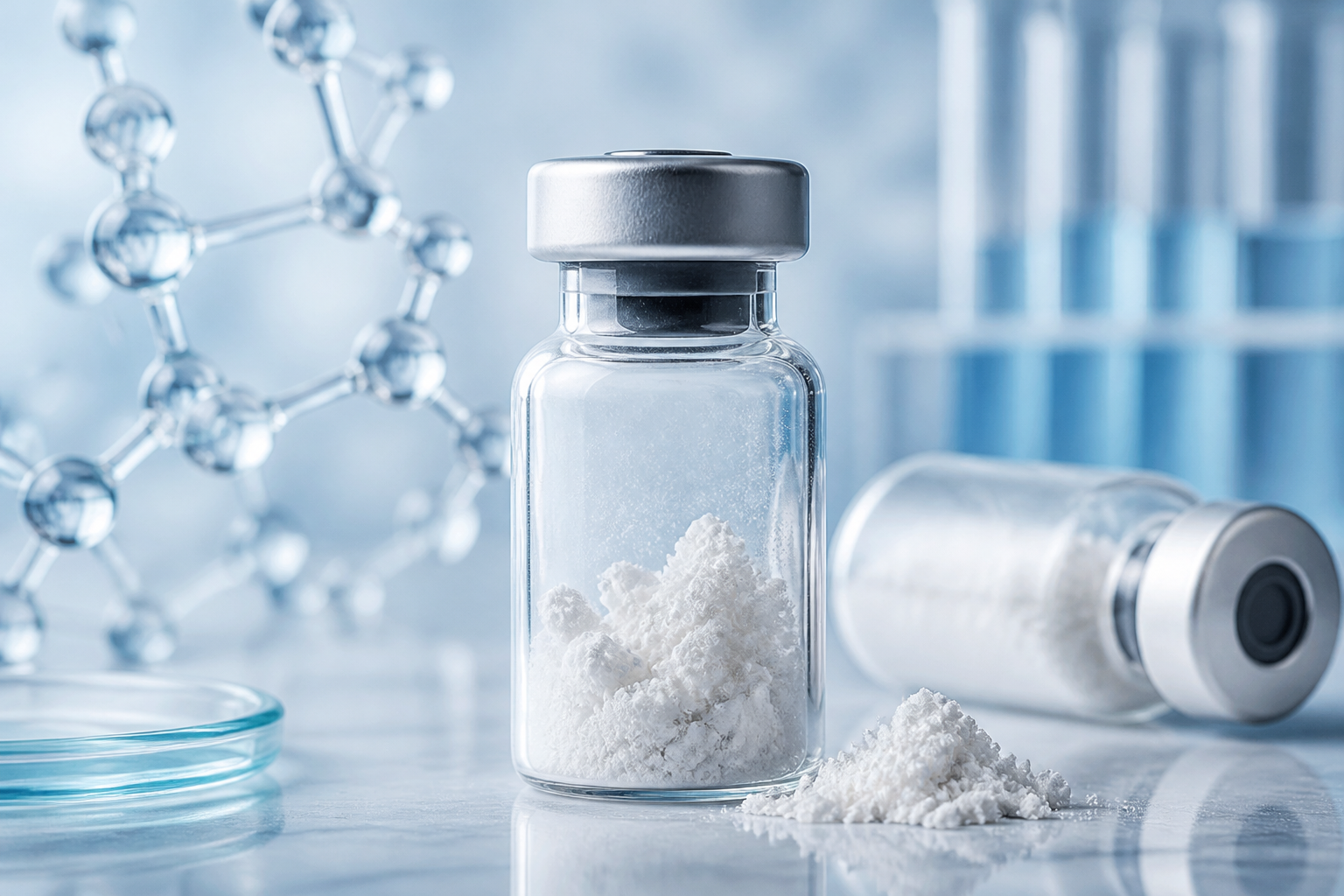
Freeze-dried peptides are short chains of amino acids that have been converted from an aqueous or solvent-containing solution into a dry solid using lyophilization. The final material may appear as a white to off-white powder, a fluffy solid, a thin film, or a porous cake at the bottom of a vial. Appearance can vary depending on peptide concentration, formulation components, vial geometry, salt content, and the freeze-drying cycle.
Peptides are often synthesized by solid-phase peptide synthesis, cleaved from the resin, deprotected, purified, and analyzed. After purification, usually by preparative HPLC, the peptide-containing fractions are pooled and dried. In many workflows, lyophilization is used after purification to remove water and volatile solvents, producing a material suitable for storage and later reconstitution.
Why Peptides Are Often Supplied in Dry Form
Many peptides are prone to degradation in solution. Potential pathways include hydrolysis, oxidation, deamidation, aggregation, adsorption to container surfaces, and microbial contamination if solutions are not handled appropriately. Drying the peptide limits molecular mobility and reduces water-mediated reactions. For this reason, lyophilized format is widely used for research peptides, standards, antigens, peptide libraries, and assay reagents.
How Freeze-Drying Works
Lyophilization is a dehydration process that removes solvent by freezing the sample and then lowering the pressure so that frozen solvent sublimes directly from solid to vapor. The process is carefully controlled because peptide structure, cake quality, and residual moisture can be affected by temperature, pressure, drying time, and formulation composition.
Step 1: Freezing
The peptide solution is first frozen, typically in vials or trays. During freezing, water forms ice crystals while solutes become concentrated in the unfrozen fraction. Freezing rate can influence ice crystal size and drying behavior. Rapid freezing often creates smaller crystals, while slower freezing can create larger crystals and more open channels for sublimation. The optimal approach depends on the sample and desired product characteristics.
Step 2: Primary Drying
Primary drying occurs under vacuum. Heat is carefully supplied to the frozen sample so that ice sublimates. The product temperature must remain below a critical threshold to avoid collapse, melt-back, or loss of cake structure. Primary drying removes most of the frozen water but usually does not remove all bound water.
Step 3: Secondary Drying
Secondary drying removes additional water that is adsorbed or bound to the peptide and other solutes. This stage is generally performed at a higher temperature than primary drying, while maintaining reduced pressure. The target residual moisture depends on the peptide and formulation. Very low moisture can improve stability for some materials, but excessively aggressive drying may not be suitable for every compound.
Why Freeze-Drying Improves Peptide Stability
Peptide degradation often requires molecular motion, water, oxygen, light, or reactive impurities. Lyophilization reduces water activity and limits the mobility of peptide molecules. This can slow many degradation reactions and help maintain the peptide in a usable state until reconstitution.
However, freeze-drying is not a universal solution. Peptides containing methionine, cysteine, tryptophan, asparagine, glutamine, or N-terminal glutamine may require special attention because these residues can be susceptible to oxidation, disulfide exchange, deamidation, or cyclization. Peptides with high hydrophobicity may aggregate or dissolve slowly after reconstitution. Peptides with multiple basic or acidic residues may absorb moisture from the atmosphere or show variable solubility depending on pH and counterion composition.
Residual Moisture and Stability
Residual moisture is a key quality attribute for lyophilized materials. Too much moisture may accelerate degradation or microbial risk after exposure. Too little moisture may, in some cases, contribute to structural stress or handling issues. Laboratories should follow supplier documentation when available and avoid repeatedly exposing vials to humid air.
Common Formats and Appearance
Lyophilized peptides are typically supplied in sealed vials, microtubes, or plates. Small quantities may be difficult to see because the material can form a thin film on the vial wall or appear as a nearly transparent residue. A vial that appears empty may still contain the correct amount of peptide, especially at microgram or low milligram scale.
The material may not always form a uniform cake. Some peptides produce a compact pellet, some form a loose powder, and others adhere to the glass or plastic surface. These differences do not necessarily indicate poor quality. Analytical documentation, such as HPLC purity and mass spectrometry confirmation, is more informative than visual appearance alone.
Storage Conditions for Freeze-Dried Peptides
Storage recommendations depend on the peptide sequence, purity, formulation, and intended use. In general, lyophilized peptides are commonly stored desiccated, protected from light, and at low temperature. Short-term storage may be acceptable at refrigerated conditions for some peptides, while long-term storage is often performed at -20 degrees Celsius or below. Peptides that are oxidation-sensitive, fluorescently labeled, phosphorylated, or otherwise modified may require more stringent conditions.
Temperature, Light, and Moisture Control
Moisture control is especially important. Vials should be tightly sealed, stored with desiccant when appropriate, and allowed to equilibrate to room temperature before opening. Opening a cold vial immediately can cause condensation to form inside the container, introducing moisture that may reduce stability. Light-sensitive peptides, including some dye-labeled or photoactive compounds, should be stored in amber vials or protected from light.
Avoiding Freeze-Thaw and Repeated Exposure
Although the dry peptide itself is not undergoing aqueous freeze-thaw stress, repeated warming, opening, and cooling can introduce humidity and contamination. After reconstitution, repeated freeze-thaw cycles can be particularly damaging. For this reason, many laboratories prepare aliquots of stock solution and store them under validated conditions appropriate for the experiment.
Reconstitution: Turning the Dry Peptide into Solution
Reconstitution is one of the most important handling steps. The best solvent depends on peptide sequence, hydrophobicity, charge, modifications, and downstream application. Common solvents include sterile water, phosphate-buffered saline, dilute acetic acid, dilute ammonium hydroxide, dimethyl sulfoxide, or mixtures containing organic solvent such as acetonitrile. Not all solvents are compatible with all assays or biological systems, so solvent choice should be planned before opening the vial.
General Reconstitution Considerations
Before adding solvent, briefly centrifuge the vial to collect material at the bottom. Add the calculated volume of solvent carefully, then allow the peptide to dissolve with gentle mixing. Vigorous vortexing, sonication, or heating may be useful for some peptides but can be inappropriate for others, especially sensitive or aggregation-prone sequences. If solubility is uncertain, it is often prudent to test a small amount first.
Acidic peptides may dissolve better in basic conditions, while basic peptides may dissolve better in mildly acidic conditions. Hydrophobic peptides may require an initial small volume of DMSO or acetonitrile before dilution into aqueous buffer. When using organic solvents, researchers should account for final solvent concentration in the assay system.
Calculating Concentration
Peptide concentration should be calculated using the amount stated in the certificate of analysis or accompanying documentation. Some peptide quantities are reported as gross weight, while others may be reported as net peptide content. Net peptide content accounts for water, salts, counterions, and other non-peptide components. For quantitative experiments, net peptide content and molecular weight should be considered when preparing molar stock solutions.
Quality Control and Documentation
Reliable use of freeze-dried peptides depends on appropriate analytical characterization. Common quality control methods include analytical HPLC or UPLC for purity assessment and mass spectrometry for molecular weight confirmation. Additional analyses may include amino acid analysis, water content determination, residual solvent testing, counterion analysis, endotoxin testing, or peptide content determination, depending on application requirements.
Purity Versus Content
Purity and content are related but not identical. Purity typically refers to the proportion of the main peptide peak relative to impurities detected by a chromatographic method. Content refers to the actual amount of peptide present in the weighed material. A lyophilized peptide can have high chromatographic purity but still contain water, salts, or counterions that affect gravimetric concentration. This distinction is important for quantitative biological assays, calibration standards, and dose-response experiments.
Common Handling Challenges
Several practical issues can arise when working with freeze-dried peptides. Poor dissolution may result from hydrophobic sequence composition, aggregation, incorrect pH, or insufficient mixing time. Loss of material may occur when small quantities adhere to vial walls or pipette tips. Concentration errors may occur if moisture uptake, salt content, or peptide content are not considered.
To reduce variability, laboratories should document storage conditions, reconstitution solvent, stock concentration, aliquot size, number of freeze-thaw cycles, and date of preparation. Using low-binding tubes, calibrated pipettes, and consistent mixing procedures can also improve reproducibility.
Conclusion
Freeze-dried peptides are widely used because lyophilization can improve stability, simplify storage, and allow controlled reconstitution for research applications. Proper handling remains essential: peptides should be protected from moisture, light, and inappropriate temperatures, and reconstituted using solvents compatible with both the sequence and the intended experiment. By understanding the freeze-drying process, storage requirements, and analytical documentation, researchers can use lyophilized peptides more consistently and interpret experimental results with greater confidence.